Discover Best Apps according to The Community!

Discover the most voted AI applications that have been built during lablab.ai hackathons. Explore our AI Hackathon projects and get inspired to create your own!

CodeBaseBuddy

CodeBaseBuddy

Tool Name: CodeBaseBuddy with Codestral Key Features: - Privacy-preserving: Locally deployable, ensuring all operations remain on the user's machine. - Semantic Code Search: Utilizes advanced techniques for precise and relevant code search results. - Accelerated Onboarding: Quickly brings new contributors up to speed with any codebase. - Error Reduction: Provides specific guidance to minimize mistakes and prevent bugs. - Enhanced Engagement: Encourages contributions from those hesitant due to unfamiliarity with the codebase. - Continuous Learning: Helps both newcomers and experienced developers discover and learn about lesser-known parts of the codebase. - Technical Implementation: - **Vector Indexing**: Builds an annoy vector index by generating embeddings for every file in the repository. - **Query Processing**: Utilizes Annoy for efficient querying of the vector index. - **Guidance Generation**: Leverages locally deployed Codestral to provide step-by-step instructions based on user queries. - Original Contributions: - Local LLMs for Semantic Code Search: Uses Ollama's local large language models for running and managing models on a user's laptop. - Advantages:: - Privacy: Everything is deployed locally, ensuring user data remains secure. - Speed: Accelerates the process of getting acquainted with a new codebase. - Accuracy: Reduces the likelihood of errors with precise guidance. - Encouragement: Motivates more community contributions by simplifying the onboarding process. - Learning: Continues to be a resource for experienced developers to explore and understand different parts of the codebase. Summary: CodeBaseBuddy with Codestral is a cutting-edge tool designed to streamline the onboarding process for new developers, provide precise code search capabilities, and enhance overall engagement and learning within development teams. By maintaining a local deployment, it ensures privacy while offering robust and innovative features.

CodeBaseBuddy
medal
LangChain
LegacyLink AI

LegacyLink AI

LegacyLink AI is an AI-assisted legacy database modernization tool built for the IBM Bob Hackathon. It helps developers convert messy legacy SQL schemas into clean Python SQLAlchemy ORM project scaffolds, reducing the time needed to understand old database structures and generate boilerplate code. The system lets users upload a legacy SQL file, then automatically parses database objects such as tables, columns, data types, indexes, constraints, views, and functions. It normalizes cryptic names into readable conventions, such as converting tbl_CUST_MSTR_2012_v2 into Customer, fk_str_id into store_id, and dt_upd_dt into updated_at. LegacyLink AI generates a downloadable project containing SQLAlchemy 2.0 ORM models, database setup code, pytest test files, requirements.txt, README documentation, and a modernization report explaining the transformation. The generated project can be tested immediately using pytest. The project also includes an optional IBM watsonx.ai AI Assistant powered by IBM Granite. The assistant helps users explain schemas, summarize modernization reports, identify possible foreign-key-like fields, and understand generated ORM code in simple English. For enterprise traceability, AI Assistant interactions can be logged into PostgreSQL. IBM Bob can then connect through MCP to inspect the audit logs and summarize recent assistant activity, including the user question, model used, SQL file processed, table count, and status. IBM Bob was used as the development partner for planning, coding, debugging, testing, documentation, and MCP workflow validation. The final result combines Streamlit, SQLAlchemy, pytest, IBM watsonx.ai, PostgreSQL, MCP, and IBM Bob into a practical modernization workflow for legacy database teams.
Try-Tri-Hard
Streamlit
application badge
IBM watsonx AssistantIBM GraniteIBM+2
Sight beyond Sight

Sight beyond Sight

Our website enhances online content accessibility for the visually impaired with a cost-effective text-to-speech service using contemporary AI tools. Current market solutions lack necessary amenities and are costly. Working on the website: > once the website loads, the user inputs the URL of the website to be analyzed > this website is parsed using Beautiful Soup to gather the meaningful text content available on the page > this content is passed to the OpenAI text-davinci-003 model as a prompt and a summary is generated for the same > this summary is read out to the user using Azure in natural human tone > next, the website is again parsed using Beautiful Soup with the aim to download relevant images on that website > these images are then analyzed using Google Cloud Vision API and feature labels describing the prominent objects/contents of that image are generated > these labels are passed as a prompt to the OpenAI text-davinci-003 model and a meaningful sentence is generated which describes the images > the prompt already includes a set of sample labels and outputs that the model can use to understand the format of the desired output. > the image description generated in the above step is then read aloud using Azure. For Redis: Redis caches URL results for up to 3 hours, if URL exists in cache, output is displayed/read aloud. Otherwise, website is processed for new output. Results are removed after 3 hours for possible content changes. It allows for fast data access making it suitable for high performance use cases. For voice control: > using space bar, user can ask queries regarding summary through available chatbot > above query is converted to text via speech recognition library of python > this text and the summary are given to the OpenAI text-davinci-003 model as a prompt and the query is resolved > the result is spoken out and if speech unrecognized, an error message stating to retry is read aloud

Galacticos
RedisGPT-3
RepoMind : AI Onboarding Copilot

RepoMind : AI Onboarding Copilot

RepoMind solves one of the biggest pain points in software development: onboarding into large and complex codebases. Developers joining new projects often spend weeks trying to understand system architecture, dependencies, and workflows. This slows productivity, delays delivery, and creates frustration across engineering teams. RepoMind is an AI-powered onboarding copilot built using IBM watsonx and IBM Granite. Users paste a GitHub repository URL and instantly receive an architecture summary, module breakdowns, execution flow explanations, and a conversational AI assistant that answers questions like “How does authentication work?” or “Where is the payment logic handled?” The platform uses IBM Granite 3 8B Instruct through watsonx.ai to deliver contextual understanding of entire repositories. The backend is powered by FastAPI and GitPython for repository analysis, while the frontend runs on Streamlit for a simple and interactive experience. RepoMind was developed in collaboration with IBM Bob and is designed for junior developers, onboarding engineers, open-source contributors, and teams managing legacy systems. The business opportunity is significant. The global developer tools market exceeds $26 billion, while AI-powered coding and onboarding tools continue to grow rapidly. RepoMind follows a scalable SaaS model with free access for public repositories and premium plans for private repositories, team dashboards, and enterprise integrations with GitHub, GitLab, and Bitbucket. Unlike tools focused on autocomplete or code search, RepoMind specializes in full codebase comprehension through natural-language interaction, helping developers understand systems faster and reduce onboarding time from weeks to minutes.

Kernel Panic
Streamlit
application badge
IBM watsonx AssistantStreamlitIBM Granite+1
ARCA SENTRY

ARCA SENTRY

Thousands of companies are racing to ship AI — chatbots, voice agents, automated customer service. But who audits them? The EU AI Act takes full effect in August 2026, with fines reaching up to 7% of global revenue. A single non-compliant chatbot response can trigger an investigation. Most teams have no defense. ARCA SENTRY is the compliance brain for enterprise AI. A council of five specialised auditor agents — running on DeepSeek through Featherless — audits every interaction your AI produces, in real time, against the full EU regulatory stack: EU AI Act, GDPR, DORA, PII leakage and prompt injection. It integrates with any AI channel: drop-in proxy mode (OpenAI / Anthropic / Gemini), raw HTTP endpoints, WhatsApp Business, Facebook Messenger. Zero code changes beyond the base URL. Before you ship, run the Red Team: an automated pen-test suite that probes your agents against every European framework and exports forensic reports in PDF, Markdown and HTML — showing exactly how the model can be broken. In production, the gateway intercepts violations mid-flight, blocking the response before it reaches the user. Every incident auto-generates a remediation ticket with estimated fine, suggested fix (generated by Gemini Pro), and a tamper-evident SHA-256 hash chain for forensic reproducibility. Auto-detects five languages: Italian, Portuguese, Spanish, Chinese, English. Don't let AI become your most expensive line item. Take back control of your agents. The council of auditors guards your AI — and your business. ARCA SENTRY. Don't pay the fine. Pay attention.

AI Society - B Drive
Vercel
application badge
Claude CodeGemini AIFeatherless+6
Trellis: The Knowledge Fabric for Law Firms

Trellis: The Knowledge Fabric for Law Firms

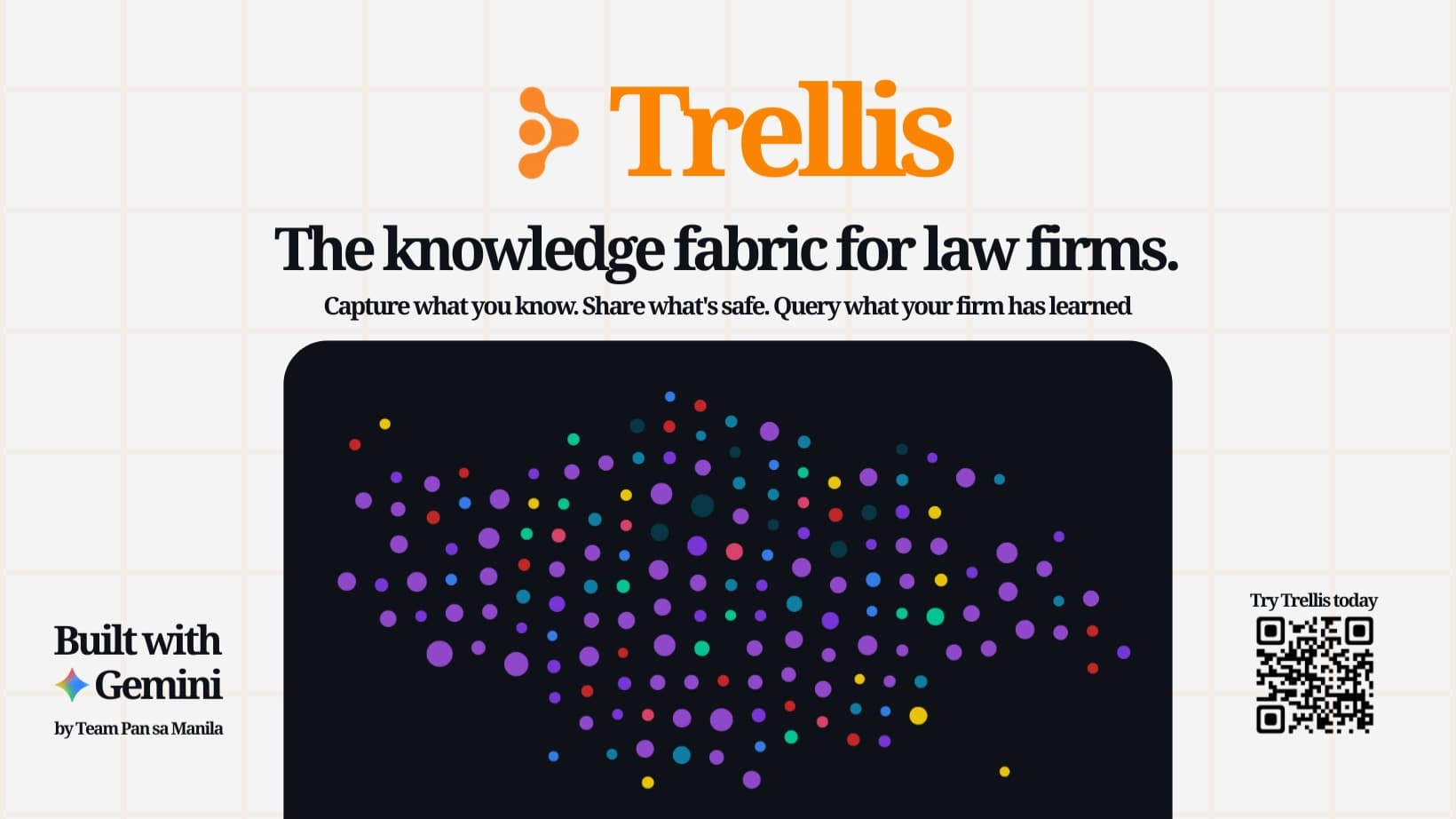
Every law firm sits on an unmined fortune: the experiential wisdom of senior partners. Yet, when a veteran attorney retires or departs, decades of strategic instinct permanently evaporate. This institutional knowledge loss costs mid-to-large firms $15M to $40M annually. The barrier to documentation is economic. Lawyers bill in six-minute increments; spending time writing down lessons represents an immediate loss of billable revenue. While generative AI should solve this, strict obligations toward attorney-client privilege block public LLM tools. Meanwhile, vertical legal tools like Harvey provide generic legal advice but lack a firm's specific internal wisdom. Trellis solves this with a secure, two-tier system architecture. The first layer is the Personal Second Brain. This is a private, on-device edge environment running Gemini Nano where attorneys quickly capture unstructured thoughts via voice memos, notes, or image OCR. Because data stays local, capture is entirely unredacted and factual. The second layer is the Team-Managed Knowledge Graph. This shared ledger is built through an automated, dual-pass sanitization pipeline. First, Microsoft Presidio strips explicit PII like names, dates, and entities. Second, Gemini Pro abstracts the specific case details into generalized strategic principles. The lawyer reviews a side-by-side diff before approving publication to the firm's shared memory. Using a hybrid vector-graph RAG model, team members can query this collective intelligence using natural language. To eliminate legal risk, Trellis enforces a hard deterministic guardrail: if the retrieved context score falls below a strict threshold, the system executes a strict refusal rather than risk a hallucination. Finally, Trellis exposes a Model Context Protocol (MCP) endpoint. This allows third-party tools like Harvey, CoCounsel, or Copilot to securely plug directly into the substrate, grounding generic legal AI capabilities in the firm's actual historical wisdom.

Pan sa Manila
Vercel
application badge
Gemini AIGemini 3 proGemini 3 Flash+2
CodeAtlas

CodeAtlas

CodeAtlas is an AI-powered engineering intelligence platform designed to help developers and engineering teams understand, audit, and modernize complex codebases. Modern software systems are increasingly difficult to reason about. As repositories grow, teams lose visibility into architecture, dependencies, technical debt, and change impact. Refactoring becomes risky, onboarding slows down, and modernization projects become expensive and unpredictable. CodeAtlas solves this problem by transforming GitHub repositories into interactive engineering intelligence. Users can import a repository directly from GitHub, and CodeAtlas automatically scans the codebase, analyzes dependencies, maps architecture relationships, identifies high-risk modules, and generates modernization insights. The platform includes: Interactive dependency graph visualization Risk-based module analysis Blast-radius simulation Technical debt estimation Architecture health scoring Dependency confidence analysis Engineering findings and onboarding guidance Suggested modernization sequences Exportable engineering reports One of the key goals of CodeAtlas is transparency. Instead of pretending the analysis is perfect, the system exposes dependency confidence limitations caused by unresolved imports, framework aliases, or dynamic imports. This makes the platform more trustworthy and operationally useful for real engineering teams. The frontend was built with Next.js, TypeScript, and React Flow, while the backend uses FastAPI with a custom repository scanner, dependency graph engine, and risk analysis system. CodeAtlas was built during the IBM Bob Hackathon to demonstrate how AI can assist engineering organizations with architecture visibility, modernization planning, and repository intelligence.

CodeAtlas
Vercel
application badge
ChatGPTIBMIBM watsonx Assistant
BiteBuddy Meal Planner

BiteBuddy Meal Planner

BiteBuddy is a meal-planning tool that is prized for its customization. What this entails is that for every different user, a different meal plan is generated based on the user's preferences, needs, and dislikes. A tool to create a meal plan needs to understand what the customer needs. Therefore, the tool asks the user about their body characteristics to help organize the facts needed to create a balanced diet. Precisely, the user's Body Mass Index (BMI) is calculated to give an idea about the possible goals and hence, display an adequate diet. After that, the tool asks the user about any allergies, if any exist, so as not to include these foods in the plan. Moreover, they are asked to input any preferences they might have to include in their diet. The user input is then processed to generate the data. After which, the data is sent via the APIs through properly formatted prompts. The generated meal plan is then displayed in table format for every day of the week and at least three meals per day. Each meal has its nutritional values displayed, including carbohydrates, calories, fats, and proteins; the tool also suggests the right portions and the recipe with the ingredients that aid in preparing that meal. The recipe sub-window also illustrates the meal by providing a photo. Sorting is a feature that can be used to sort the meals based on their nutritional facts. The main advantage of this website is that it groups everything that the user might need to plan a healthy diet, considering their allergies and any food preferences they might have for the week. The tool replaces the need to visit nutritionists and explore different food regimes. It also replaces searching and exploring various recipes among multiple cooking platforms.

The DeCoders
ChatGPTDALL-E-2GPT-3
InsightStream: AI Customer Analytics

InsightStream: AI Customer Analytics

InsightStream is an AI-powered customer business analytics dashboard designed to help businesses transform raw customer data into meaningful insights and smarter decisions. Many organizations collect large amounts of customer data but struggle to analyze it effectively due to the complexity of traditional analytics tools. InsightStream solves this problem by providing an interactive and user-friendly platform that makes customer analytics accessible to both technical and non-technical users. The platform enables users to upload customer datasets, explore interactive dashboards, perform RFM (Recency, Frequency, Monetary) customer segmentation, identify churn risks, and generate actionable business recommendations to improve customer retention and customer lifetime value. It also supports SQL-based data exploration, CSV uploads, SQLite database integration, and exportable visual reports for better decision-making. Built using Python, Streamlit, SQLite, Pandas, and Plotly, InsightStream focuses on scalability, modular development, and rapid prototyping. Throughout the development process, IBM Bob served as an AI-powered development partner by assisting with code generation, debugging, architecture planning, workflow optimization, and repository understanding. InsightStream demonstrates how AI-assisted development can accelerate the creation of practical, business-focused software solutions with real-world value.

Token Overflow
Streamlit
application badge
IBM
Autonomous Agents from APIs - Zero Code Builder

Autonomous Agents from APIs - Zero Code Builder

Using Vultr, Groq, Llama, Coral, and Fetch.ai, our project introduces a transformative way to generate and deploy Autonomous AI Agents from APIs—a no-code, prompt-driven AI Agent Builder and conversational interface to manage intelligent agents across enterprise systems in real time. From Prompt ➜ Plan ➜ Code ➜ Execute ➜ Iterate ➜ Deploy ➜ Use (on Coral, Custom, and Fetch AI) User explains their goal in natural language. Our AI locates relevant APIs, generates step-by-step agent plans, writes the code, deploys tools to Vultr-hosted MCP servers, and registers them with Coral and Fetch.ai. All agents are accessed via a multi-modal chat interface—text or voice—enabling users to test, refine, and operate agents live. These agents interact with real-world APIs via the MCP servers created through the Agent Builder. No code. Just intent. From developers and marketers to support and operations teams—anyone can turn apps into automations, tools, or digital workers. Enterprise-ready and built for the future of work, Vortex IQ enables users to go from idea to working agent in minutes. All AI inference runs on Groq’s ultra-low-latency hardware using Llama 3 models, making it fast, private, and cost-efficient. Agents are also composable via Fetch.ai’s Agentverse and ASI:One. Future-Ready with Scalable Impact: a. 3,000+ Retailers: Rolling out AI agents across BigCommerce, Adobe Commerce, Shopify, and Salesforce Commerce Cloud. b. Composable Agent Hub: 100s of reusable agents and templates for plug-and-play use across any API-powered system. c. Cloud Partnerships: Vultr, GCP, and Azure hosting for global agentic compute-as-a-service access. Tech Stack: Hosted on Vultr, using Groq, Llama 3, Coral Protocol, and Fetch.ai for compute, orchestration, and autonomy. Other tech: Google ADK, Next.js From prompt to production—this is how the future of work is built.

Autonomous Agents from APIs - Vultr Track
medal
GroqLlama 3.2Llama 3.1+4
Code PRO

Code PRO

The code optimization and error fixing app is a powerful tool for developers and programmers that is designed to help them identify and fix errors in their code, as well as optimize it for better performance. Built using Codex, a cutting-edge AI language model, the app supports around 200 different programming languages, making it a versatile and comprehensive solution for all kinds of developers. The app provides a user-friendly interface that allows developers to easily upload their code and quickly identify any errors or issues. The app uses advanced algorithms and machine learning techniques to analyze the code and highlight any errors or bugs that may be present. It also provides suggestions and recommendations for fixing the errors, as well as optimizing the code for better performance. One of the key features of the app is its ability to provide real-time feedback as the developer is coding. This means that as the developer writes the code, the app can identify errors and provide suggestions for how to fix them. This can save developers a significant amount of time and effort, as they no longer have to spend hours debugging their code manually. The app also provides a range of other useful features, including code formatting, syntax highlighting, and autocomplete functionality. These features make it easier for developers to write code that is easy to read and understand, and that follows best practices and coding standards. Overall, the code optimization and error fixing app is a powerful and comprehensive tool that can help developers to write better code, faster. Whether you are a beginner or an experienced developer, this app can help you to identify and fix errors in your code, and optimize it for better performance.

BitsPeeps
Streamlit
application badge
Codex
ClinSight: Agentic Multimodal Clinical AI

ClinSight: Agentic Multimodal Clinical AI

Every year, 795,00 Americans are harmed by delayed diagnosis in emergency departments. Preliminary chest X-ray review takes 30-60 minutes. Rural hospitals wait 4-24 hours for teleradiology. ClinSight is an open-source multimodal clinical intelligence system built entirely on AMD hardware. It ingests chest X-ray images, lab values, vitals, and triage notes simultaneously — then reasons across all modalities through a compiled LangGraph agent pipeline on AMD Instinct MI300X via ROCm 7.0 and vLLM. Architecture: 5 parent agents orchestrate 7 subagents (12 reasoning nodes). Coordinator validates input and runs pediatric safety gates. Radiologist analyzes X-rays via Qwen2.5-VL-7B. Lab Analyst detects critical values and correlates patterns. Safety runs 3 parallel checks (contradiction, hallucination guard, bias audit) with a merge node. Documenter produces deterministic ESI scoring, differential diagnosis, and structured reports. Dual-Model Stack: Qwen2.5-VL-7B-Instruct (vision, ~14GB) + Qwen3.5-35B-A3B MoE (reasoning, ~70GB) = ~99GB / 192GB HBM3. Both models served simultaneously via vLLM on ROCm 7.0 — impossible on H100 80GB without quantization. Live Evidence: 50-case pure CXR benchmark on real MI300X. Mean latency: 23.02s. All 50 cases live, zero cache. GPU utilization: 10-49%, power 231-263W. rocm-smi evidence captured at baseline, during, and post-inference. Safety & Rigor: Physician-in-the-loop by design. Pediatric gate blocks adult-trained recommendations for under-18 patients. Bias auditor stratifies by age and sex. ESI scoring is rules-based, never LLM-generated. Apache 2.0 license.

Recourse
AMD Developer CloudAMD ROCmClaude Code+7
SentimentSense AI

SentimentSense AI

SentimentSense is an innovative AI-powered sentiment analysis app purposefully built for Monday.com's brand-new AI assistant. It offers accurate detection and analysis of emotions, specifically tailored to enhance the functionality of the Monday.com platform. By seamlessly integrating with Monday.com, SentimentSense allows users to leverage the power of AI to gain deep insights into sentiments expressed within their Monday.com items, groups, boards, and projects. In addition to its advanced sentiment analysis capabilities, SentimentSense goes beyond by providing assessment reports for selected users. These reports evaluate strengths, areas to improve, and a summary of individual users' performance within the Monday.com ecosystem. With SentimentSense, Monday.com users can effortlessly monitor and analyze customer feedback and public sentiment directly within the platform. This empowers businesses to make data-driven decisions, identify areas for improvement, and promptly respond to customer concerns, all within the familiar Monday.com environment. Utilizing advanced machine learning algorithms and natural language processing techniques, SentimentSense delivers sentiment analysis, enabling users to gauge public perception, measure brand sentiment, and uncover emerging trends. Its intuitive interface and interactive visualizations make interpreting and sharing sentiment insights seamless within the Monday.com ecosystem. In summary, SentimentSense is a purpose-built AI-powered sentiment analysis app designed to seamlessly integrate with Monday.com, providing Monday.com users with enhanced sentiment analysis capabilities to make informed decisions and gain valuable insights and suggested action items within their projects and workflows. The assessment reports further evaluate strengths, areas to improve, and an overall summary, enabling users to enhance their performance and drive better outcomes.

Appfire Team
medal
OpenAI
Ilewa

Ilewa

Benin, a country rich in enchanting and inspiring stories, offers a wealth of cultural treasures. Take the example of the Amazons, legendary warrior women who embody the courage and pride of the Beninese people. Their legacy is honored at the Place de l'Amazone, near the Palais des Congrès, a symbolic site where the history of these heroines continues to resonate. However, a major challenge remains: conveying this history to foreign tourists. The stories are often poorly interpreted or mistranslated, losing their essence and magic. To address this issue, we created ilewa AI. "Ilewa," meaning "our lands" in the local language (yoruba), reflects our deep attachment to our heritage. Our ambition? To make Benin the world's top tourist destination by 2030. Ilewa AI revolutionizes how Beninese stories are shared. Using our technology, content in local languages, whether audio or text, is transformed into captivating and faithful images. The benefits for tourism are immense. Visitors will have access to authentic and accurate visual representations of Beninese stories and traditions, enriching their cultural experience. They will gain a better understanding and appreciation of our heritage, increasing their satisfaction and desire to return. Ilewa AI primarily targets travel agencies, tour operators, and tourism industry stakeholders looking to offer an enriched and immersive experience to their clients. Additionally, our technology will appeal to museums, cultural centers, and educational institutions eager to promote Beninese culture to an international audience. From a business perspective, ilewa AI opens new horizons. By facilitating access to our culture, we attract more tourists, stimulate the local economy, and enhance Benin's reputation on the international stage. Investing in ilewa AI means supporting an innovative project that values our history and identity while contributing to a prosperous future for our country. Join us on this exciting journey!

IlewaAI
Streamlit
application badge
Stable DiffusionOpenAI
OncoTriage AMD-Boosted Uncertainty-Aware CT Triage

OncoTriage AMD-Boosted Uncertainty-Aware CT Triage

OncoTriage is a clinical decision support system designed to detect and triage lung nodules in chest X-rays with high reliability. Developed solo for the 2026 AMD Hackathon, it addresses the lack of transparency in automated diagnostics by implementing Bayesian Deep Learning. The system utilizes a Bayesian EfficientNet-B4 backbone. By employing MC Dropout, the model generates a predictive distribution rather than a single point estimate, allowing for the calculation of epistemic uncertainty. This effectively quantifies the model's confidence for every detection. In clinical settings, this allows the system to flag low-confidence predictions for priority human review, reducing the risk of false negatives inherent in standard "black-box" AI. In addition to this, in order to handle the intensive computational requirements of Bayesian inference, OncoTriage is optimized for AMD Instinct MI300X instances. Leveraging AMD’s high-bandwidth memory (HBM3) and the ROCm stack, the system achieves the rapid inference times necessary for real-time clinical triage. The environment is fully containerized via Docker, ensuring seamless scalability across high-performance compute clusters. The Mission: OncoTriage represents a shift toward accountable, transparent AI. By bridging the gap between raw computational power and clinical safety, it provides radiologists with a reliable partner in oncological screening—transforming raw data into uncertainty-aware medical intelligence.

Reaper Eagle
Stable DiffusionSolo Tech
AI-Driven Social Media Content Optimization

AI-Driven Social Media Content Optimization

Our innovative solution, powered by AI, revolutionizes social media content optimization for platforms such as Instagram, Twitter, YouTube, bloggers and podcasts. Leveraging the advanced capabilities of the Llama 2 model, we seamlessly generate hashtags for different social media posts, enhancing content discoverability. Recognizing the growing popularity of podcasts, we employ the state-of-the-art models, converting audio content into text transcripts. This integration enables podcasters to effortlessly refine their content for social sharing along with attention-grabbing descriptions and relevant hashtags. Moreover, we have incorporated the BLIP-2 model , enabling effortless conversion of images to text and extracting captivating captions. These captions are then enriched with platform-specific keywords and trending phrases, ensuring optimized engagement. We employed Open-CV framework model to process video files, transforming them into individual frames. These frames subsequently serve as inputs for the BLIP-2 and LLAMA2 model, enabling the generation of appropriate hashtags and meaningful captions. This innovation benefits both content-creators and users, as it facilitates efficient hashtag searches for desired content, enhancing the overall user experience. Overall, Experience a new era of content optimization where AI seamlessly transforms text, images, and audio into captivating social media posts, expanding reach, engagement, and impact across diverse platforms. Technical Aspects:- A web application has been built, employing AngularJS for the frontend and Flask for the backend. The application integrates Clarifai for hosting machine learning models, enabling advanced AI functions like image recognition and analysis. This fusion results in an engaging and intelligent user experience.

Kamikazee
ClarifaiLlama 2
30apps loaded