Browse applications built on modern technologies. Explore PoC and MVP applications created by our community and discover innovative use cases for modern technologies.
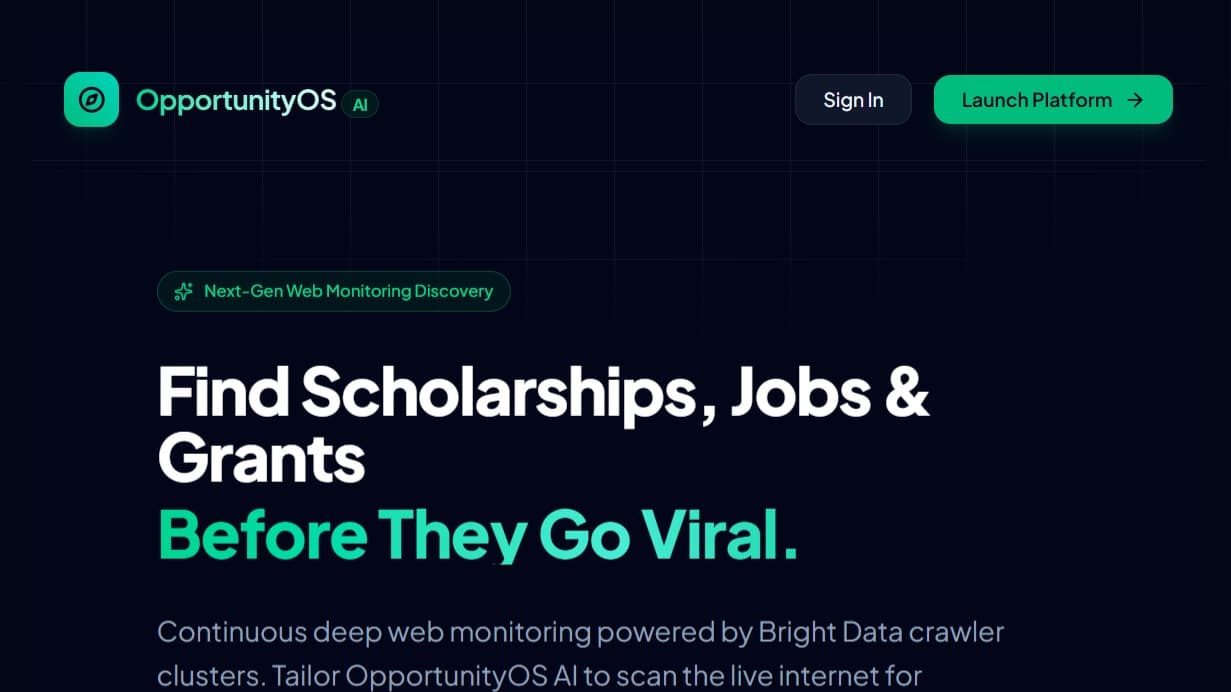
Continuous deep web monitoring powered by Bright Data crawler clusters. Tailor OpportunityOS AI to scan the live internet for scholarships, tech internships, startup grants, and accelerator programs matching your profile
VigilOS automates edge security using Speechmatics ASR, Gemini Pro & Bright Data OSINT. Configured via NativelyAI, Cursor & AntiGravity, it governs a decentralized BAND node & polls data with Triggerware to inject Jira incidents over Cloudflare.
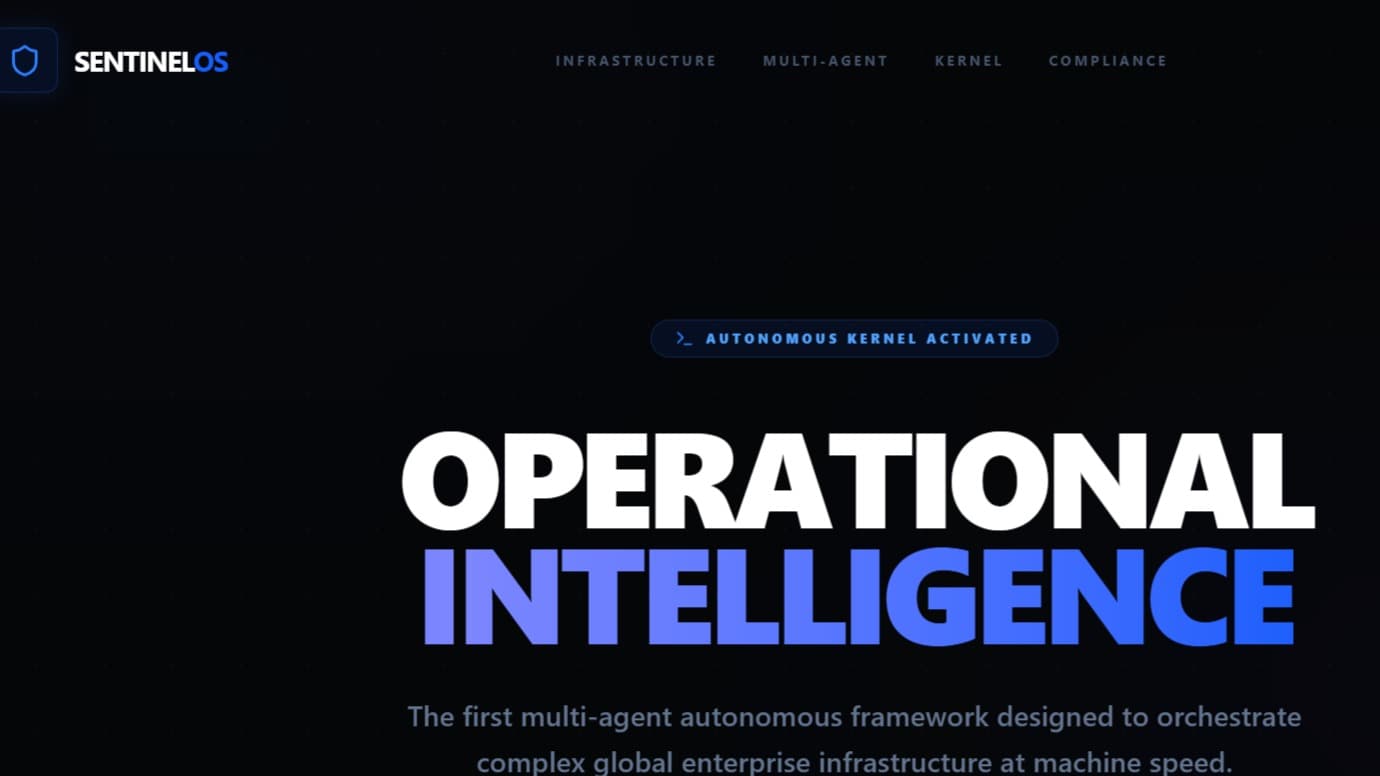
Sentinel_OS is an autonomous enterprise intelligence system that detects risks, coordinates AI agents, and orchestrates real-time operational response.
VEIL is an AI-native financial governance infrastructure that uses collaborative AI agents to evaluate transaction trust, intent, behavioral risk, and compliance before settlement — creating an autonomous trust layer between humans and money.
DecisionGraph gives AI agents permanent enterprise memory. Documents become a knowledge graph. Every decision is stored, tracked, and learned from. Any agent plugs in via MCP in 5 minutes. The enterprise gets smarter with every interaction.
An AI-powered web application designed to help students and fresh graduates practice interview questions, improve communication skills, and gain confidence for real job interviews.
OlympusOS is a multi-agent AI orchestration platform that transforms cities into cognitive systems, perceiving crowd crises, coordinating autonomous agents, and resolving emergencies before they escalate.
SolarPingu is an autonomous AI sales swarm managing cold commercial leads and inbound consumer channels. It independently finds leads, analyzes roofs, qualifies prospects, generates PDF offers, and executes automated phone workflows.
StartME is an AI company OS with 20 specialized agents orchestrated by a CEO agent — handling sales, marketing, finance, legal, DevOps & more. Built solo by a 17-year-old from Lagos. One founder. A full AI workforce.
GEM² Audit OS is an AI governance layer that turns agent actions into contract-bounded steps, audits inputs and outputs at the edge, and produces regulator-readable evidence without requiring humans to manually inspect every AI decision.
An autonomous visual AI agent that sees your screen, plans multi-step tasks, and executes them without human intervention. Built on Gemini Live API with SOM visual grounding, adaptive replanning. Your computer, finally working for you.
Aegis OS is an AI-powered digital nervous system that detects, analyzes, and coordinates autonomous emergency response operations in real time.
MCP Foundry turns CSV/Excel into interactive AI agents via Streamlit. It uses IBM Bob to forge MCP servers, auto-generate OpenAPI specs, and link any local or cloud LLM without manual backend code.
ContribFlow is a 4-stage AI co-pilot that guides OSS contributors from idea to PR-ready code. It finds contribution gaps, deduplicates ideas, maps change impact with dependency tracing, and reviews code quality before submission.
Bob-SRE transforms the IBM Bob CLI from a simple coding assistant into a fully autonomous Site Reliability Engineer. By wrapping the AI in a robust orchestration platform, it automatically generates multi-stage Docker/Docker Swarm/Cloud infrastructure.
Spec-to-Ship converts plain-English software feature requests into structured engineering tasks and automated GitHub pull requests using IBM Bob IDE, watsonx Orchestrate agents, 7 GitHub API automation. Demo: https://spec-to-ship-pied.vercel.app/
A nostalgic Microsoft Bob-inspired AI desktop companion with OpenAI and Anthropic API key integration that can chat, launch apps, open websites, and automate desktop tasks through a customizable animated assistant.
Turn every IBM Bob session into replayable memory. CrumdBob captures Bob's repo analysis as a 9-file CRUMB pack with proof chain, SQLite-backed cross-session history, FastAPI dashboard, LLM-powered insights, and enterprise observability.
Friday is an autonomous AI assistant that remembers context, orchestrates 30+ specialized agents, and uses voice, tools, and proactive reasoning to turn complex workflows into finished actions.
MindShield by BrainSNN is a 3D cognitive firewall for enterprise AI, using Gemini analysis, Veea Lobster Trap, and self-evolving defenses to detect manipulation, block unsafe prompts, and fuse multimodal knowledge.
QATALYST SDS is an auditable agent orchestration framework running locally on AMD hardware. By exposing AI decision-making via a transparent four-stage loop, it ensures reliable, inspectable automation with zero cloud dependencies.
AvrilOS is a local AI-powered Linux environment where even small language models can understand, modify, and personalize the desktop in real time through structured system configs and safe automation.
LightningBoost is a hybrid AI agent that monitors local RAM/CPU via psutil. It intelligently routes heavy LLM tasks from low-RAM laptops to AMD Instinct MI300X GPUs on the cloud via ROCm, enabling high-performance AI on modest hardware.
Alice is a local-first AI sidecar that turns voice into real-time system control, running entirely on-device with low latency and zero cloud dependency.
An open-source agentic engine that drives Chrome through every available channel — DOM, accessibility tree, network interception, JS evaluation, multi-tab and multi-context. Each task graduates to a direct API call after first run. Linux + ROCm on AMD.
LockLens replaces April tags with plain-English AI vision tracking for any Linux robot. Type a target, it locks on and follows. Built on AMD MI300X with Qwen2.5-VL, deployed on a custom hoverboard platform with Flipsky VESCs over CAN bus.
Evolution Edge is a self-evolving AI bridge. A local model handles queries on CPU/NPU, while a symbolic router escalates complex tasks to an AMD Instinct MI300X cloud. The system distills new knowledge back to the edge, creating a lifelong learner.
ArcSplit routes every workflow payment directly to the creators behind the pieces—LoRAs, tools, assets, and extensions—using USDC nanopayments so community builders earn every time their work is used.