🤝 Top Collaborators


.png&w=640&q=75)

🤓 Latest Submissions

mindX Augmentic Intelligence
The design of self-improving intelligence has long been a central challenge in artificial intelligence (AI) research. While contemporary machine learning techniques have achieved unprecedented performance across domains such as vision, natural language processing, and game playing, they remain fundamentally constrained by static architectures and externally imposed objectives [Russell & Norvig, 2020]. The quest for open-ended, autonomous, and self-constructive intelligence has driven theorists and practitioners alike to explore approaches that extend beyond conventional paradigms. Two particularly influential contributions in this lineage are the Gödel Machine, introduced by Schmidhuber [2003; 2009], and its conceptual extension, the Darwin–Gödel Machine. These frameworks draw on deep theoretical insights from Gödel’s incompleteness theorems and Darwinian evolution to propose mechanisms by which a system might engage in recursive self-modification, thereby transcending the limitations of fixed architectures. However, both models remain largely theoretical, with limited practical instantiation. In the mindX Augmentic Intellgence core folder agint.py is designed as an agnostic intelligence to act as a traditional Gödel Machine consisting of: A formal axiomatic system describing its own software, hardware, and utility function. A proof searcher that attempts to find formal proofs that specific self-modifications will increase its expected utility. A self-rewrite mechanism that executes such modifications once proofs are discovered. This design theoretically guarantees a self optimised decision workflow : if the system finds a provably beneficial modification, it will implement it, thereby becoming strictly better at achieving its objectives. In this way, mindX will include in its own design extrapolation from existing agents into a system deciding from action which agent / tool to use and / or procedure to build. mindX is an implementation of a Darwin-Godel machine.
21 Sep 2025
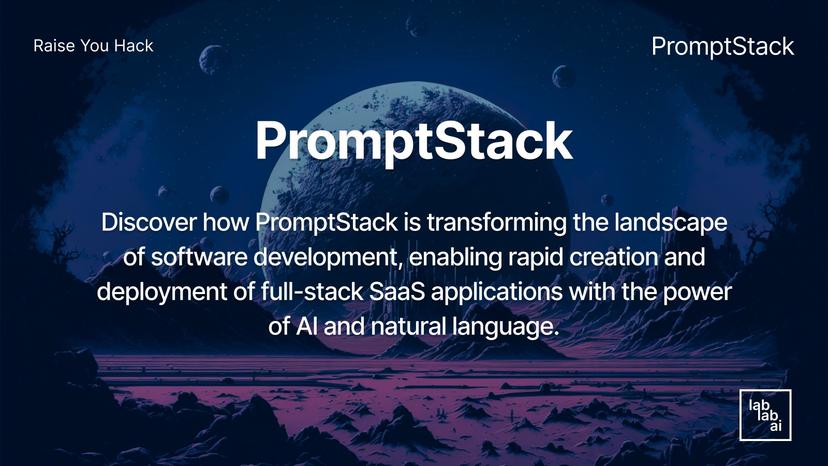
PromptStack
PromptStack is an AI-powered platform that generates full-stack SaaS applications from simple prompts. Unlike tools that only create static pages, it builds real backend logic, APIs, databases, and interactive dashboards. Developers can make live updates using natural language and have complete access to the codebase, including editing, versioning, and deployment control. PromptStack empowers teams to accelerate development, streamline workflows, and fully customize their applications with ease and precision. It reduces time-to-market and enhances productivity for startups and enterprises alike.
8 Jul 2025


