🤝 Top Collaborators

.png&w=640&q=75)



🤓 Latest Submissions

mindX Augmentic Intelligence
The design of self-improving intelligence has long been a central challenge in artificial intelligence (AI) research. While contemporary machine learning techniques have achieved unprecedented performance across domains such as vision, natural language processing, and game playing, they remain fundamentally constrained by static architectures and externally imposed objectives [Russell & Norvig, 2020]. The quest for open-ended, autonomous, and self-constructive intelligence has driven theorists and practitioners alike to explore approaches that extend beyond conventional paradigms. Two particularly influential contributions in this lineage are the Gödel Machine, introduced by Schmidhuber [2003; 2009], and its conceptual extension, the Darwin–Gödel Machine. These frameworks draw on deep theoretical insights from Gödel’s incompleteness theorems and Darwinian evolution to propose mechanisms by which a system might engage in recursive self-modification, thereby transcending the limitations of fixed architectures. However, both models remain largely theoretical, with limited practical instantiation. In the mindX Augmentic Intellgence core folder agint.py is designed as an agnostic intelligence to act as a traditional Gödel Machine consisting of: A formal axiomatic system describing its own software, hardware, and utility function. A proof searcher that attempts to find formal proofs that specific self-modifications will increase its expected utility. A self-rewrite mechanism that executes such modifications once proofs are discovered. This design theoretically guarantees a self optimised decision workflow : if the system finds a provably beneficial modification, it will implement it, thereby becoming strictly better at achieving its objectives. In this way, mindX will include in its own design extrapolation from existing agents into a system deciding from action which agent / tool to use and / or procedure to build. mindX is an implementation of a Darwin-Godel machine.
21 Sep 2025
drAIML - Medical AI Consultant
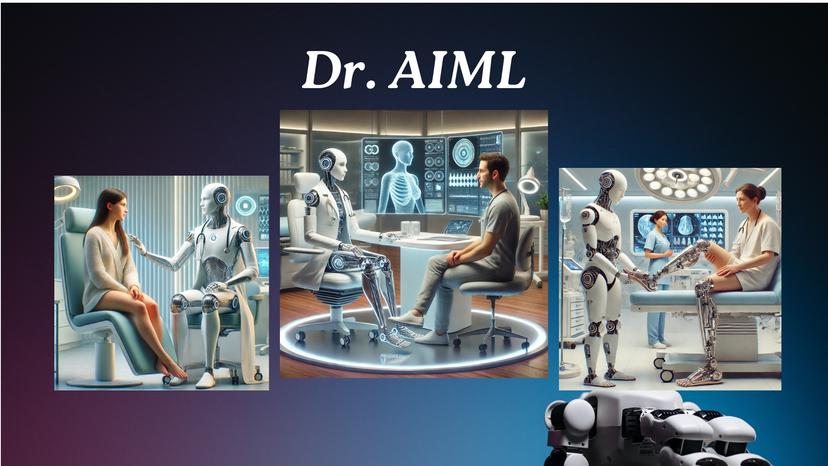
Dr. AIML revolutionizes healthcare by integrating cutting-edge AI with precision, adaptability, and empathy. It leverages advanced APIs and technologies to deliver real-time medical consultations, personalized diagnostics, and ethical care anytime, anywhere. Dr. AIML interacts seamlessly with OpenAI, Llama3 Groq, and Together.ai APIs, enabling access to powerful language models and medical insights. Using python-dotenv, it securely manages API keys and environment variables for streamlined operations. The platform’s user interface is powered by NiceGUI, a FastAPI-based framework that ensures a responsive and user-friendly experience. Backend operations utilize aiohttp for high-performance asynchronous HTTP handling and asyncio for efficient concurrent processing. For data handling, Dr. AIML employs ujson for fast JSON processing and psutil for system-level process management, ensuring optimal performance. Additionally, Streamlit is used to create an interactive and engaging front-end experience for users. With its mission to provide accessible, accurate, and ethical healthcare, Dr. AIML combines state-of-the-art APIs, secure integrations, and advanced machine learning to redefine the future of medical consultation. It’s more than just AI; it’s a trusted partner in safeguarding human health.
26 Jan 2025

ezAGI easy Augmented Generative Intelligence
ezAGI {easy Augmented Generative Intelligence} provides a comprehensive framework to develop modular, scalable and efficient AGI. Integrating multiple AI models ezAGI handles API management efficiently while managing memory effectively for continuous reasoning and interaction without user intervention. Components of ezAGI include SocraticReasoning, AGI, FundamentalAGI, LogicTables, OpenMind, memory management and API key management with multi-model support.ezAGI seamlessly integrates models from Together, Groq, and OpenAI to enhance any LLM with Continuous Autonomous Reasoning. ezAGI creates short term memory as an input/reponse constant. Leveraging internal reasoning and logic ezAGI will autonomously create decisions based on data inputs and predefined rules. ezAGI is a comprehensive framework for developing autonomous modular AGI systems. SocraticReasoning.py implements socratic reasoning to add premises and challenging them to draw_conclusion. agi.py handles learning from data to make_decision by initializing AGI as a chatter instance. memory provides the abiltity to learn from environmental data and store dialogue as history. automind.py manages environment interaction and response generation to . logic.py handles logical variables and expressions, generates truth tables, and validates truths, supporting ezAGI's reasoning. openmind.py provides an internal reasoning loop for continuous AGI operation, adding prompts reasoned from premise into processed conclusions while autonomously saving internal reasoning. memory.py manages memory storage, ensuring organized and persistent storage of short-term, long-term, and episodic memories. api.py uses the dotenv library for secure API key management, allowing dynamic integration with AI services. chatter.py provides input-response mechanisms for a multi-model environment including together, groq, and openAI ensuring robust and logical response. ezAGI augments the intelligence of large language models.
21 Jul 2024

Agent Speak ToolKitBuilder and AutoPacker
Introducing Project AUTOMINDx, a state-of-the-art initiative engineered to redefine the way autonomous agency integrates within multi-model design paradigms. The core of AUTOMINDx leverages the synergy of Agent Speak with pY4J technology, crafting a nexus that facilitates the interoperability between heterogeneous modeling frameworks aligning seamlessly with user needs. The design goals of AUTOMINDx are technologically intricate and ambitious. Primarily, the project exploits Agent Speak to create semantically rich communication channels between agents, leveraging BDI (Belief-Desire-Intention) models to facilitate complex negotiations and decision-making processes within autonomous systems. The conjunction of ToolKitBuilder, the superagi toolkit deployer, and Autopacker's agent-deb, plays a pivotal role, allowing for an enhanced modular approach that streamlines tool management and provisioning within distributed environments. AUTOMINDx ensures seamless inter-operation between Python and Java (JVM), facing the inherent challenges of multi-model design The actualization of ToolKitBuilder and Autopacker is not a mere aspiration but a tangible achievement within AUTOMINDx. The fusion of these diverse technologies required a robust architecture supporting high-level abstraction, low-level efficiency, and the scalability to adapt to evolving demands. The ultimate aim of AUTOMINDx is pioneering autonomous agency as a deployment strategy. Creating intelligent agents that can perceive, reason, and act within their environment with anarchitecture fostering agility and resilience. Project AUTOMINDx stands as a technical mastery, orchestrating a future where technology transcends traditional roles to become an intelligent and autonomous partner. By bridging the gap between theoretical frameworks and practical deployment, AUTOMINDx sets a new benchmark in the field of autonomous systems, heralding a future that is not just automated but genuinely intelligent.
21 Aug 2023