.png&w=256&q=75)
🤝 Top Collaborators



🤓 Latest Submissions
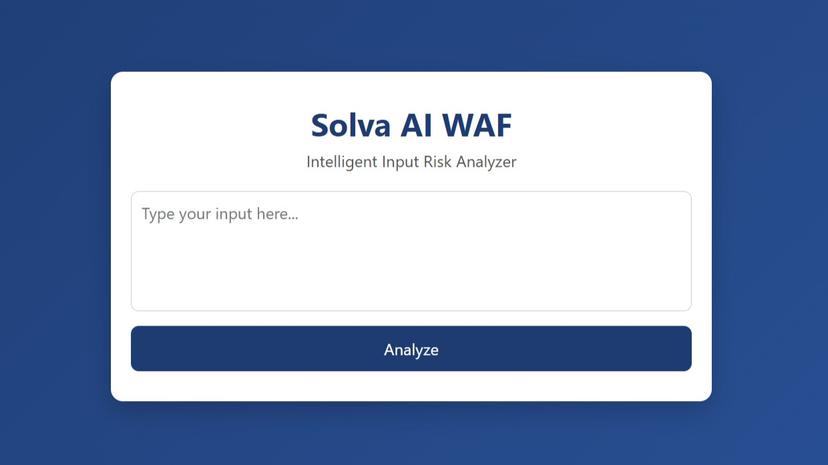
AI Web Application Firewall
AI-WAF (Artificial Intelligence Web Application Firewall) is a full-stack security application designed to safeguard AI systems and web applications from malicious user inputs. The system uses an AI model to analyze incoming prompts and classify them as Benign, Suspicious, or Malicious, assigning a dynamic risk score and an explanation for each decision. The backend is built using FastAPI and integrates with an AI inference model via Groq, enabling fast, real-time intent analysis. A secure API endpoint processes user input and returns structured security insights, ensuring consistent and safe responses even in failure scenarios. The frontend is developed with HTML, CSS, and JavaScript, providing a responsive and user-friendly interface where users can test prompts and instantly view security assessments. The frontend and backend are deployed independently using Netlify and Railway, following modern microservice deployment practices. AI-WAF is capable of detecting: Prompt injection attempts SQL injection-like patterns Cross-site scripting (XSS) payloads Data exfiltration and policy-bypass attempts This project demonstrates real-world implementation of AI security, API design, cloud deployment, and frontend-backend integration, making it suitable for production demos, hackathons, and portfolio showcases.
7 Feb 2026
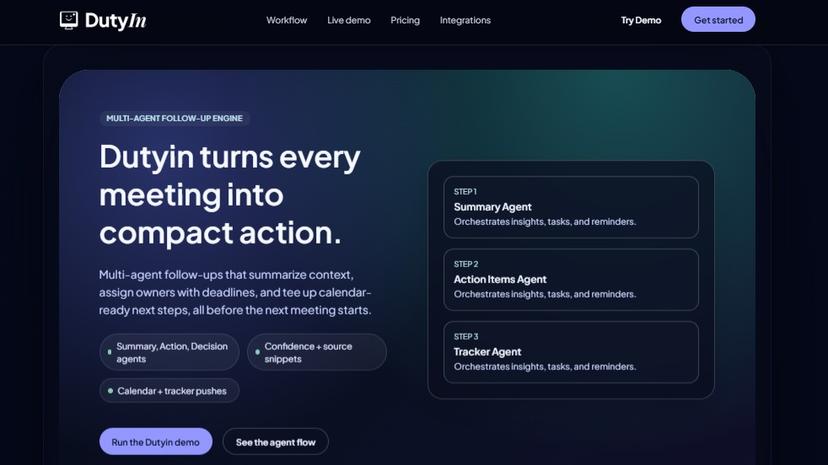
DutyIn AI Agents
Background & Motivation Teams spend hours in meetings, but execution collapses because follow-up tasks are not tracked properly. Across organizations: • Meeting notes are inconsistent • Action items are forgotten • Responsibilities remain unclear • Deadlines slip • Important decisions don’t get implemented This gap between discussion and execution creates lost productivity, missed deadlines, and weak accountability. DutyIn is designed to eliminate this gap using autonomous AI agents. SOLUTION: DutyIn DutyIn introduces an agentic AI ecosystem that works automatically: • Summarizes meetings clearly • Extracts action items with owners and deadlines • Schedules reminders in participants’ calendars • Sends follow-up emails instantly • Tracks task progress through a weekly dashboard
23 Nov 2025

mindX Augmentic Intelligence
The design of self-improving intelligence has long been a central challenge in artificial intelligence (AI) research. While contemporary machine learning techniques have achieved unprecedented performance across domains such as vision, natural language processing, and game playing, they remain fundamentally constrained by static architectures and externally imposed objectives [Russell & Norvig, 2020]. The quest for open-ended, autonomous, and self-constructive intelligence has driven theorists and practitioners alike to explore approaches that extend beyond conventional paradigms. Two particularly influential contributions in this lineage are the Gödel Machine, introduced by Schmidhuber [2003; 2009], and its conceptual extension, the Darwin–Gödel Machine. These frameworks draw on deep theoretical insights from Gödel’s incompleteness theorems and Darwinian evolution to propose mechanisms by which a system might engage in recursive self-modification, thereby transcending the limitations of fixed architectures. However, both models remain largely theoretical, with limited practical instantiation. In the mindX Augmentic Intellgence core folder agint.py is designed as an agnostic intelligence to act as a traditional Gödel Machine consisting of: A formal axiomatic system describing its own software, hardware, and utility function. A proof searcher that attempts to find formal proofs that specific self-modifications will increase its expected utility. A self-rewrite mechanism that executes such modifications once proofs are discovered. This design theoretically guarantees a self optimised decision workflow : if the system finds a provably beneficial modification, it will implement it, thereby becoming strictly better at achieving its objectives. In this way, mindX will include in its own design extrapolation from existing agents into a system deciding from action which agent / tool to use and / or procedure to build. mindX is an implementation of a Darwin-Godel machine.
21 Sep 2025


