
Asma Zubair@Asma_Zubair
16
Events attended
9
Submissions made
Pakistan
1 year of experience
About me
AI student with a strong foundation in Python and Data Structures & Algorithms (DSA), I am passionate about creating innovative and efficient solutions in the field of Artificial Intelligence. My skills allow me to approach complex problems with a structured and analytical mindset, and I’m always eager to explore new technologies and push the boundaries of what AI can achieve. Constant learning and problem-solving drive my enthusiasm for the future of AI development.
🤝 Top Collaborators


.png&w=640&q=75)
.png&w=640&q=75)
🤓 Latest Submissions

SafeSite AI
THE PROBLEM Every 3 minutes a construction worker is injured in the U.S. and every 8 hours one dies. Human supervisors cannot watch every corner of a 5‑acre site; it’s a biological limit, not negligence. Meanwhile traditional AI solutions hallucinate bounding boxes and cause alarm fatigue. OUR SOLUTION SafeSite AI is a dual‑layer safety pipeline purpose‑built for construction sites. The “eyes” of the system are YOLOv8, a fast, local object detector that spots missing hardhats, vests, and harnesses in 1.6 ms per frame with pixel‑perfect bounding boxes and zero hallucination risk. The “brain” is Google Gemini 2.5, which wakes only when YOLO finds a potential violation. A Vision Agent confirms the threat; a Regulation Agent pulls the verbatim OSHA standard from an 800‑page PDF loaded in context; and an Alert Agent drafts a structured, legally‑grounded supervisor notification. Crucially, no alarm sounds until Gemini has verified the danger—giving the supervisor a yellow “checking” card first, then a red verified alert with the exact OSHA code and penalty, while the worker receives an instant polite audio reminder. TECHNICAL HIGHLIGHTS • YOLOv8 + Roboflow PPE model – 1.6 ms per frame, 30+ FPS, local inference • Gemini 2.5 Flash (vision confirmation), Pro (OSHA grounding), Flash‑Lite (alert formatting) • Python FastAPI async backend with WebSocket push to a React dashboard • SQLite audit log records every detection, verification, and human acknowledgment • Human‑in‑the‑loop approval – the supervisor always has the final say BUSINESS VALUE SafeSite AI reduces preventable injuries and OSHA fines. Every avoided fall saves an estimated $145 000 in penalties and litigation, while letting supervisors focus on high‑value tasks instead of monitoring screens.
19 May 2026
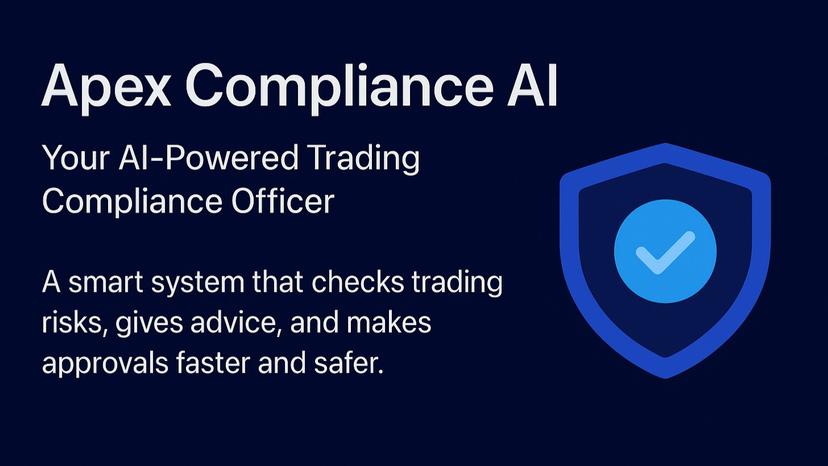
Apex Compliance AI
A smart system that checks trading risks, gives advice, and makes approvals faster and safer. We envisioned a transformative approach: What if we could imbue an AI with the critical judgment and diligence of a seasoned Trade Compliance Officer? An intelligent assistant capable of evaluating every trade with unprecedented speed and accuracy. This AI would instantaneously assess trades and provide: A precise risk level (e.g., low, medium, high) Identification of specific compliance violations or anomalies Actionable recommendations for next steps All this, occurring before any human approval, streamlining the process and enhancing safety.
19 Nov 2025

mindX Augmentic Intelligence
The design of self-improving intelligence has long been a central challenge in artificial intelligence (AI) research. While contemporary machine learning techniques have achieved unprecedented performance across domains such as vision, natural language processing, and game playing, they remain fundamentally constrained by static architectures and externally imposed objectives [Russell & Norvig, 2020]. The quest for open-ended, autonomous, and self-constructive intelligence has driven theorists and practitioners alike to explore approaches that extend beyond conventional paradigms. Two particularly influential contributions in this lineage are the Gödel Machine, introduced by Schmidhuber [2003; 2009], and its conceptual extension, the Darwin–Gödel Machine. These frameworks draw on deep theoretical insights from Gödel’s incompleteness theorems and Darwinian evolution to propose mechanisms by which a system might engage in recursive self-modification, thereby transcending the limitations of fixed architectures. However, both models remain largely theoretical, with limited practical instantiation. In the mindX Augmentic Intellgence core folder agint.py is designed as an agnostic intelligence to act as a traditional Gödel Machine consisting of: A formal axiomatic system describing its own software, hardware, and utility function. A proof searcher that attempts to find formal proofs that specific self-modifications will increase its expected utility. A self-rewrite mechanism that executes such modifications once proofs are discovered. This design theoretically guarantees a self optimised decision workflow : if the system finds a provably beneficial modification, it will implement it, thereby becoming strictly better at achieving its objectives. In this way, mindX will include in its own design extrapolation from existing agents into a system deciding from action which agent / tool to use and / or procedure to build. mindX is an implementation of a Darwin-Godel machine.
21 Sep 2025
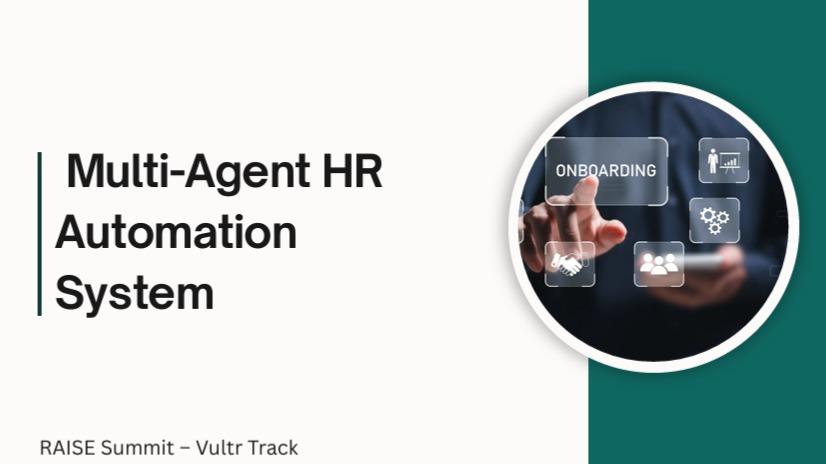
Multi-Agent HR Automation System
Project Title: Multi-Agent HR Automation System Description: Traditional HR processes are often repetitive, inefficient, and lacking in personalization. Our project, the Multi-Agent HR Automation System, addresses these challenges through a collaborative network of intelligent agents designed to streamline and enhance the employee onboarding experience. Built for the RAISE Summit under the Vultr Track, our system uses a modular approach, where each agent specializes in a key HR function. The Info Collector Agent gathers user data via forms or chat interfaces. The Policy Explainer Agent intelligently answers employee queries using company documents, leveraging Retrieval-Augmented Generation (RAG) and vector databases like Chroma or Qdrant. The Task Planner Agent generates personalized onboarding task lists, while the Scheduler Agent handles automated meeting scheduling via the Google Calendar API. Finally, the Feedback Agent collects user insights to improve HR workflows over time. Our system is powered by cutting-edge technologies: Vultr provides reliable cloud infrastructure; Groq delivers ultra-low latency LLM inference for real-time interaction; and LLaMA powers natural language understanding and decision-making. This multi-agent architecture not only boosts efficiency but also enables scalable, data-driven HR management. With potential expansion into areas like performance reviews, employee engagement, and predictive HR analytics, our project lays the groundwork for the future of intelligent, automated HR systems. By combining clean architecture, real-time AI capabilities, and a user-centric design, we deliver a powerful solution tailored for modern enterprises aiming to transform their HR operations.
8 Jul 2025
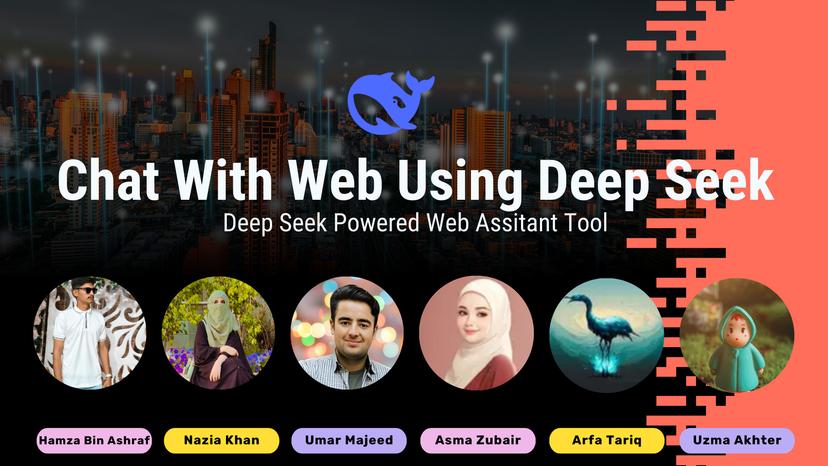
DeepSeek Web Assistant
Our project, DeepSeek Web Assistant, is a powerful AI-driven browser extension designed to make web browsing more interactive and insightful. With this extension, users can: --Summarize web pages instantly using DeepSeek’s AI models. --Ask questions about web content and receive relevant answers. --Use the "Highlight to Ask" feature, allowing them to highlight text and ask questions related to the selected content. --Interact with research papers, articles, and general web pages to extract key insights efficiently. --Seamlessly integrate AI-powered search and summarization into their browsing experience. This tool is particularly useful for students, researchers, and professionals who need quick, precise information while browsing the web.
16 Feb 2025
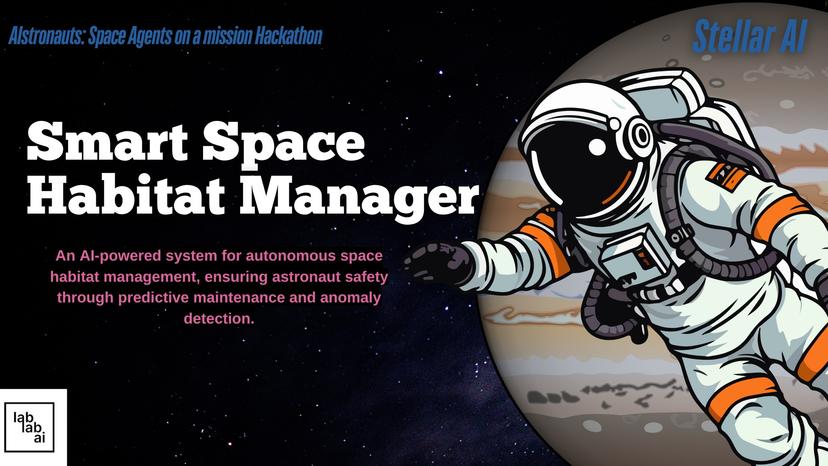
Smart Space Habitat Manager
The Smart Space Habitat Manager is a cutting-edge AI-driven solution designed to autonomously manage life-support systems in space habitats like the International Space Station (ISS), lunar bases, and Mars colonies. This system integrates real-time astronaut health monitoring, machine learning-based predictive maintenance, and statistical anomaly detection to prevent failures before they occur. By leveraging Random Forest regression models for failure prediction and statistical analysis for anomaly detection, it ensures a safe, self-sustaining environment without constant human intervention. Live sensor data tracking oxygen levels, temperature, CO₂ concentration, humidity, and power usage provides instant alerts for potential risks, enabling proactive decision-making. With its automated monitoring, predictive AI models, and real-time anomaly detection, this project represents a crucial step toward the future of sustainable space exploration, ensuring that astronauts remain safe while humanity expands beyond Earth
9 Feb 2025
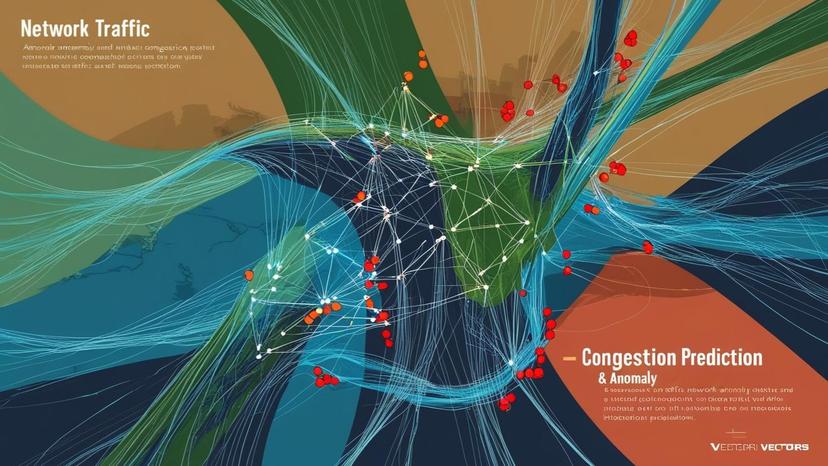
Network traffic anomaly and congestion prediction
Network Anomaly Detection & Congestion Prediction System This tool is designed to help you analyze and visualize your network traffic data to identify unusual patterns (anomalies) and predict potential network congestion. Whether you’re a network admin, a data scientist, or simply curious about traffic analysis, this app has you covered. Key Features: Anomaly Detection: Identify abnormal network traffic based on various metrics like packet length, protocol type, and time. Congestion Prediction: Predict potential network congestion by analyzing traffic patterns and detecting anomalies. Interactive Visualizations: Stunning charts and graphs for a more insightful analysis of the data, anomalies, and congestion. Technologies Used: Streamlit: The backbone of this web app, providing an interactive and easy-to-use interface. Pandas: For data manipulation and analysis of the network traffic data. NumPy: For numerical operations and data transformations. Plotly: Interactive and dynamic visualizations like histograms, scatter plots, and pie charts. Scikit-learn: Machine learning models like Isolation Forest for anomaly detection and congestion prediction. Python: The main programming language behind the app’s backend logic. Steps to Use: Step 1: Upload your network traffic data (CSV format). Step 2: Run Anomaly Detection to detect abnormal traffic patterns. Step 3: Predict Network Congestion based on detected anomalies. Visual Enhancements: Anomaly Distribution: A histogram to visualize how many records are normal and how many are anomalous. Anomalies Over Time: Scatter plot shows anomalies in relation to the time of day. Anomaly vs Normal: A pie chart to compare the number of normal vs anomalous records.
26 Jan 2025
DocuSummarize - AI - Powered PDF PPT Chatbot
DocuSummarize is an innovative AI-powered chatbot designed to simplify document analysis by providing instant summaries of PDF and PowerPoint files. Built using the Llama model, it enables users to interact with the chatbot, asking follow-up questions to dive deeper into the content. This tool is perfect for professionals, students, and researchers who frequently manage large documents. It supports seamless text extraction and summarization from PDFs and PowerPoint slides, providing concise insights in real time. Looking ahead, DocuSummarize plans to expand its capabilities by incorporating image summarization through OCR, making it a more versatile tool for comprehensive content analysis.
20 Oct 2024
WorkUp - AI-Driven Project Management Automation
WorkUp is a project management tool designed to streamline and automate the process of project setup and management. Using AI-powered algorithms, the tool efficiently distributes tasks to team members based on their expertise, ensuring optimal productivity. WorkUp allows users to upload project descriptions and team expertise in various formats (PDF, DOCX, TXT) or manually input the data. The AI system analyzes this information to assign tasks, generate detailed workflows, and create visual flowcharts for a clearer understanding of the project’s progression. Additionally, WorkUp suggests creative project names and generates a starter code structure to kickstart development. Built on a user-friendly Streamlit interface, the tool allows for seamless interaction and feedback collection, enabling continuous improvement. WorkUp saves time, enhances collaboration, and scales easily to accommodate projects of different sizes and complexities. Future enhancements include advanced customization options, integration with existing project management tools, and mobile support.
13 Oct 2024