
🤝 Top Collaborators

.png&w=640&q=75)

🤓 Latest Submissions

SafeSite AI
THE PROBLEM Every 3 minutes a construction worker is injured in the U.S. and every 8 hours one dies. Human supervisors cannot watch every corner of a 5‑acre site; it’s a biological limit, not negligence. Meanwhile traditional AI solutions hallucinate bounding boxes and cause alarm fatigue. OUR SOLUTION SafeSite AI is a dual‑layer safety pipeline purpose‑built for construction sites. The “eyes” of the system are YOLOv8, a fast, local object detector that spots missing hardhats, vests, and harnesses in 1.6 ms per frame with pixel‑perfect bounding boxes and zero hallucination risk. The “brain” is Google Gemini 2.5, which wakes only when YOLO finds a potential violation. A Vision Agent confirms the threat; a Regulation Agent pulls the verbatim OSHA standard from an 800‑page PDF loaded in context; and an Alert Agent drafts a structured, legally‑grounded supervisor notification. Crucially, no alarm sounds until Gemini has verified the danger—giving the supervisor a yellow “checking” card first, then a red verified alert with the exact OSHA code and penalty, while the worker receives an instant polite audio reminder. TECHNICAL HIGHLIGHTS • YOLOv8 + Roboflow PPE model – 1.6 ms per frame, 30+ FPS, local inference • Gemini 2.5 Flash (vision confirmation), Pro (OSHA grounding), Flash‑Lite (alert formatting) • Python FastAPI async backend with WebSocket push to a React dashboard • SQLite audit log records every detection, verification, and human acknowledgment • Human‑in‑the‑loop approval – the supervisor always has the final say BUSINESS VALUE SafeSite AI reduces preventable injuries and OSHA fines. Every avoided fall saves an estimated $145 000 in penalties and litigation, while letting supervisors focus on high‑value tasks instead of monitoring screens.
19 May 2026

mindX Augmentic Intelligence
The design of self-improving intelligence has long been a central challenge in artificial intelligence (AI) research. While contemporary machine learning techniques have achieved unprecedented performance across domains such as vision, natural language processing, and game playing, they remain fundamentally constrained by static architectures and externally imposed objectives [Russell & Norvig, 2020]. The quest for open-ended, autonomous, and self-constructive intelligence has driven theorists and practitioners alike to explore approaches that extend beyond conventional paradigms. Two particularly influential contributions in this lineage are the Gödel Machine, introduced by Schmidhuber [2003; 2009], and its conceptual extension, the Darwin–Gödel Machine. These frameworks draw on deep theoretical insights from Gödel’s incompleteness theorems and Darwinian evolution to propose mechanisms by which a system might engage in recursive self-modification, thereby transcending the limitations of fixed architectures. However, both models remain largely theoretical, with limited practical instantiation. In the mindX Augmentic Intellgence core folder agint.py is designed as an agnostic intelligence to act as a traditional Gödel Machine consisting of: A formal axiomatic system describing its own software, hardware, and utility function. A proof searcher that attempts to find formal proofs that specific self-modifications will increase its expected utility. A self-rewrite mechanism that executes such modifications once proofs are discovered. This design theoretically guarantees a self optimised decision workflow : if the system finds a provably beneficial modification, it will implement it, thereby becoming strictly better at achieving its objectives. In this way, mindX will include in its own design extrapolation from existing agents into a system deciding from action which agent / tool to use and / or procedure to build. mindX is an implementation of a Darwin-Godel machine.
21 Sep 2025
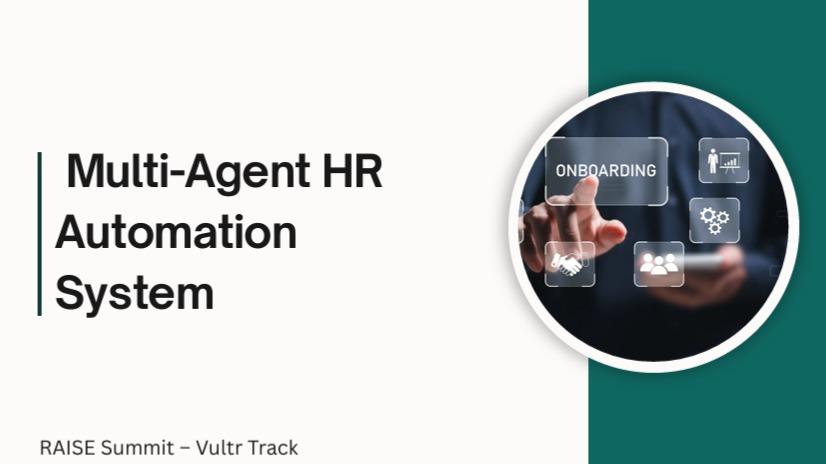
Multi-Agent HR Automation System
Project Title: Multi-Agent HR Automation System Description: Traditional HR processes are often repetitive, inefficient, and lacking in personalization. Our project, the Multi-Agent HR Automation System, addresses these challenges through a collaborative network of intelligent agents designed to streamline and enhance the employee onboarding experience. Built for the RAISE Summit under the Vultr Track, our system uses a modular approach, where each agent specializes in a key HR function. The Info Collector Agent gathers user data via forms or chat interfaces. The Policy Explainer Agent intelligently answers employee queries using company documents, leveraging Retrieval-Augmented Generation (RAG) and vector databases like Chroma or Qdrant. The Task Planner Agent generates personalized onboarding task lists, while the Scheduler Agent handles automated meeting scheduling via the Google Calendar API. Finally, the Feedback Agent collects user insights to improve HR workflows over time. Our system is powered by cutting-edge technologies: Vultr provides reliable cloud infrastructure; Groq delivers ultra-low latency LLM inference for real-time interaction; and LLaMA powers natural language understanding and decision-making. This multi-agent architecture not only boosts efficiency but also enables scalable, data-driven HR management. With potential expansion into areas like performance reviews, employee engagement, and predictive HR analytics, our project lays the groundwork for the future of intelligent, automated HR systems. By combining clean architecture, real-time AI capabilities, and a user-centric design, we deliver a powerful solution tailored for modern enterprises aiming to transform their HR operations.
8 Jul 2025


