Top Builders

Explore the top contributors showcasing the highest number of app submissions within our community.

Weaviate

Weaviate is an open-source vector database that enables you to store data objects and vector embeddings from your preferred ML models. Moreover, it offers smooth scalability for handling billions of data objects.

General
AuthorWeaviate
Repositoryhttps://github.com/weaviate
TypeVector Database

Weaviate - Helpful Resources

Explore Weaviate resources to better understand and utilize Weaviate, the AI native vector database, effectively in your projects.

  • Weaviate Documentation Comprehensive documentation for Weaviate
  • Weaviate Quickstart In this quickstart guide, you'll discover how to build a vector database using Weaviate Cloud Services (WCS), import data, and conduct vector search.
  • WCS - Weaviate SaaS Connect to the Weaviate Cloud Services or to a local Weaviate (Keep in mind that Weaviate can also be utilized locally with Docker).

Delve into Weaviate's similarity search to quickly and accurately identify closely related data within your vector database.


GraphQL API


Weaviate AI technology page Hackathon projects

Discover innovative solutions crafted with Weaviate AI technology page, developed by our community members during our engaging hackathons.

MonadLabs

MonadLabs

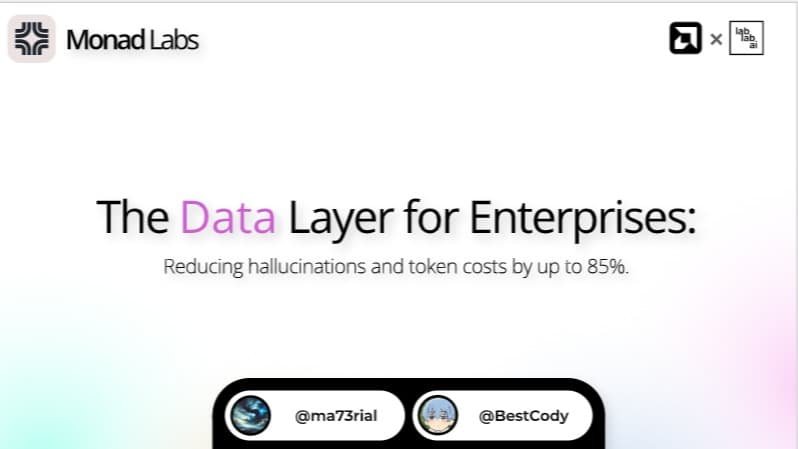
Unstructured, multimodal data is one of enterprises’ biggest bottlenecks and largest untapped assets. Companies are buried in PDFs, screenshots, videos, emails, logs, spreadsheets, and semi-structured data that existing AI systems cannot reliably understand. Models are improving, but their inputs remain fragmented and noisy. The result is hallucinating RAG systems, brittle agents, duplicated processing, rising API costs, and human reviewers forced to verify every critical output. MonadLabs fixes this problem at the data layer. It converts enterprise files into a Universal Intermediate Representation: a standardized, agent-ready format containing typed chunks, source metadata, entities, relationships, timestamps, embeddings, and readable Markdown. A format router sends each input through a specialized pipeline—Docling for PDFs and Office files, Fireworks vision for images, Whisper and pyannote for audio transcription and speaker diarization, and a lightweight video pipeline that combines transcripts with Florence-2 frame captions into time-aligned chunks. The data is token-sized, enriched, embedded with BGE-small, validated against the UIR schema, and made searchable through semantic retrieval with title-priority ranking. MonadLabs’ assistant does not receive blindly preloaded context. It autonomously calls search and source-expansion tools, then produces grounded answers with visible tool traces and chunk-level citations. Flask APIs, SQLite persistence, optional Weaviate storage, global search, and multi-user chat let it plug into workflows. The impact is reliability and scale. Better context reduces hallucinations and hidden failures. Traceable citations reduce human QA. Reusable structured data prevents companies from repeatedly sending entire documents to expensive models, cutting token usage and hallucinations by up to 85%. As enterprise AI bills grow into the billions, MonadLabs makes production AI more accurate, auditable, and economically sustainable.

RepoPilot

RepoPilot

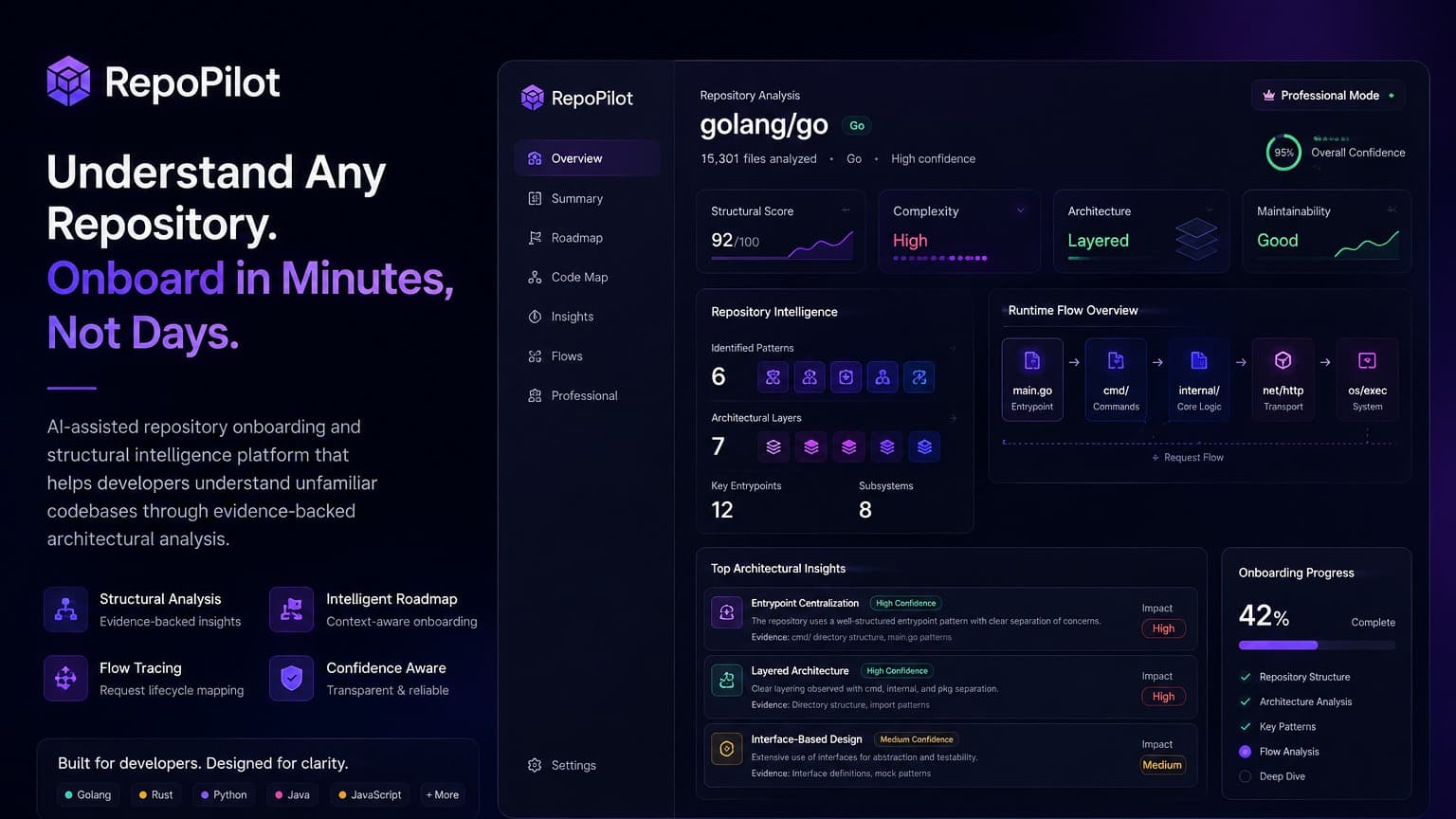
RepoPilot is an AI-powered developer onboarding platform that helps developers quickly understand complex codebases. Modern repositories are often large and difficult to navigate, making onboarding slow and confusing. RepoPilot solves this by turning repositories into an interactive, AI-driven learning experience. It connects directly to GitHub and performs deep analysis of project structure, architecture, dependencies, modules, APIs, workflows, and runtime behavior. Instead of manually exploring code, developers get structured insights and AI-generated explanations. A key feature is its Codebase Q&A Assistant, where users can ask questions in natural language and receive context-aware answers based on the repository. It also provides automatic code explanations that simplify complex modules while still supporting advanced detail. RepoPilot includes project structure visualization and dependency mapping, helping developers understand how files, services, and modules connect and how data flows through the system. It also offers runtime flow tracing to visualize execution paths step by step. A Smart Onboarding Flow generates guided learning paths based on repository complexity, ensuring developers explore important components in the right order. The platform supports Beginner and Professional modes to adjust explanation depth. Built with Next.js, React, TypeScript, Tailwind CSS, and GitHub APIs, RepoPilot reduces onboarding time and improves developer productivity by making complex systems easier to understand.

ChartSeek AI Search for Trading Education Videos

ChartSeek AI Search for Trading Education Videos

ChartSeek: AI-Powered Trading Education Video Intelligence Traders face an overwhelming challenge: thousands of hours of educational videos, yet finding that moment explaining a "head and shoulders pattern" means scrubbing through endless footage. Traditional search fails because traders need to find visual chart patterns, not just spoken words. The Industry Gap Current video platforms offer only keyword search against titles and descriptions. Trading platforms like TradingView, Investopedia, and YouTube provide no way to search inside video content. Enterprise solutions cost $50K+ annually yet still can't match visual patterns. Traders waste hours rewatching purchased content, unable to locate specific setups. This gap costs traders their most valuable resource: time for analyzing live markets. How ChartSeek Bridges This Gap ChartSeek combines OpenAI's CLIP visual understanding with Whisper speech recognition. Unlike keyword search, ChartSeek understands what's visually on screen. Search "bullish engulfing on support" or "descending triangle breakdown"—and instantly jump to that exact frame, even if never explicitly mentioned by the instructor. The system transcribes spoken commentary, extracts representative keyframes, and generates visual embeddings. Searches query both transcript and visual index simultaneously, returning ranked results with confidence scores. Technical Foundation Built on TheAgenticAI's CortexON multi-agent framework with OpenAI Codex workflow architecture. Runs 100% locally using open-source models—zero API costs, complete privacy for proprietary strategies. Key Capabilities - Visual pattern search by description - Cross-modal text-to-image matching - Automatic timestamped transcription - Instant clip extraction ChartSeek delivers 90% reduction in search time, transforming passive video libraries into queryable intelligence. Less searching, more trading.