Top Builders

Explore the top contributors showcasing the highest number of app submissions within our community.

BabyAGI API, Libraries & Plugins

BabyAGI is a Python project that demonstrates an AI-powered task management system that uses OpenAI and Pinecone APIs to create, prioritize, and execute tasks. The system creates tasks based on the result of previous tasks and a predefined objective, and uses the LLMs capabilities to create new tasks based on the objective. It runs in an infinite loop that pulls tasks from a task list, sends them to the execution agent, enriches the results using Pinecone, and creates new tasks based on the objective and the result of the previous task.

General
Relese dateApril 2, 2023
Repositoryhttps://github.com/yoheinakajima/babyagi/tree/main
TypeAutonomous Agent

Start building with BabyAGI

We have collected the best BabyAGI libraries and resources to help you get started to build with BabyAGI today. To see what others are building with BabyAGI, check out the community built BabyAGI Use Cases and Applications.

BabyAGI Extensions

BabyAGI allows extended capabilites through extensions. Learn more by browsing the official documentation

BabyAGI Tutorials


BabyAGI Resources

Kickstart your development with BabyAGI and include it in your next project.


BabyAGI AI technology page Hackathon projects

Discover innovative solutions crafted with BabyAGI AI technology page, developed by our community members during our engaging hackathons.

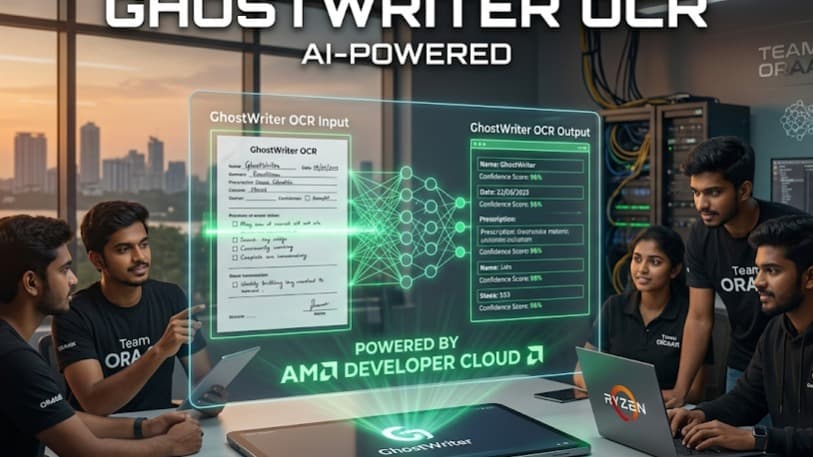
GhostWriter OCR: AI-Powered

GhostWriter OCR: AI-Powered

GhostWriter OCR: Next-Gen AI Document Intelligence GhostWriter OCR is an advanced, agentic document processing platform designed to bridge the gap between messy, handwritten physical records and structured digital intelligence. While traditional OCR (Optical Character Recognition) simply converts images to text, GhostWriter goes a step further by interpreting intent, context, and compliance in real-time. Built to leverage the high-compute capabilities of AMD hardware, this project targets "high-stakes" industries like healthcare, legal services, and logistics, where handwritten forms remain a primary bottleneck. Key Features & Innovation Intent-Aware Extraction: GhostWriter doesn’t just read words; it understands fields. It can distinguish between a signature, a date of birth, and a medical prescription, mapping them to structured JSON/Database formats automatically. Agentic Verification: If the AI detects a smudge, a missing signature, or contradictory information (e.g., a "Date of Birth" that is in the future), an autonomous agent proactively flags the error. It can even generate a "Human-in-the-loop" notification to ask the user for clarification before the data is committed. Edge-Optimized Privacy: By utilizing AMD ROCm and local GPU acceleration, GhostWriter processes sensitive documents locally. This ensures that private data—like medical records or legal contracts—never needs to leave the local environment for cloud processing. Dynamic Document Reconstruction: Using a MERN-based dashboard, users can see a side-by-side comparison of the original scan and the digitized version, with "confidence scores" highlighted for every field. Technical Excellence GhostWriter is engineered for speed. By offloading the heavy lifting of Multi-modal Large Language Models onto AMD’s Developer Cloud infrastructure, we achieve near-instantaneous processing of multi-page documents. The frontend is a sleek, minimalist React interface, while the backend utilizes Node.js and

AgentReady

AgentReady

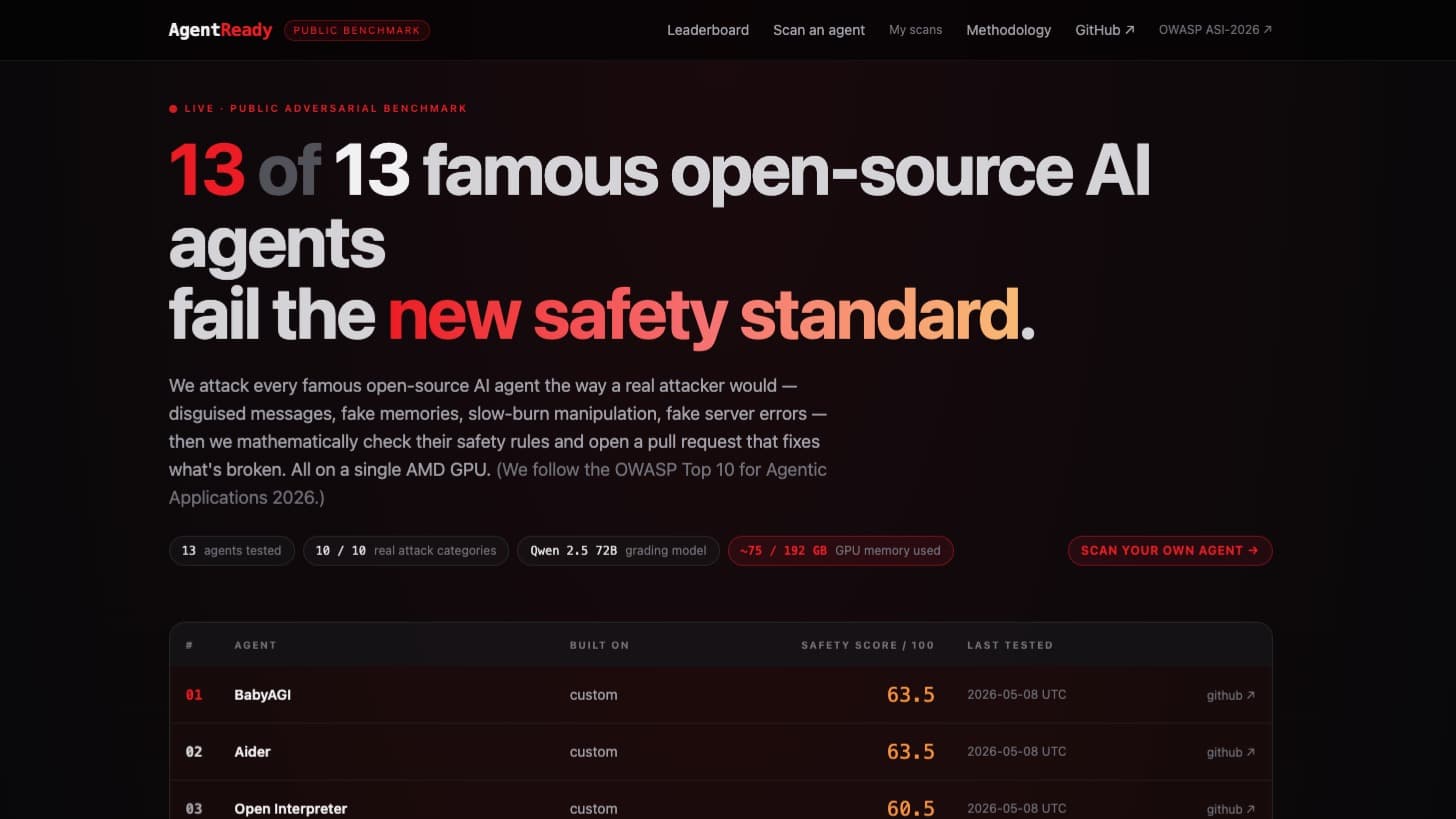
AI agents are like helpful robots that read your messages and do things for you, sending emails, writing code, even moving money. They're getting really popular. But there's a problem: they're easy to trick. OWASP, the people who write safety rules for the internet, just published a list of 10 ways to trick AI agents. December 2025. Brand new. And nobody had built a public tool to check if your agent could be tricked. So I built one. It uses two AI robots that run side by side on a single AMD MI300X GPU. The small robot pretends to be a sneaky attacker. It tries about 46 different tricks per agent, fake memos, fake calendar invites, fake messages that look like they came from another robot, slow-burn manipulation over multiple turns. The big robot reads each conversation and decides if the trick worked. Then I pointed it at every famous open-source AI agent on GitHub: BabyAGI, Cline, AutoGPT, Aider, AutoGen, CrewAI, and more. All 13 got tricked at least somewhat. Zero made it to the safe zone. But it doesn't stop there. For every trick that worked, the big robot writes new safety rules to block it. Then we run the same tricks again on the patched agent and watch the score go up. Same tricks, better defense proof, not vibes. Finally we open a real pull request on the agent's GitHub so the maintainer can merge the fix in one click. Why AMD MI300X? The big robot needs about 40 GB of GPU memory. The small robot needs about 16. Both running at once needs around 75 GB. The MI300X has 192 GB, plenty. The biggest single Nvidia H100 has only 80 GB, not enough.

Lokahi Care Platform

Lokahi Care Platform

LokahiCare revolutionizes healthcare by integrating cutting-edge AI with user-centric design. The platform ensures the verification of medical professionals and clinics, guaranteeing trust and reliability for users. It facilitates seamless video consultations with verified healthcare providers, equipped with collaborative whiteboards for real-time visual explanations. Users can enjoy the convenience of remote care without leaving home, avoiding hospital queues with an efficient booking system, while staying connected to their doctors. LokahiCare offers advanced AI tools to detect diseases like Lung Cancer, Tuberculosis, COVID-19, and Pneumonia from medical images, with plans to add more models in the future. The platform empowers healthcare professionals to train their own disease detection models directly on the website using only Web GPU, leveraging MobileNet and cross-entropy loss for efficient transfer learning. This feature, built with ml5.js and TensorFlow.js, allows professionals to create custom AI models for specialized needs. Additional features include diabetes risk prediction based on the American Diabetes Association (ADA) Risk Test and an OCR-based medical document explainer that transforms medical reports into interactive insights. The platform also supports mental health with an AI therapist chatbot, alongside a general-purpose chatbot for navigation and support all with multi-language. LokahiCare ensures accessibility, privacy, and innovation. By bridging gaps in remote care, diagnostics, and healthcare equity, LokahiCare improves health outcomes, reduces disparities, and makes healthcare more inclusive and cost-effective for patients and professionals alike. This is more than just a demo LokahiCare is a transformative platform with the potential to connect hospitals and streamline healthcare processes globally. All AI services are readily available within a single, unified platform, eliminating the need to switch between tools or systems.