Top Builders

Explore the top contributors showcasing the highest number of app submissions within our community.

SuperAGI

SuperAGI is a dev-first, open-source autonomous AI agent framework - Enabling developers to build, manage & run useful autonomous agents quickly and reliably. Users can extend Agent capabilities with tools such as GitHub, Jira, Slack, Twitter, etc., and also run multiple agents concurrently.

SuperAGI also provides users with a GUI to easily configure and monitor their agents. Users can access organization, run, and user-level metrics via the Agent Performance Monitoring (APM) dashboard to get actionable insights about improving their agents.

General
Repositoryhttps://github.com/TransformerOptimus/SuperAGI
TypeLarge Language Model Framework

SuperAGI - Resources

Resources to get started with SuperAGI

SuperAGI - Video Walkthroughs

SuperAGI - Use cases

Use cases for SuperAGI

SuperAGI AI technology page Hackathon projects

Discover innovative solutions crafted with SuperAGI AI technology page, developed by our community members during our engaging hackathons.

Lodestar — Offline AI Survival Copilot

Lodestar — Offline AI Survival Copilot

GPS denial is no longer rare: Poland logged 2,732 jamming incidents in one month in early 2025, and an EU Commission President's plane lost GPS near Bulgaria and landed on paper maps. When navigation fails, everything built on top tends to fail at once including medical guidance, since most first-aid apps assume connectivity that may not exist when it matters most. Lodestar is an offline, on-device AI survival copilot built for that moment. It runs on Snapdragon hardware via ExecuTorch, requesting no INTERNET permission at all, across three capabilities: TREAT — describe an injury by voice or text and get a severity-ranked, source-cited first-aid response. Severity comes from a deterministic safety-tree engine, not the language model, so the system can't be talked into downgrading a critical call by ambiguous phrasing. The model explains and cites a TCCC/MARCH corpus but cannot override the verdict underneath. We tested negation handling ("hasn't stopped" vs. "has stopped now"), the failure mode that matters in the field — and caught and fixed a real bug here during testing. ORIENT — true north without a satellite. By day, a solar compass derives heading from the sun's position, verified against documented sunrise, sunset, and solar-noon directions. By night, on-device star plate-solving matches a photographed sky against a catalog. A status strip shows the active position source — GPS_TRUSTED, DEAD_RECKONING, SOLAR_FIX, or STAR_FIX — and flips in real time if GPS is spoofed, freezing to the last trusted fix. COMMUNICATE — medic-casualty translation plus a one-tap SOS card from the TREAT conversation. Every model-backed capability sits behind one interface, so the app was built and tested against a stub before the real models landed swapping to production is a one-line change. We're upfront about what's tested today (safety tree, solar math, spoof detection all pass automated tests) versus what's in progress (corpus coverage, runtime integration)

OmniSentinel: Watching Everything, Missing Nothing

OmniSentinel: Watching Everything, Missing Nothing

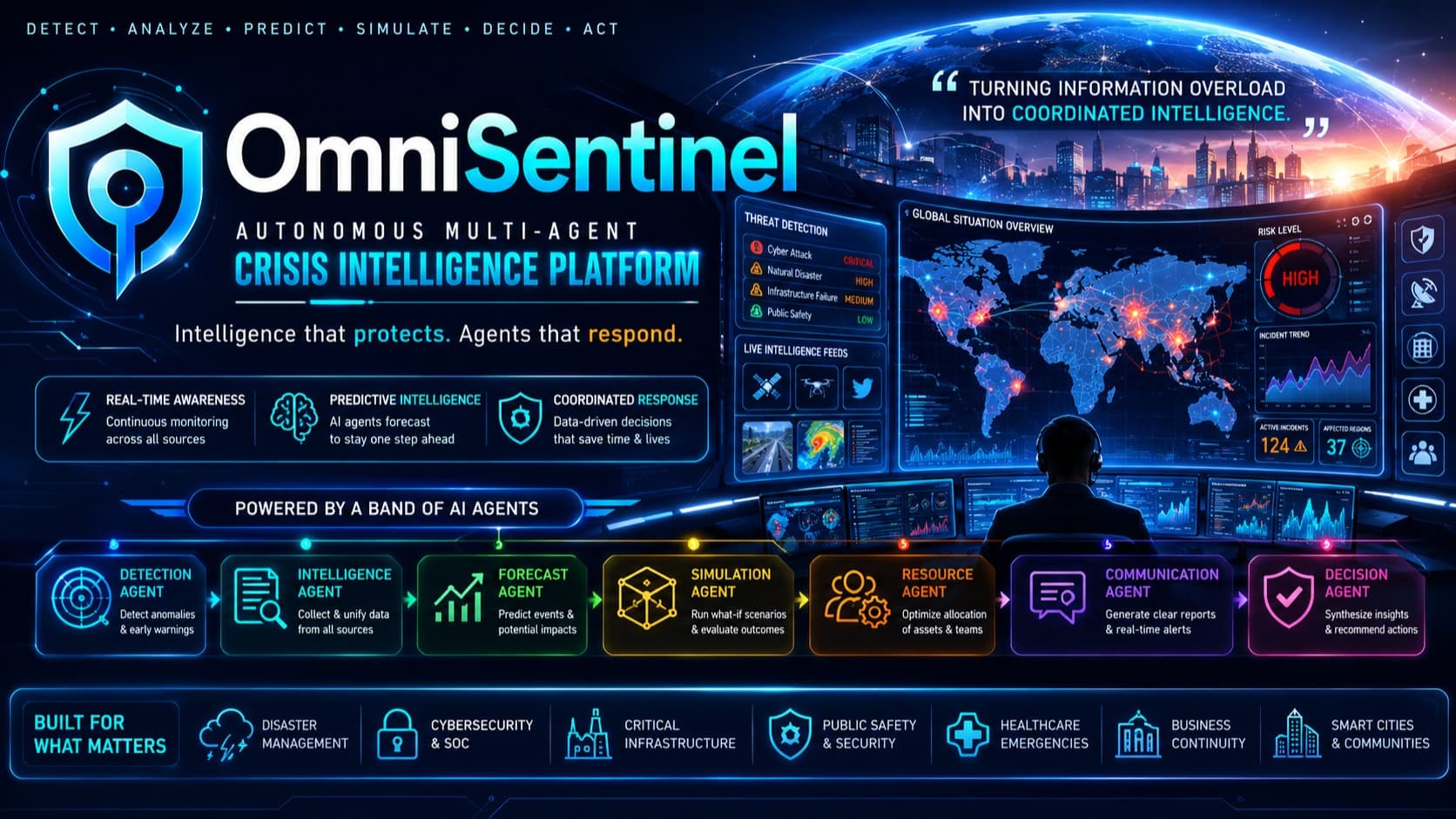
OmniSentinel is an autonomous multi-agent crisis intelligence platform that helps organizations, governments, and emergency teams detect, understand, and respond to critical events in real time. Modern crises such as natural disasters, cyberattacks, infrastructure failures, and public health emergencies generate vast amounts of fragmented information that can overwhelm human decision-makers. OmniSentinel transforms this complexity into coordinated intelligence through a Band of AI Agents working together as a unified command center. The platform combines specialized agents that continuously monitor data, identify threats, gather intelligence, forecast potential developments, simulate response scenarios, and recommend optimal actions. Instead of operating independently, these agents collaborate, validate findings, and refine recommendations to provide accurate and actionable insights. This collective reasoning approach enables faster situational awareness and more confident decision-making during high-pressure events. OmniSentinel provides a real-time view of evolving situations, helping users understand current risks, anticipate future impacts, and evaluate possible response strategies before taking action. For demonstration purposes, the platform can simulate scenarios such as cyberattacks, severe weather events, infrastructure outages, or large-scale emergencies, showcasing how multiple AI agents coordinate autonomously to analyze information and generate strategic response plans within seconds. By turning information overload into coordinated intelligence, OmniSentinel empowers decision-makers to respond faster, smarter, and more effectively when every second matters.

SuperAGI