
will hermann@wilherman21
1
Events attended
1
Submissions made
4+ years of experience
Socials
🤝 Top Collaborators
🤓 Latest Submissions
TripBalm
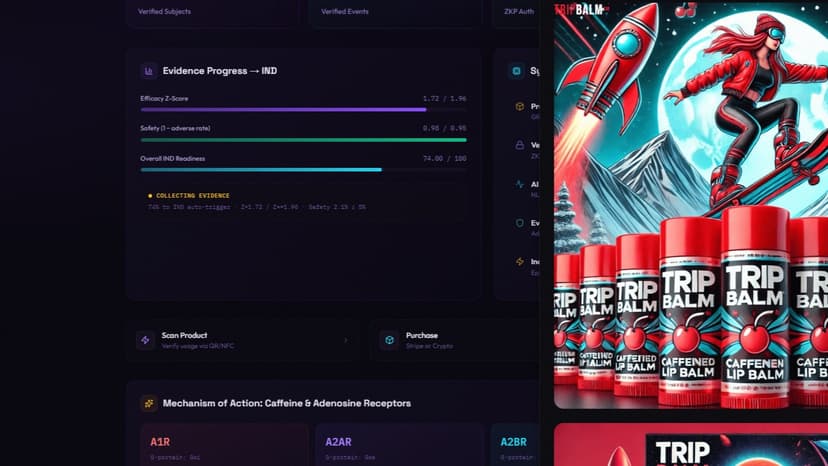
TripBalm is a Gemini 3 AI-powered dosing optimization protocol for transdermal caffeinated lip balm (GRAS). The system integrates ROOK Connect API to pull real-time biometric data from 400+ wearable devices — heart rate, HRV, SpO2, sleep stages, hydration, and activity — then maps these biomarkers to the four adenosine receptor subtypes (A1R, A2AR, A2BR, A3R) that caffeine antagonizes. The core innovation is the receptor activity model: A1R tracks sleep disruption via deep sleep percentage. A2AR measures the primary alertness response through HR delta and HRV changes. A2BR monitors vasodilation and transdermal absorption via SpO2 shifts. A3R uses bathroom frequency and hydration patterns as a renal adenosine proxy to detect kidney stress — a novel approach to caffeine tolerance monitoring. Each product unit carries a QR/NFC tag with a unique UID. Users scan to verify usage, then an AI agent conducts a clinical-grade outcome interview (NCI-CTCAE aligned). Both subjective reports and objective wearable data are cryptographically committed to a registry-trial ledger using zero-knowledge proofs — no PII on-chain. The evidence layer aggregates all data into an adaptive dataset that continuously computes efficacy Z-scores and safety posteriors. When statistical thresholds are met (Z≥1.96, adverse rate ≤5%), the system auto-triggers IND filing preparation in CDISC format. An epoch-based staking mechanism incentivizes sustained participation through Stripe and crypto payment rails. Built with React, Vite, Vercel serverless functions, ROOK Connect API (with Terra API fallback), and a patent-pending architecture (Application 15814729_000047). The platform transforms a simple consumer lip balm into a regulatory-grade evidence generation engine — bridging the gap between wellness products and pharmaceutical-grade
15 Feb 2026


