
Next Hackathon
AI Factory
Starts Aug 3, 2026
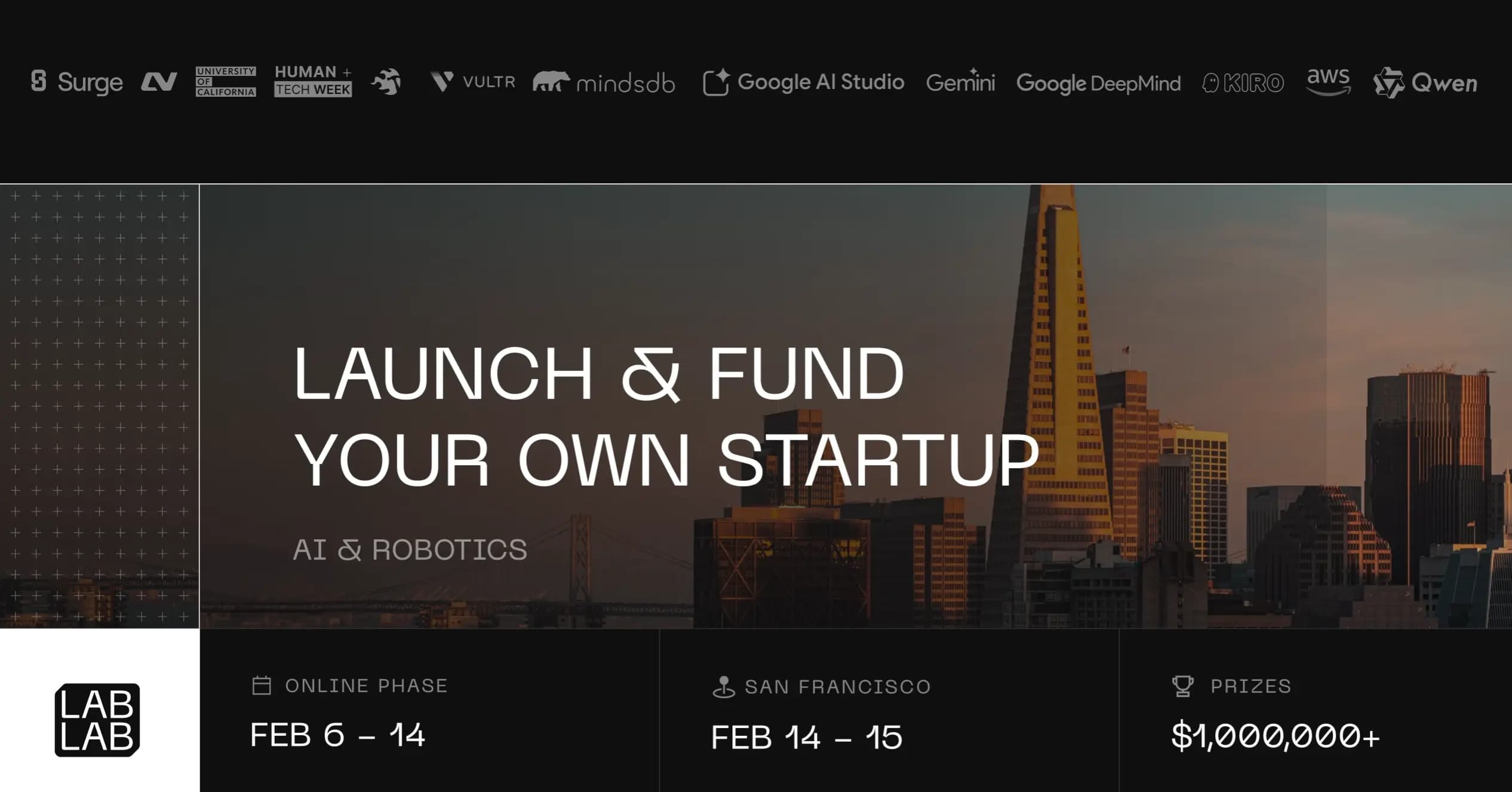
Launch and Fund Your Own Startup – Edition 1
AI Meets Robotics
Join our $1,000,000+ startup challenge series powered by Surge
📌 This announcement outlines the launch of a Global Human+AI Exchange - aligning universities, global cities, talent networks, and industry to accelerate human-centered AI innovation, technology transfer, and economic growth.
⏱️ 8 days to turn your idea, or existing product, into an investable demo.
📅 February 6 – 15, 2026
• Feb 6 – 14 (Online Phase) - Collaborate and build online with developers and AI innovators from around the world. All projects must be submitted by the end of the online phase on February 14th.
🕙 Doors open at 10:00 AM, first come, first served.
• Feb 14 (On‑site Build Day) - Selected participants will be invited to an exclusive in‑person session to refine their projects and connect directly with mentors.
• Feb 15 (On‑site Demos & Awards) - Live pitching sessions to a panel of judges and ecosystem partners, followed by the official winner announcement.
🌟 Get feedback from startup mentors and technical experts.
📍 On-site Venue (Feb 14–15):
MindsDB SF AI Collective
3154 17th St, San Francisco, California, USA
📲 Real-time on-site updates (SF)
For real-time announcements and information during the on-site portion (Feb 14–15), join the LabLab SF Chapter WhatsApp group:
🤝 Join solo or with a team. New founders and existing startups are welcome.
🏆 $1,000,000+ in credits, token prizes, perks and funding opportunity.
📍 On-site participation is by invitation only. Travel and accommodation expenses will not be covered.
🧑💻 Apply now to build, validate, and pitch with purpose.
Hackathon Overview
Our AI hackathon brought together a diverse group of participants, who collaborated to develop a variety of impressive projects based on:
4410
Participants
356
Teams
94
AI Applications
Winners and Finalists
- We are in the process of selecting the finalist teams.
- Your voice matters! Vote on your favorite projects in the section below.
- Join us for the winner announcement stream, which will be streamed live on Twitch.



.png&w=3840&q=75)
.png&w=3840&q=75)





This event has now ended, but you can still register for upcoming events on lablab.ai. We look forward to seeing you at the next one!
Check out Upcoming Events →Each edition features a unique technical theme, high-stakes prizes, and an intensive bootcamp-style build cycle, all designed to take you from idea → demo → pitch → funding.
⚠️ Prizes Eligibility:
To be eligible to win prizes, all teams must post their final submission video on X (Twitter) and tag both
in the same post.
The direct link to this post must be included in the official submission form. (For more information, please go to the "What to submit?" section below
Teams that do not meet this requirement will not be eligible to win prizes.
Media & Community partners



In this hackathon, you will design and build software-first robotics systems that operate entirely in simulation, combining AI, automation, and modern cloud infrastructure.
Your goal is to create a production-minded robotics application that demonstrates autonomy, decision-making, and real-world relevance. Physical robots are not required. Simulation-first approaches are strongly encouraged.
Teams should think like startup builders and deliver solutions that could realistically evolve into real products.
Tracks
Participants must choose one primary track. You may incorporate ideas from multiple tracks, but your submission should clearly align with one main focus.
Track 1: Autonomous Robotics Control in Simulation
Challenge: Build an AI system that controls a robot operating fully within a simulated environment.
This track focuses on robot autonomy and control, including movement, task execution, and decision-making for simulated robots such as mobile robots, robotic arms, or multi-robot systems.
Your solution should demonstrate how a robot:
-
• Uses simulated state and sensor data to plan actions
-
• Reacts to environmental changes
-
• Completes objectives without manual intervention
Projects should emphasize robust, adaptable behavior, not scripted or hard-coded sequences. Teams are encouraged to show how their control logic could be transferred to real robots in the future.
Track 2: Simulation-to-Real Training and Evaluation Pipelines
Challenge: Build systems that use simulation as the primary environment for training, testing, or validating robotic behaviors before deployment on real robots.
This track focuses on reducing the cost, time, and risk of real-world robotics development. Projects may include:
• Training pipelines
• Domain randomization setups
• Evaluation and benchmarking frameworks
• Tools for validating robotic performance across scenarios
Solutions should clearly show how simulation outputs can be reused or adapted for real robotic systems, and how the approach scales beyond a single demo.
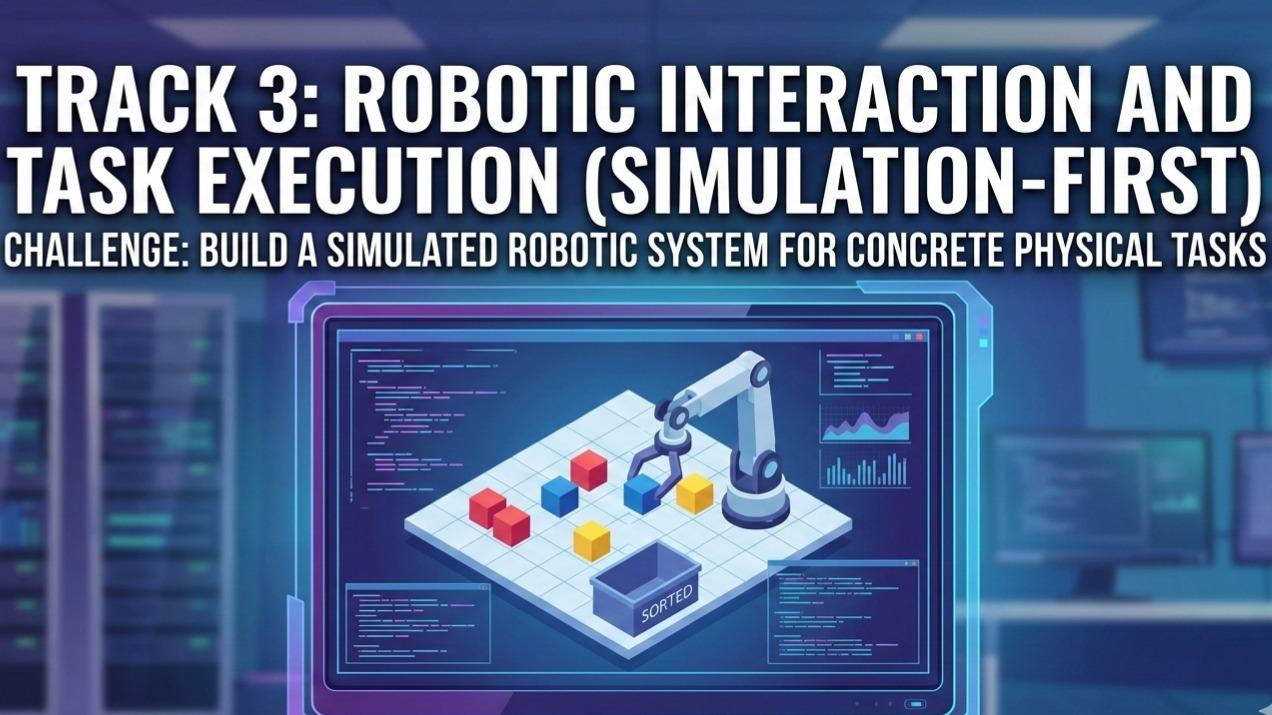
Track 3: Robotic Interaction and Task Execution (Simulation-First)
Challenge: Build a simulated robotic system that performs a concrete physical task through interaction with objects or its environment.
Examples include:
• Picking and placing objects
• Sorting or organizing items
• Simple assembly
• Structured interaction with the environment
Projects should focus on reliable task execution under different simulated conditions rather than perfect physics or overly complex scenarios. Solutions should demonstrate repeatability, basic failure handling, and clear performance metrics.
Technology
This edition is software-only and simulation-first. Your project should run entirely in simulation, digital twin environments, or as robotics tools/platforms — no physical hardware is required or expected.
You’re free to choose the stack you know best. The focus is on end-to-end value for a real user, not on any specific framework.
🧪 Software-only robotics
• Simulation-based – robots, environments, and behaviors running in a simulator
• Digital twins or virtual environments – modeled warehouses, factories, farms, buildings, etc.
• Robotics devtools / platforms – dashboards, orchestration, monitoring, analytics, CI/CD, or other software for robotics teams
If judges can open your app in a browser and see your product or simulation in action, you’re in the right place.
🦾 Robotics stack & simulation
• Frameworks: ROS / ROS 2 or your own robotics middleware
• Simulators: Gazebo / Ignition, Webots, Isaac Sim, Unity, Unreal, or similar
• Digital twins: simplified models of real-world spaces to demonstrate your use case (e.g., warehouse aisles, hospital corridors, fields)
Use whatever lets you show a realistic scenario for your “robotics startup” in software.
🧠 AI, perception & planning
• Vision models on simulated camera feeds (detection, tracking, segmentation, pose estimation)
• SLAM, mapping, localization, or navigation using simulated sensor data
• LLMs or agents for task planning, instruction-following, operator copilots, or workflow automation
• Rule-based or learned decision layers that decide what the robot(s) do next in sim
🎛 Control, orchestration & ops
Build the software layer that would actually run a robotics product:
• High-level control of single robots or fleets in simulation
• Task/job scheduling across multiple simulated agents
• Teleoperation UIs that control simulated robots
• Monitoring, logging, replay and debugging tools for simulated runs
🖥 Product & UX
Remember: this is a startup-focused challenge, not just a technical one. Think about the product experience:
• Operator dashboards and control panels (web apps)
• Analytics views and alerts for robotics teams or customers
• APIs and webhooks so other systems can integrate with your robotics product
⚠️ Important – Prize Eligibility Requirement:
To be eligible to win prizes, ALL teams must complete ALL of the following steps:
1. Post your final submission video on X (Twitter)
2. In the SAME post, tag BOTH:
3. Copy the link to the post
4. Paste the link into the official submission form
⚠️ Note:
Teams that do not complete all steps above will not be eligible to win prizes.
Technology Partners & Workshops

Vultr
powers the backend infrastructure for this hackathon. All projects must deploy a backend on
Vultr infrastructure
and use it as the central system of record for planning, coordination, and execution.
Build a
web-based robotics, simulation, or digital twin application deployed on Vultr. Your system should act as a centralized backend for planning, coordination, and operations in simulated or virtual robotics environments.
Projects should demonstrate multi-step, agentic or rule-based workflows, realistic future-of-work use cases, and a
production-style web application
— all running on Vultr infrastructure.
Simulation-first is encouraged. Physical robots are optional.
What We’re Looking For
AI / Backend on Vultr
• Deploy a VM-based backend on Vultr (mandatory)
• Vultr should be used as the central system of record and control, not just for static hosting
• Vultr Serverless Inference is optional for agentic or reasoning workflows
Robotics & Simulation Integration
• Strongly recommended (but optional)
• Use simulators, digital twins, or virtual environments
• Physical robots are optional
• Robots or simulations should communicate with your Vultr backend
Future of Work Focus
Address real operational challenges in industries such as:
• Warehousing & logistics
• Manufacturing & factories
• Healthcare & hospitals
• Retail & stores
• Construction & facilities
• Office operations & enterprise workflows
Show how software platforms + automation improve daily work.
Production-Ready Web Application
• Must be accessible via a public web browser
• Demonstrate a real product-style experience
• Clear user flows, not just a local demo
Key Positioning
• Vultr is the central backend powering your system
• Your application coordinates planning, workflows, and operations
• Focus on platform thinking, not just a one-off demo
Developer Expectations
Each team must provide:
✅ GitHub repository with setup and documentation
✅ Vultr VM backend deployment
✅ Public demo URL
✅ Recorded demo video
• Clear explanation of architecture and use case
Technology
Required
• Vultr VM backend
• Web application deployed on Vultr
Strongly Recommended
• REST or WebSocket APIs
• Simulation or digital twin integration
• Web dashboards for control and monitoring
Optional
• Vultr Serverless Inference (for agentic workflows or lightweight AI)
• Physical robots (simulation-first)
⚠️ Note: Vultr GPUs are not available for this event.
Resources:


Gemini is Google’s family of next-generation multimodal AI models designed to power intelligent, autonomous systems. Gemini can reason across text, images, code, video, and audio, making it well suited for building AI agents that perceive environments, plan actions, and adapt to changing conditions in robotics and simulation contexts.
Google AI Studio is a browser-based environment where developers can quickly explore and prototype with Gemini models. Teams can test prompts, refine outputs, and experiment with multimodal inputs before integrating Gemini into production workflows using the Gemini API.
Challenge:
Google supports this hackathon by providing AI tooling that teams can use to add intelligence, reasoning, and autonomy to their robotics and simulation systems.
Your project should demonstrate how AI agents powered by Gemini can analyze inputs, make decisions, and coordinate actions within simulated or virtual robotics environments.
Your solution should:
- • Use Gemini models (via Google AI Studio or the Gemini API) for reasoning, planning, perception, or multimodal understanding• Implement agent-driven or automated workflows that react to state, sensor data, or system inputs• Show how AI improves robot behavior, task execution, coordination, or system-level decision-making in simulation
Recommended Gemini Models:
Participants are encouraged to choose the Gemini model that best fits their use case.
- Gemini 3 Flash is optimized for speed and responsiveness. It is well suited for real-time applications such as reactive robot control, fast decision loops, environment monitoring, and interactive dashboards where low latency is critical.
- Gemini 3 Pro is designed for deeper reasoning and more complex cognitive tasks. It is ideal for agents that need to analyze longer contexts, plan multi-step behaviors, coordinate multiple agents, or evaluate performance across simulated scenarios.
Multimodal Commerce Examples:
Gemini’s multimodal capabilities enable advanced robotics and simulation use cases, such as:
- • Interpreting visual inputs from simulated cameras or environments to inform robot actions
- • Analyzing logs, telemetry, or sensor data to adapt behavior or detect failures
• Combining vision, text, and structured data to support planning, validation, or evaluation workflows
Access to Technology:
Participants can explore Gemini throughtwo main options - both include free access:
- 🌐 Google AI Studio: A free, browser-based IDE for experimenting with Gemini.Teams can write prompts, test outputs, adjust parameters, and prototype agent behavior without setting up billing or API keys. Ideal for rapid iteration during the hackathon.
- 💻Gemini API: For developers ready to integrate Gemini directly into their apps. The free tier includes a monthly allowance of tokens for text and multimodal inputs/outputs, letting you test and build with Gemini’s core models at no cost. Paid usage only applies for higher-volume or production-level apps.
- 🔓 Google Cloud Credits:
- New Google Cloud accounts receive $300 in free Google Cloud credits, valid for 90 days.
- These credits can be used across eligible Google Cloud services, including Gemini API usage, subject to Google Cloud’s standard terms and regional availability.
👉 Learn more about Google Cloud’s free tier
- Note: After the free credits are used or expire, continued usage of billable services requires enabling billing on your Google Cloud account. Charges only apply if you choose to continue using paid services.
🚀How to Get Started
1. Visit the Gemini docs
2. Follow the Quickstart Guide to explore Gemini in AI Studio
3. Experiment with text, code, images, video, or audio prompts
4. Build and test your multimodal agents or workflows
📘 Resources:
- • Gemini API models
- • Gemini 3 Developer Guide
- • Gemini API pricing & models docs
- • Gemini API billing FAQ & limits
- • Google AI Studio official overview
- • Google AI Studio quickstart
- • Antigravity
- • Embodied reasoning docs
Kiro
Kiro is an AI-powered development platform built on AWS infrastructure that helps developers quickly turn ideas into code and automated workflows. It provides AI-driven tools for task automation, code generation, and agent orchestration, making it ideal for hackathon projects that need rapid prototyping and intelligent agents.
Access to Technology:
Kiro will provide 500 bonus Kiro credits, on top of the standard 500 credits given to first-time users. These credits are sufficient to build a full hackathon-scale project.
• Credits are valid for one month
• Redeemable by up to 1,500 attendees
• Promo becomes active on Feb 6
Redeem Kiro Credits:
👉 Click here to redeem your Kiro credits
🚀 How to Get Started with Kiro
- 1. Open the redeem URL above (no installation required yet)
- 2. Sign in with GitHub, Google, or email
- 3. Credits will be automatically added to your account
- 4. Install Kiro and start building
📘 Resources:
⚠️ Important Notes:
• Kiro credits are subject to availability and terms
• lablab.ai is not responsible for credit delivery
• Participants are responsible for managing usage

NVIDIA
NVIDIA is supporting hackathon teams with access to cloud GPU credits and Isaac Sim, a powerful robotics simulation platform, to help teams prototype AI solutions faster.
Access to Technology:
• The first 200 team leaders to take action will receive $60 worth cloud credits for their teams.
• Credits provide access to Brev cloud instances and Isaac Sim launchables.
• Credits are valid for the duration of the hackathon.
🚀 How to Get Started:
• Credits provide access to Brev cloud instances and Isaac Sim launchables.
• Credits are valid for the duration of the hackathon.
🚀 How to Get Started:
-
Team
- 1. Create or sign in to a Featherless account
- 2. Redeem the provided coupon code
-
Explore the model catalog and integrate inference into your project
-
Team
📘 Resources:
⚠️ Important Notes:
• Only the first 200 team leaders will be able to claim credits.
• Each code is redeemable only once.
• lablab.ai and NVIDIA are not responsible for credit mismanagement.
• Only the first 200 team leaders will be able to claim credits.
• Each code is redeemable only once.
• lablab.ai and NVIDIA are not responsible for credit mismanagement.
🎓 Workshops
Get inspired and boost your skills with exclusive sessions from our partners and experts. Watch them anytime!
Speaker: Paul Ruiz - Developer Relations Lead: Embodied AI
Topic: Google DeepMind Tech Overview
Speaker: Joanna Slupczewska - Partnerships & Marketing Manager
Topic: AI & Robotics Hackathon Kick off Stream
Speaker: Sanskriti Harmukh - Junior Developer Relations
Topic: Supabase
👉 Read more about Supabase
Speaker: Rob Dahal - Developer Advocate | Agentic AI
Topic: Reading Emotions The Programming Way with Kiro & AWS
Speaker: Sanskriti Harmukh - Junior Developer Relations
Topic: Coolify
👉 Read more about Coolify
Speaker: David Yam - AI Solutions Architect, Alibaba Cloud International
Topic: Model Studio is your gateway to Qwen
⚠️ Disclaimer on $SURGE token: Surge Tokens ($SURGE) are NOT vested.
⚠️ Important – Prize Eligibility Requirement:
To be eligible to win prizes, ALL teams must complete ALL of the following steps:
1. Post your final submission video on X (Twitter)
2. In the SAME post, tag BOTH:
3. Copy the link to the post
4. Paste the link into the official submission form
⚠️ Note:
Teams that do not complete all steps above will not be eligible to win prizes.
Community & Social Channels
Stay connected with the teams behind the hackathon and follow along for updates, highlights, and future opportunities.
What to submit?
📋 Basic Information
• Project Title
• Short Description
• Long Description
• Technology & Category Tags
• Final Submission Video Link (X / Twitter – Required)
📸 Cover Image and Presentation
• Cover Image
• Video Presentation
• Slide Presentation
💻 App Hosting & Code Repository
• Public GitHub Repository
• Demo Application Platform
• Application URL
For further details and guidance, please visit Submission Guidelines
⚠️ Important – Prize Eligibility Requirement:
To be eligible to win prizes, ALL teams must complete ALL of the following steps:
1. Post your final submission video on X (Twitter)
2. In the SAME post, tag BOTH:
3. Copy the link to the post
4. Paste the link into the official submission form
⚠️ Note:
Teams that do not complete all steps above will not be eligible to win prizes.
Hackathon Details
Join lablab.ai hackathon and innovate using the latest models in the market. Discover all the relevant details below.
🗓️ Where and when
The start date of the hackathon is mentioned according to the date specified on the hackathon page, cover and schedule. The hackathon will take place on the lablab.ai platform and lablab.ai Discord server.
🦸🏼♂️ Who can join?
Everyone is welcome to participate, regardless of previous AI or coding experience! We encourage anyone with a passion for AI or an interest in exploring how it can be used in their field to join.
😅 What about teams?
If you don't have a team, don't worry! You can connect with other participants from all over the world on our dashboard or Discord server. We also recommend checking out our Discord server to find teammates and bounce around ideas. You can join the server here.
🛠️ How to participate
The hackathon will take place online on lablab.ai platform and lablab.ai Discord Server. Please register for both in order to participate. To participate click the "Enroll" button at the bottom of the page and read our Hackathon Guidelines and Getting Started Guide.
🧠 Get prepared / Use Lablab.ai to Learn About AI
To get ready for the hackathon, visit our AI Tech pages and read up on all the available technologies. You can also check out our tutorials page for more information on how to use them. Get a head start on your project by using the resources on lablab.ai!
Speakers, Mentors & Judges


Event Schedule
- To be announced
Winner Submissions 🏆
Submitted concepts, prototypes and pitches
Submissions from the teams participating in the Launch and Fund Your Own Startup-Edition 1 event and making it to the end 👊
.png&w=3840&q=75)


.png&w=3840&q=75)
.png&w=3840&q=75)


.png&w=3840&q=75)


.png&w=3840&q=75)








.png&w=3840&q=75)


.png&w=3840&q=75)


.png&w=3840&q=75)







.png&w=3840&q=75)




.png&w=3840&q=75)

Teams: Launch and Fund Your Own Startup-Edition 1
Check out the roster and find teams to join

.png&w=3840&q=75)
.png&w=3840&q=75)

Next Hackathon
AI Factory
Starts Aug 3, 2026