🤝 Top Collaborators
.png&w=640&q=75)
🤓 Latest Submissions
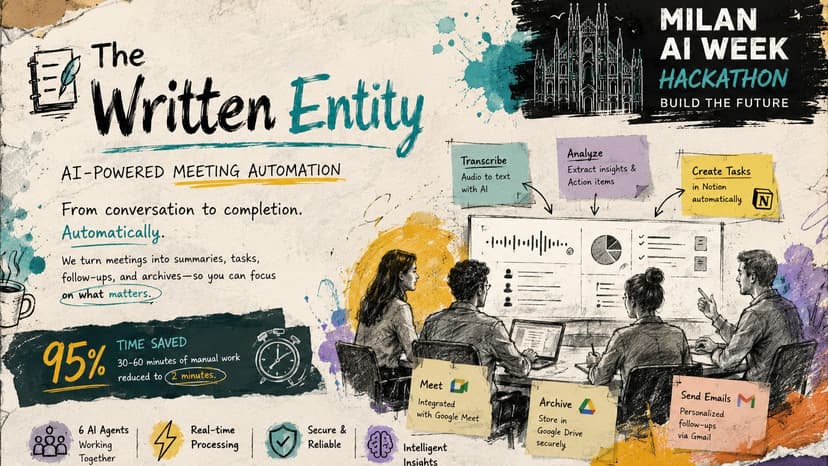
The Written Entity
The Written Entityis an AI-powered meeting automation platform that transforms conversations into actionable outcomes automatically. Instead of spending 30–60 minutes after every meeting on notes, summaries, tasks, emails, and documentation, teams can complete the entire workflow in under 2 minutes through intelligent automation. Built with a multi-agent architecture, the platform orchestrates six specialized AI agents that work together in real time: transcription, analysis, task generation, communications, archiving, and orchestration. The system converts meeting recordings and transcripts into structured insights, extracts action items, assigns ownership, drafts follow-up emails, and archives summaries automatically. The platform integrates deeply with Google Workspace (Gmail, Calendar, Drive, Meet), Notion, Supabase Authentication, and Gemini AI to create an end-to-end productivity ecosystem. Meetings become searchable knowledge assets rather than forgotten conversations. Tasks are automatically created in Notion, emails are generated through Gmail, and summaries are archived in Drive without manual effort. The Written Entity provides real-time pipeline tracking, live WebSocket updates, progress visualization, retry mechanisms, fallback processing, and robust error handling for production readiness. The system achieves up to **95% reduction in post-meeting workload, allowing teams to focus on execution instead of administration. Designed for product teams, engineering teams, executives, remote organizations, and collaborative workflows, The Written Entity turns meetings into action automatically.
19 May 2026
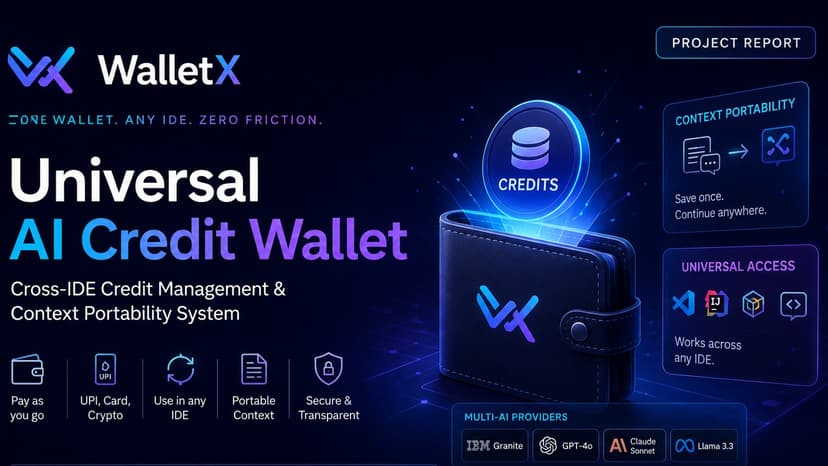
WalletX : Universal AI Credit Wallet
WalletX is a universal AI credit wallet and cross-IDE context management system built for the modern developer. It solves a critical pain point: developers using multiple AI-powered IDEs like Cursor, Windsurf, GitHub Copilot, and Antigravity must maintain separate subscriptions and lose context when switching between tools costing time, money, and productivity. WalletX introduces a single rechargeable credit wallet that works across all supported IDEs, eliminating vendor lock-in and redundant subscriptions. Developers recharge once using Stripe, Razorpay (UPI), or cryptocurrency, and spend credits freely across any integrated tool. With UPI support and a $1 minimum recharge, WalletX is specifically designed to be accessible to the 4.5 million Indian developers who are largely excluded from mainstream AI tooling due to payment barriers. Beyond payments, WalletX introduces Context Snapshots a first-of-its-kind feature allowing developers to save their full working context (code, conversation history, active files) and instantly restore it in any other supported IDE via a portable Secret Address. No more re-explaining your project every time you switch tools. The system comprises three production-ready components: a Node.js backend API with MongoDB, a Chrome MV3 extension with a full dark-theme UI, and a JavaScript SDK for IDE integration. Built in 7 days with IBM watsonx as the primary development accelerator, WalletX delivered a 6.4x productivity multiplier saving an estimated 56.5 hours of development time across 15+ documented AI sessions.
17 May 2026
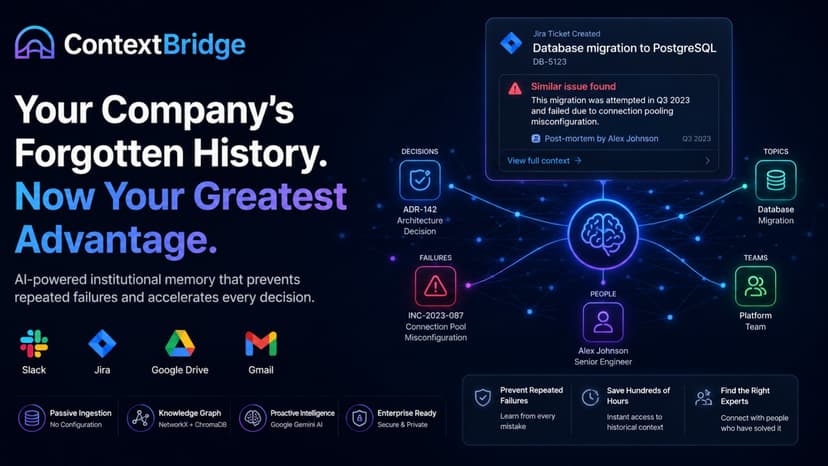
ContextBridge - Enterprise Institutional Memory AI
Every enterprise suffers from the same invisible crisis: institutional amnesia. When employees leave, their knowledge leaves with them. Teams repeat the same mistakes because nobody knows what was already tried and failed. New engineers spend weeks asking questions already answered in a Slack thread from two years ago. No existing tool solves this problem. ContextBridge is an AI-powered institutional memory agent that connects to enterprise communication tools Slack, Jira, Google Drive, Gmail, and meeting transcripts and builds a living knowledge graph of every decision, failure, lesson, and context inside the organization. It then proactively surfaces the right knowledge at the exact moment someone needs it, before damage is done. When an engineer creates a Jira ticket for a database migration, ContextBridge immediately warns: this migration was attempted in Q3 2023, it failed due to connection pooling misconfiguration, and here is the post-mortem from the engineer who led it. One warning like this can save months of wasted work. ContextBridge works in three layers. First, a passive ingestion engine connects to enterprise tools and extracts structured knowledge automatically without any user action. Second, a knowledge graph built with NetworkX and ChromaDB maps relationships between decisions, people, teams, and topics across time. Third, a proactive intelligence engine powered by Google Gemini detects when current work resembles past events and delivers actionable insights with source citations instantly. The system includes real integrations for Slack, Jira, Google Drive, and Gmail, a full REST API, a React TypeScript dashboard with D3.js graph visualization, and one-command Docker deployment. ContextBridge does not replace existing tools it becomes the intelligence layer on top of all of them.
19 May 2026
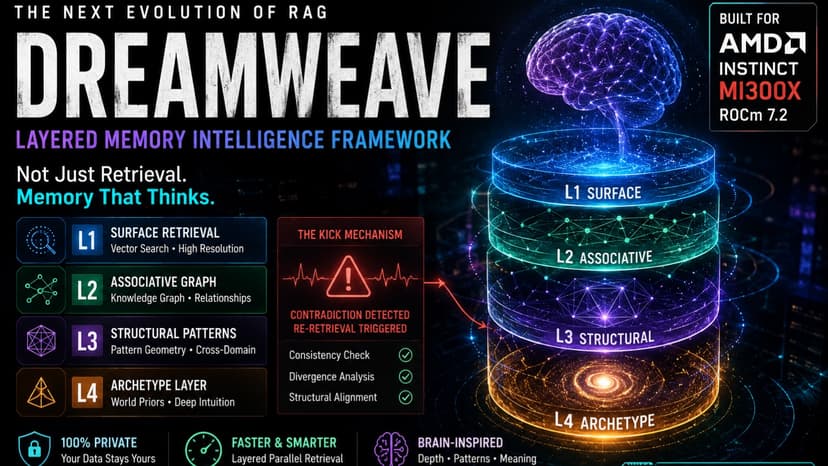
DREAMWEAVE: Layered Memory Intelligence Framework
DREAMWEAVE is a cognitive memory framework and layered retrieval middleware designed to transform how AI systems store, organize, retrieve, and reason over knowledge. Unlike traditional RAG systems that rely on flat vector similarity search, DREAMWEAVE introduces a multi-layered memory architecture inspired by neuroscience, structural reasoning, and the layered reality model from Inception. The framework operates through multiple cognitive layers. L1 handles high-resolution semantic retrieval using vector embeddings and depth-scored memory. L2 builds associative intelligence through dynamic knowledge graphs and entity relationships. L3 introduces DREAMWEAVE’s core innovation: Pattern Geometry Matching, allowing the system to retrieve information based on structural similarity instead of keywords alone. The architecture also includes the Kick Mechanism, an epistemic consistency system that detects contradictions between surface retrieval and structural reasoning, triggering automatic re-retrieval and self-correction before generation occurs. DREAMWEAVE is fully LLM-agnostic and integrates with GPT, Claude, Llama, Qwen, and other OpenAI-compatible models. The entire system runs on AMD Instinct MI300X infrastructure using ROCm and vLLM with zero external API dependency, enabling complete data sovereignty and high-performance local inference. By combining vector search, knowledge graphs, structural pattern matching, asynchronous orchestration, and contradiction-aware retrieval, DREAMWEAVE represents a new architecture for intelligent memory systems and next-generation AI reasoning infrastructure.
10 May 2026


