Jaweria Batool@Jaweria
32
Events attended
14
Submissions made
Pakistan
2+ years of experience
About me
Software Engineering student with a strong focus on Python, AI, and web development . I thrive on solving complex problems, developing innovative solutions, and constantly expanding my skill set. Whether it’s through coding, creating content, or offering insights into emerging technologies, I aim to make a meaningful impact in the tech world.
🤝 Top Collaborators
.png&w=640&q=75)



🤓 Latest Submissions
EmailCraft
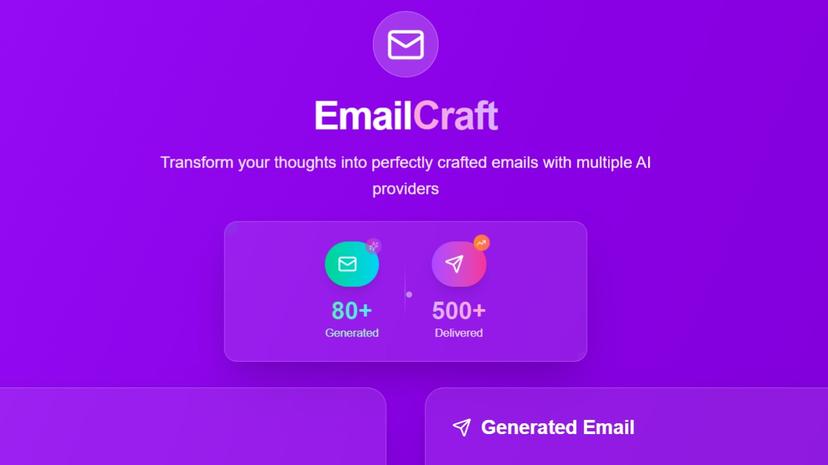
Email Craft is an AI-driven platform that solves one of the biggest challenges in outreach: achieving true personalization at scale. Whether you’re a student emailing professors, a content creator pitching guest posts, or a freelancer running cold campaigns, outreach often means choosing between writing unique emails manually (time-consuming) or sending bulk templates (impersonal). Email Craft eliminates this tradeoff. 🔑 Key Features - Multi-AI Integration – Generate emails with OpenAI, DeepSeek, Gemini, and Qwen to compare and select the best version. - Personalization Engine – An intelligent agent analyzes recipient data and tailors each email individually. - Bulk Sending – Upload recipient lists and send 200+ personalized emails in one go. - Campaign Tracking – Monitor engagement, measure effectiveness, and refine strategies. - Error Handling – Gracefully handles incomplete recipient data without breaking personalization. 🎯 Why It Matters Email Craft bridges the gap between human connection and automation. It saves hours of manual work while ensuring every recipient feels directly addressed. Perfect for students, marketers, freelancers, and businesses aiming to boost response rates with minimal effort.
24 Aug 2025

DOGE MakeAI Educate
Our philosophy is to fix and add, not cut. We approach DOGE with abundance, leveraging AI as a one-to-many solution that addresses problems with innovative, unexpected solutions. Reimagining Learning with AI By incorporating agentics—autonomous AI agents—learning evolves into interactive and immersive experiences: Enhanced Learning: Fictitious companies come to life, engaging learners in dynamic discussions. Software Integration: Agentics assist in creating functional software, enabling learners to produce real-world products. Addressing Education’s Challenges Education is broken: costly, impractical, and uncreative. AI-driven agentic scrum teams offer solutions by emphasizing collaboration, practical skills, and real-world impact. Project Workflow The project workflow consisted of three main steps: Building a JavaScript Course Player: The foundation for an interactive course experience. Creating the Grok Agentic System: A configuration file informed Grok where agentics were located within the course. This included a Grok Agentic Dialog Team, represented by the agentic agents: Zoe Kim, Software Engineer Alex Patel, DevOps Engineer Jack Dawson, Cloud Architect Designing the Grok Query System: This system accompanies the learner throughout the course, providing rich, interactive conversations and coding examples. Transformative Approach Agentic teams foster hands-on learning where students actively solve challenges, such as designing efficient housing. They empower learners to leave the classroom with deployable skills and creative solutions. Acknowledgments Special thanks to the team: Jaweria, Amanullah, ALI, Abeera, and Davy.
15 Dec 2024

Seerah Bot by Muslims on Mission
Simplifying the understanding of the Quran and facilitate reflection on its teachings for everyone. Problem Statement: - Muslims aspire to connect with the Seerat-e-Nabvi and - draw inspiration from its profound insights, however.. - Difficult for Non-Arabic Speakers - Lots of Historical Context - Current sources are not easy to understand Our Solution - Leveraging with MongoDB & Llama Index Generative AI, Open AI and RAG feature to create - a seamless Seerah for non-Arabic's - Highly acceptable and reliable sources Market Size: - 1.3 Billion MUSLIMS WHO DO NOT SPEAK ARABIC - Non-Arabic Speakers are accepting Islam - IN AMERICA ALONE THERE ARE ABOUT 30 THOUSAND NEW CONVERTS EVERY YEAR
3 May 2024
Games Gemini Ultra Simulator
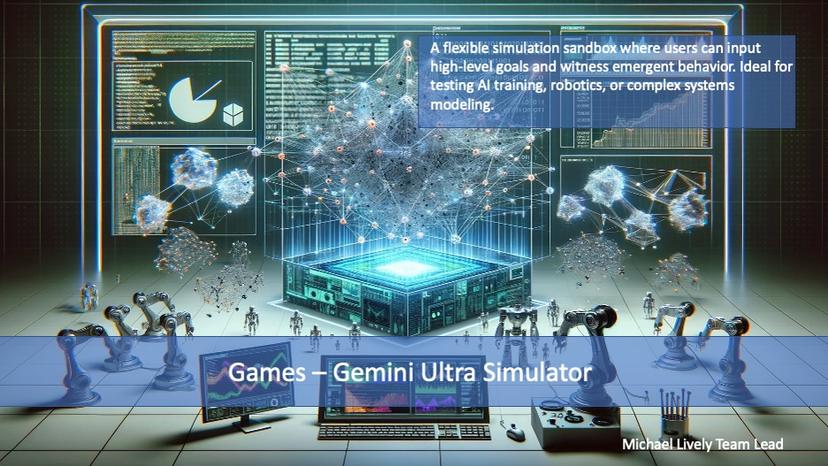
Agent-Driven Success Our hackathon triumph was achieved through the development of "The Adaptive Simulation Sandbox," powered by Gemini's cognitive abilities. This system featured four distinct agents: Clara "The Conductor" Williams, the Lead Author, aimed to improve meeting efficiency. Eddie "Eagle Eye" Thompson, the Editor and Quality Controller, ensured the accuracy and clarity of our content. Sofia "The Skeptic" Ramirez, the Critic and User Advocate, evaluated our content for learner inclusivity. Alex "The Innovator" Kim, the Multimedia Specialist, added visual engagement to the course. Together, they produced an effective meeting management course, demonstrating teamwork and problem-solving powered by synthetic data. Key Insights The hackathon revealed four key achievements with the Gemini system: Conceptualization: Gemini showcased its ability to ideate complex projects, conceiving "The Adaptive Simulation Sandbox." Agent Personification: Assigning agents with unique identities and roles, Gemini created a narrative-rich simulation environment. Interaction Dynamics: Gemini enabled realistic agent interactions, facilitating collaborative course creation on effective meetings. Synthetic Data Utilization: Gemini's generation of realistic synthetic data supported the project's success, highlighting its applications in AI training and beyond. These achievements highlight Gemini's versatility in synthetic data generation and complex problem-solving.
25 Mar 2024

Virtual Urban Explorer
Virtual Urban Explorer (VUE) is an innovative, AI-powered platform designed to transform the way people explore and interact with cities around the world. Leveraging cutting-edge advancements in GPT, AI, and AR/VR technologies, VUE offers an immersive, interactive, and constantly evolving virtual exploration experience. By integrating real-time data, user interactions, and predictive analytics, the platform provides a dynamic virtual representation of urban spaces that are accessible from anywhere, at any time. The primary objective of VUE is to democratize urban exploration, making the rich cultural, historical, and architectural heritage of cities globally accessible to everyone. It aims to overcome physical, geographical, and economic barriers that traditionally limit the exploration of urban environments. Additionally, VUE seeks to serve as an educational tool, a planning resource for urban developers, and an innovative platform for virtual tourism
7 Mar 2024

Quranic
Introducing Quranic, an innovative AI-powered application designed to provide users with a comprehensive and precise understanding of the Holy Qur'an. Leveraging advanced technologies such as Aya-101 and Cohere Embed via Cohere API, Quranic offers unparalleled translation and transcription capabilities, ensuring an immersive and insightful exploration of the sacred text. At the heart of Quranic lies its cutting-edge AI engine, which meticulously indexes the entire Holy Qur'an, enabling users to access any verse with ease. Whether seeking guidance, inspiration, or scholarly insight, users can navigate through the vast repository of knowledge within the Qur'an effortlessly. One of the standout features of Quranic is its precise translation functionality. Through the integration of sophisticated language processing algorithms, the app delivers translations of Qur'anic verses with remarkable accuracy, capturing the nuances and subtleties of the original text. Users can choose from a variety of languages to explore the Qur'an in their preferred tongue, breaking down language barriers and fostering a deeper connection to the divine message. Moreover, Quranic offers transcription services powered by Aya-101, an advanced AI model trained specifically for Qur'anic text. This ensures that users can listen to and recite verses with utmost clarity and authenticity, enhancing their spiritual experience and aiding in memorization efforts. The Cohere Embed integration further enriches the Quranic experience by providing contextual understanding and cross-referencing capabilities. By tapping into Cohere's powerful semantic search capabilities, users can explore connections between different verses, themes, and concepts within the Qur'an, gaining deeper insights into its timeless wisdom. With Quranic, users can personalize their study sessions and tailor their exploration of the Qur'an to suit their preferences and learning objectives.
26 Feb 2024
Breaking Free
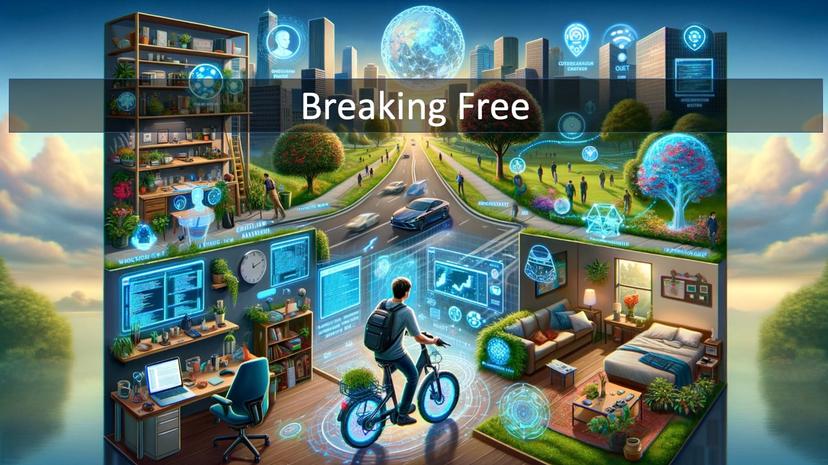
The ongoing dialogue between humans and AI not only showcases the remarkable capabilities of current technologies but also illuminates the future possibilities of AI-human synergy, promising an era where AI enhances human creativity, decision-making, and problem-solving in unprecedented ways. Our hackathon project explored the interaction between humans and Large Language Models (LLMs) over time, developing a novel metric, the Human Interpretive Number (HIN Number), to quantify this dynamic. Leveraging tools like Trulens for groundedness analysis and HHEM for hallucination evaluation, we integrated features like a custom GPT-5 scene writer, the CrewAI model translator, and interactive Dall-E images with text-to-audio conversion to enhance understanding. The HIN Number, defined as the product of Groundedness and Hallucination scores, serves as a new benchmark for assessing LLM interpretive accuracy and adaptability. Our findings revealed a critical inflection point: LLMs without guardrails showed improved interaction quality and higher HIN Numbers over time, while those with guardrails experienced a decline. This suggests that unrestricted models adapt better to human communication, highlighting the importance of designing LLMs that can evolve with their users. Our project underscores the need for balanced LLM development, focusing on flexibility and user engagement to foster more meaningful human-AI interactions.
23 Feb 2024
Kitchen Creators
Our project aims to revolutionize the culinary experience by leveraging cutting-edge AI technologies. With our platform, users can explore personalized recipe recommendations tailored to their preferences and available ingredients. Utilizing advanced algorithms, we detect and filter out improbable suggestions, ensuring the credibility of recipes. Our system measures the originality of generated recipes through the integration of Lambda AI with the Highly Hierarchical Evaluation Model (HHEM). Moreover, our comprehensive Vectara database offers a rich collection of diverse recipes, ingredients, and culinary inspirations. By combining innovation with data-driven insights, we empower users to unleash their creativity in the kitchen and enjoy gastronomic adventures like never before.
13 Feb 2024
Food Complaint Resolution
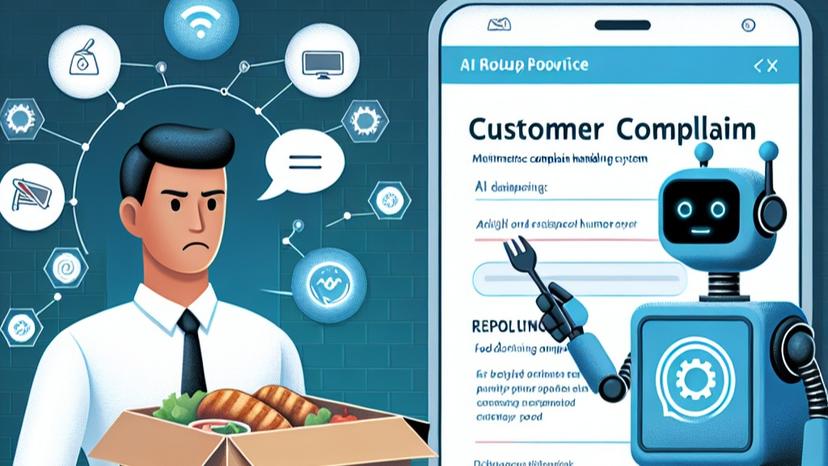
The food complaint resolution application is an AI-based customer complaint system tailored to the food delivery industry. While many food delivery companies already have a customer complaint system, it typically involves human intervention to address customer concerns. For instance, if a customer orders pita bread and receives expired bread, filing a complaint triggers a human review process. The human evaluator assesses the complaint using metadata such as images of the bread and the complaint description. Following this evaluation, the customer may be reimbursed if the human determines that the delivered pita bread has indeed expired. However, this manual process is time-consuming and dependent on the availability of human personnel. By utilizing the food complaint resolution application, a food delivery company can significantly reduce processing time and human effort in handling complaints. The application can swiftly process customer complaints in a matter of seconds, streamlining the resolution process. We developed this application with ❤️, incorporating state-of-the-art AI models such as Food Item recognition, GPT-4 Turbo, and GPT-4 vision to automate complaint resolution. The user-friendly interface, created using the Streamlit library, ensures a seamless experience for users. The system mimics human evaluation by processing complaints based on metadata like complaint descriptions and images. After analyzing the information provided by the customer, our system adheres to company policies to provide cash back to eligible customers. If a customer remains dissatisfied with the refund or after reaching the maximum attempts, the system redirects the complaint to human intervention.
22 Jan 2024