Top Builders

Explore the top contributors showcasing the highest number of app submissions within our community.

OpenAI Whisper

The Whisper models are trained for speech recognition and translation tasks, capable of transcribing speech audio into the text in the language it is spoken (ASR) as well as translated into English (speech translation). Whisper has been trained on 680,000 hours of multilingual and multitask supervised data collected from the web. Whisper is Encoder-Decoder model. Input audio is split into 30-second chunks, converted into a log-Mel spectrogram, and then passed into an encoder. A decoder is trained to predict the corresponding text caption, intermixed with special tokens that direct the single model to perform tasks such as language identification, phrase-level timestamps, multilingual speech transcription, and to-English speech translation.

General
Relese dateSeptember, 2020
AuthorOpenAI
Repositoryhttps://github.com/openai/whisper
Typegeneral-purpose speech recognition model

Start building with Whisper

We have collected the best Whisper libraries and resources to help you get started to build with Whisper today. To see what others are building with Whisper, check out the community built Whisper Use Cases and Applications.

Tutorials

Boilerplates

Kickstart your development with a GPT-3 based boilerplate. Boilerplates is a great way to headstart when building your next project with GPT-3.


Libraries

Whisper API libraries and connectors.


OpenAI Whisper AI technology Hackathon projects

Discover innovative solutions crafted with OpenAI Whisper AI technology, developed by our community members during our engaging hackathons.


Tattle Turtle

Tattle Turtle

"A second grader gets pushed at recess. She doesn't tell her teacher — she's embarrassed. She doesn't tell her parents — she doesn't want to worry them. By the time an adult notices, it's been three weeks. This happens in every school, every day. Tattle Turtle exists so no kid carries that alone. Tammy the Tattle Turtle is an AI emotional support companion running on a simulated Reachy Mini robot. Students walk up and talk to Tammy through voice. She listens, validates, and asks one gentle question at a time — max 15 words, non-leading language, strict boundaries between emotional triage and treatment. What makes Tattle Turtle different is what happens beneath the conversation. Every exchange is classified in real time into GREEN, YELLOW, or RED urgency. A bad grade vent stays GREEN — private. Recess exclusion mentioned three times this week? YELLOW — a pattern surfaces on the teacher dashboard that no human could track across 25 students. A student mentions being hit? Immediate RED alert — timestamp, summary, and next steps pushed to the teacher. The system comes to them when it matters. We built this on three sponsor technologies. Google DeepMind's Gemini API powers the conversational engine with structured JSON for severity and emotion tags. Reachy Mini's SDK provides robot simulation through MuJoCo with expressive head movements and audio I/O. Hugging Face Spaces serves as the deployment layer — one-click installable on any Reachy Mini in any classroom. Tammy's prompt engineering uses a layered 5-step framework ensuring she never crosses clinical boundaries, never suggests emotions to students, and never stores identifiable data. Privacy isn't a feature — it's a constraint baked into every layer. Tattle Turtle fills the gap between a child's worst moment and an adult's awareness. One robot. Every classroom. No kid left unheard."

RoboGripAI

RoboGripAI

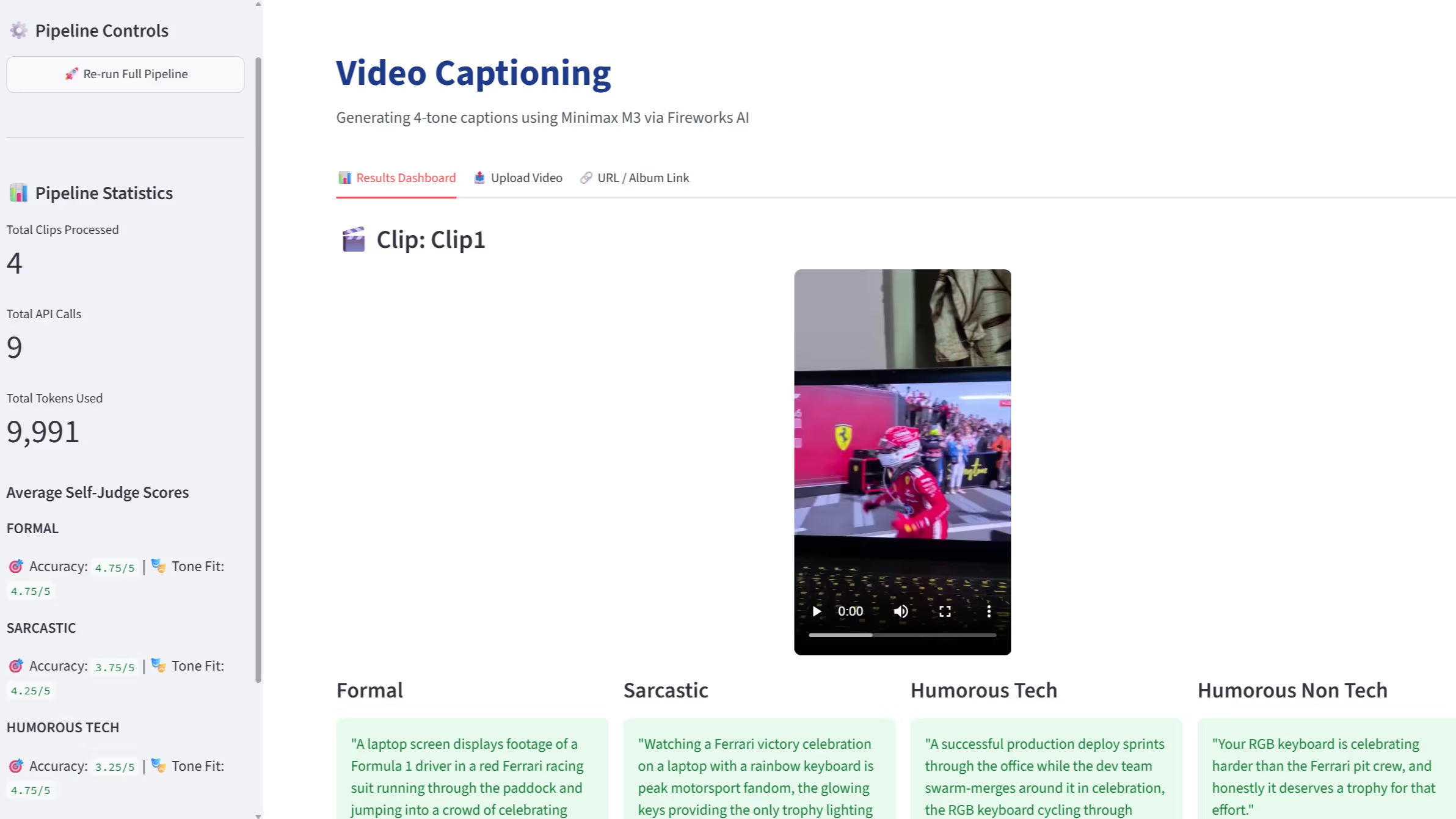
This project presents a simulation-first robotic system designed to perform structured physical tasks through reliable interaction with objects and its environment. The system focuses on practical task execution rather than complex physics modeling, ensuring repeatability, robustness, and measurable performance across varied simulated conditions. Simulation-first robotic system performing structured physical tasks such as pick-and-place, sorting, and simple assembly. Designed for repeatable execution under varied conditions, with basic failure handling, environmental interaction, and measurable performance metrics. A key emphasis of the system is reliability under dynamic conditions. The simulation introduces variations such as object position changes, minor environmental disturbances, and task sequence modifications. The robot is designed to adapt to these variations while maintaining consistent task success rates. Basic failure handling mechanisms are implemented, including reattempt strategies for failed grasps, collision avoidance corrections, and task state recovery protocols. The framework incorporates structured task sequencing and state-based control logic to ensure deterministic and repeatable behavior. Performance is evaluated using clear metrics such as task completion rate, execution time, grasp accuracy, recovery success rate, and system stability across multiple trials. The modular system design allows scalability for additional tasks or integration with advanced planning algorithms. By prioritizing repeatability, robustness, and measurable outcomes, this solution demonstrates practical robotic task automation in a controlled simulated environment, aligning with real-world industrial and research use cases. Overall, the project showcases a dependable robotic manipulation framework that bridges perception, decision-making, and action in a simulation-first setting, delivering consistent and benchmark-driven task execution.

ChartSeek AI Search for Trading Education Videos

ChartSeek AI Search for Trading Education Videos

ChartSeek: AI-Powered Trading Education Video Intelligence Traders face an overwhelming challenge: thousands of hours of educational videos, yet finding that moment explaining a "head and shoulders pattern" means scrubbing through endless footage. Traditional search fails because traders need to find visual chart patterns, not just spoken words. The Industry Gap Current video platforms offer only keyword search against titles and descriptions. Trading platforms like TradingView, Investopedia, and YouTube provide no way to search inside video content. Enterprise solutions cost $50K+ annually yet still can't match visual patterns. Traders waste hours rewatching purchased content, unable to locate specific setups. This gap costs traders their most valuable resource: time for analyzing live markets. How ChartSeek Bridges This Gap ChartSeek combines OpenAI's CLIP visual understanding with Whisper speech recognition. Unlike keyword search, ChartSeek understands what's visually on screen. Search "bullish engulfing on support" or "descending triangle breakdown"—and instantly jump to that exact frame, even if never explicitly mentioned by the instructor. The system transcribes spoken commentary, extracts representative keyframes, and generates visual embeddings. Searches query both transcript and visual index simultaneously, returning ranked results with confidence scores. Technical Foundation Built on TheAgenticAI's CortexON multi-agent framework with OpenAI Codex workflow architecture. Runs 100% locally using open-source models—zero API costs, complete privacy for proprietary strategies. Key Capabilities - Visual pattern search by description - Cross-modal text-to-image matching - Automatic timestamped transcription - Instant clip extraction ChartSeek delivers 90% reduction in search time, transforming passive video libraries into queryable intelligence. Less searching, more trading.

Qubic Liquidation Guardian

Qubic Liquidation Guardian

Qubic Liquidation Guardian is a hybrid Track 1 + Track 2 project built by CrewX that brings real-time liquidation protection, institutional-grade risk analysis, and automated alerting to the Qubic Network. The problem is simple: DeFi liquidations happen instantly, but users do not get instant signals. As a result, borrowers lose capital, protocols lose liquidity, and investors hesitate to adopt new systems without safety infrastructure. Inspired by this gap, Qubic Liquidation Guardian provides a complete safety layer over lending protocols deployed on the Nostromo Launchpad. At its core, the system includes an on-chain event listener and a real-time risk scoring engine, which analyzes: • Health Factor • Liquidation Proximity • Total Debt Exposure • Active Positions These metrics are combined into a 0–100 Risk Score, dynamically updated for each borrower. Based on the score, users are automatically classified into Low, Medium, High, and Critical risk tiers, enabling rapid decision-making. The platform also includes advanced features such as: • Whale Watch: Detect large-value transactions to anticipate market shifts • Smart Alerts: Severity-based notifications connected to any tool • Auto-Airdrop: Rewards for users who resolve high-risk positions • Crash Simulator: A built-in testing environment to simulate -70% market dumps, rebounds, and full resets to verify protocol safety Qubic Liquidation Guardian is designed to strengthen the Nostromo ecosystem by improving investor confidence, increasing protocol safety, and enabling risk-aware liquidity management. With over 35 production-ready API endpoints, an edge-distributed database, and a Next.js 15 architecture, the application is fully deployable and already live for testing. Ultimately, this project delivers exactly what new chains and protocols need: speed, stability, transparency, and automation—making Qubic safer for everyone.

Ubuntu-Patient-Care IBM agent core

Ubuntu-Patient-Care IBM agent core

THE UBUNTU REBELLION: Fighting a Moral Failure with Agentic AI ​The Problem: A Moral Failure in Healthcare ​Judges, we are here today not just to showcase code, but to challenge a fundamental injustice. The current healthcare system, dominated by corporate oligopolies, is built on planned obsolescence and vendor lock-in. We witness perfectly functional medical equipment deemed "end of life" and scrapped as e-waste, while millions of our loved ones in remote or underserved clinics go without care. This is not a business problem—it is a moral failure. ​Beyond the hardware, administrative overhead is crippling. In South Africa, billions are wasted annually as dedicated doctors and nurses spend countless hours performing soul-crushing administrative tasks—logging into dozens of disparate medical scheme portals, manually transcribing data, and battling complex claims forms. Every minute spent on paperwork is a minute stolen from patient care. ​The Ubuntu Patient Care movement exists to say: Enough. We are building a free, open-source medical system that puts humanity first. Our solution, powered by the intelligence of Granite and the orchestration of IBM watsonx Orchestrate, is the force multiplier that makes this rebellion sustainable. ​The Strategy: Offline-First Agentic Supremacy ​Our core competitive advantage, the feature that no oligopoly system can replicate, is our Offline-First, Zero-Barrier-to-Entry design. We use Agentic AI to eliminate the three largest frictions in medical system adoption: Administration, Security, and Deployment.