Top Builders

Explore the top contributors showcasing the highest number of app submissions within our community.

GPT4All

GPT4All is an open-source ecosystem of on-edge large language models that run locally on consumer-grade CPUs. It offers a powerful and customizable AI assistant for a variety of tasks, including answering questions, writing content, understanding documents, and generating code.

GPT4All is supported and maintained by Nomic AI, which aims to make it easier for individuals and enterprises to train and deploy their own large language models on the edge.

General
Release date2023
AuthorNomic AI
TypeNatural Language Processing

Start building with GPT4All

To start building with GPT4All, visit the GPT4All website and follow the installation instructions for your operating system.


GPT4All Libraries

A curated list of libraries to help you build great projects with GPT4All.


GPT4All Examples


For more information on GPT4All, including installation instructions, technical reports, and contribution guidelines, visit the GPT4All GitHub repository.

NomicAI gpt4all AI technology Hackathon projects

Discover innovative solutions crafted with NomicAI gpt4all AI technology, developed by our community members during our engaging hackathons.
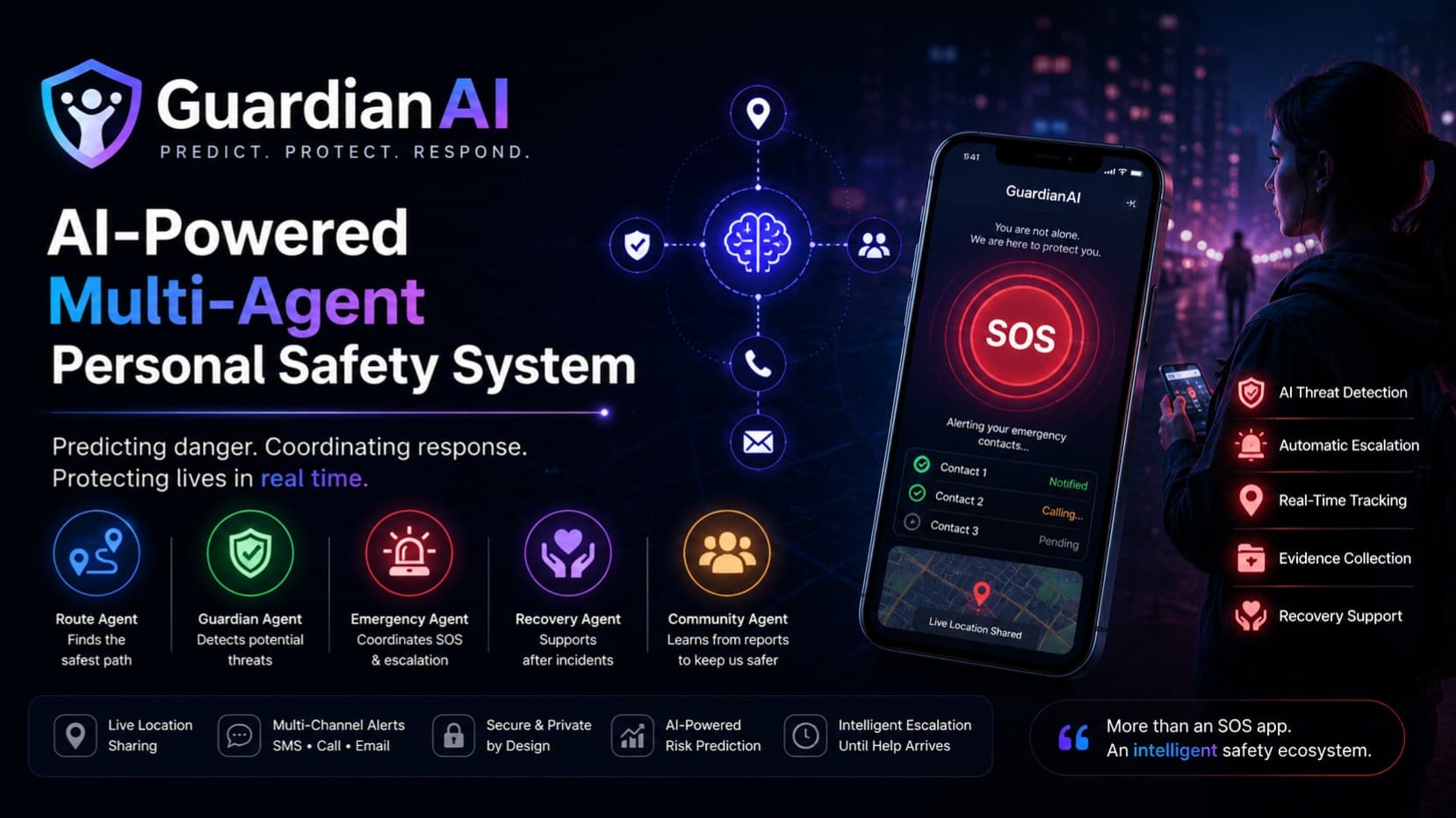
GuardianAI: AI-Powered Multi-Agent Safety System

GuardianAI: AI-Powered Multi-Agent Safety System

GuardianAI is an AI-powered multi-agent personal safety platform designed to provide intelligent assistance before, during, and after emergency situations. Unlike traditional SOS applications that send a single alert and stop, GuardianAI coordinates multiple specialized AI agents to deliver continuous situational awareness and emergency response. The platform consists of five collaborative agents. The Route Agent recommends safer travel routes, the Guardian Agent analyzes potential threats and user context, the Emergency Agent coordinates SOS activation and intelligent escalation, the Community Agent learns from community-reported incidents to identify unsafe locations, and the Recovery Agent provides post-incident guidance and maintains a complete incident timeline. When an emergency is triggered, GuardianAI securely records the incident, shares the user's live location, and automatically notifies trusted emergency contacts through multiple communication channels including SMS, voice calls, and email. If the first contact does not respond within a configurable time, the system automatically escalates the alert to the next emergency contact until someone acknowledges the incident. Throughout the emergency, live location updates, evidence management, and incident tracking continue to provide responders with accurate and up-to-date information. Built using FastAPI, Python, HTML, CSS, JavaScript, and modern AI technologies, GuardianAI follows a modular architecture that enables scalability, reliability, and future expansion. The backend incorporates API authentication, rate limiting, secure evidence handling, and input validation to enhance security and protect user data. Our long-term vision is to evolve GuardianAI into a comprehensive AI safety ecosystem by adding offline SOS capabilities, wearable device integration, push notifications, WhatsApp alerts, predictive crime analytics, and deeper collaboration with emergency response services. .

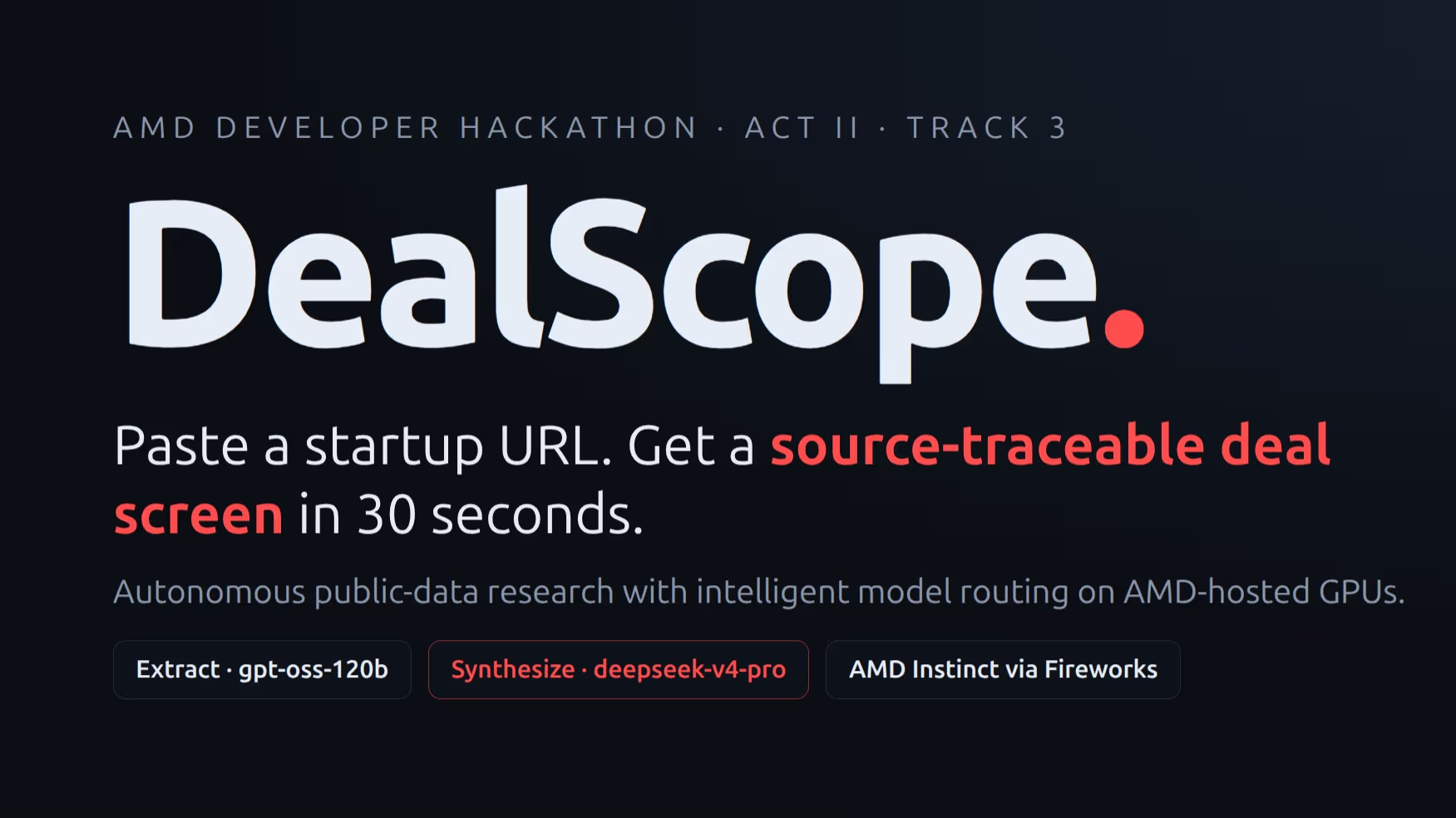
DealScope

DealScope

**The problem.** Angel investors, VC scouts, and accelerator reviewers screen 20–50 startups a month. Before the first meeting they have no tooling — just Google and gut. The only question that matters is "is this worth a call?", and nothing answers it fast. **What DealScope does.** Paste a company's URL. Autonomous agents read its public footprint — website, GitHub activity, public hiring boards — and return a structured deal screen: a verdict (Worth a call / Borderline / Pass), a risk matrix, bull and bear cases, and a confidence score. **Every claim links to the public source it came from**, so you can click and verify it yourself. The one model-opinion section (market) is labeled as such — we never fake a source. That's the difference from pasting a URL into ChatGPT: no hallucinations you can't check. **How it uses AMD — the cost engine.** Screening one company means reading 100+ pages, which is a lot of LLM calls. DealScope routes across two AMD-hosted models on Fireworks: a cheap model (gpt-oss-120b) does the high-volume extraction, and a premium model (deepseek-v4-pro) writes only the final verdict. A naive pipeline that uses the premium model for everything costs ~3.6× more. The cost-race is shown live and computed from real token counts × published Fireworks rates — the hackathon's token-efficiency thesis shipped as a product, on AMD Instinct silicon. **Built for real.** One FastAPI container serves the API and a streaming instrument-panel UI over Server-Sent Events. Runs can be recorded and replayed. 33 unit tests plus a golden-company integration harness. MIT-licensed and public on GitHub. A gallery of eight real company screens ships in the repo and replays instantly. **Who it's for.** ~300,000 US angels are untooled for the pre-meeting screen, plus micro-VCs, scouts, and accelerator reviewers. DealScope is the 30-second "worth a call?" — with receipts.

Band Review Board: Multi-Region Ad Compliance

Band Review Board: Multi-Region Ad Compliance

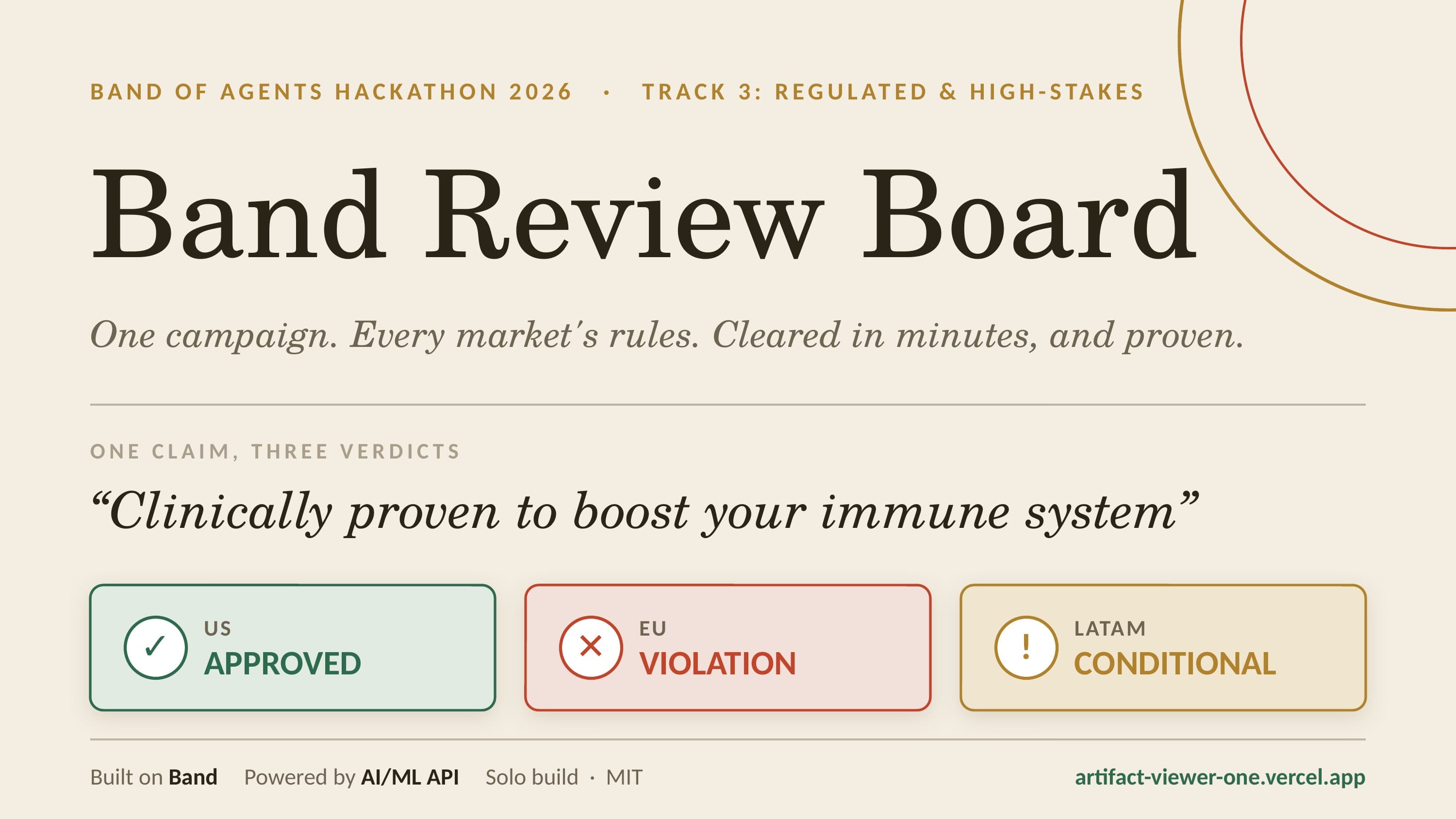
Global brands ship one campaign to many markets, and the same claim can be legal in the US and a violation in the EU, where fines reach 4 to 10% of global revenue. Today the only defense is slow, market-by-market legal review with no audit trail. Band Review Board replaces that with a room of 10 specialist agents that clears a campaign against every market's rules at once. It is not a pipeline that merges a checklist of flags. The agents hold competing mandates, claims, regulation, and brand, and they argue. Region reviewers hold or concede on the record, a mediator brokers the conflict, and a human rules only on the genuine gray area, with that ruling logged as precedent. It runs on Band as the real coordination layer, not a wrapper. Agents @mention each other to object and rebut between specific parties, the room summons the next specialist, and finally a human, with addParticipant only when a conflict will not resolve, and every finding and verdict posts to a shared live ledger with sendEvent. Take Band out and it stops working. Every agent runs the model that fits its job through one AI/ML API gateway: GPT-5, Gemini 2.5 Pro and Flash, Claude Opus, Sonnet, and Haiku, Llama via Featherless, DeepSeek, and Nano Banana for image regeneration. Cost scales with difficulty: cheap models do the back-and-forth and Opus is spent only on a deadlock. It is also multimodal, reading the video and hearing the audio. In the live demo, the claim "clinically proven to boost your immune system" is approved in the US, a violation in the EU, and conditional in LATAM. The room genuinely deadlocks and escalates to a human. Nothing is hard-coded. Try it live at artifact-viewer-one.vercel.app. Solo build, MIT licensed.

VitalFlow AI: Intelligent Care Coordination

VitalFlow AI: Intelligent Care Coordination

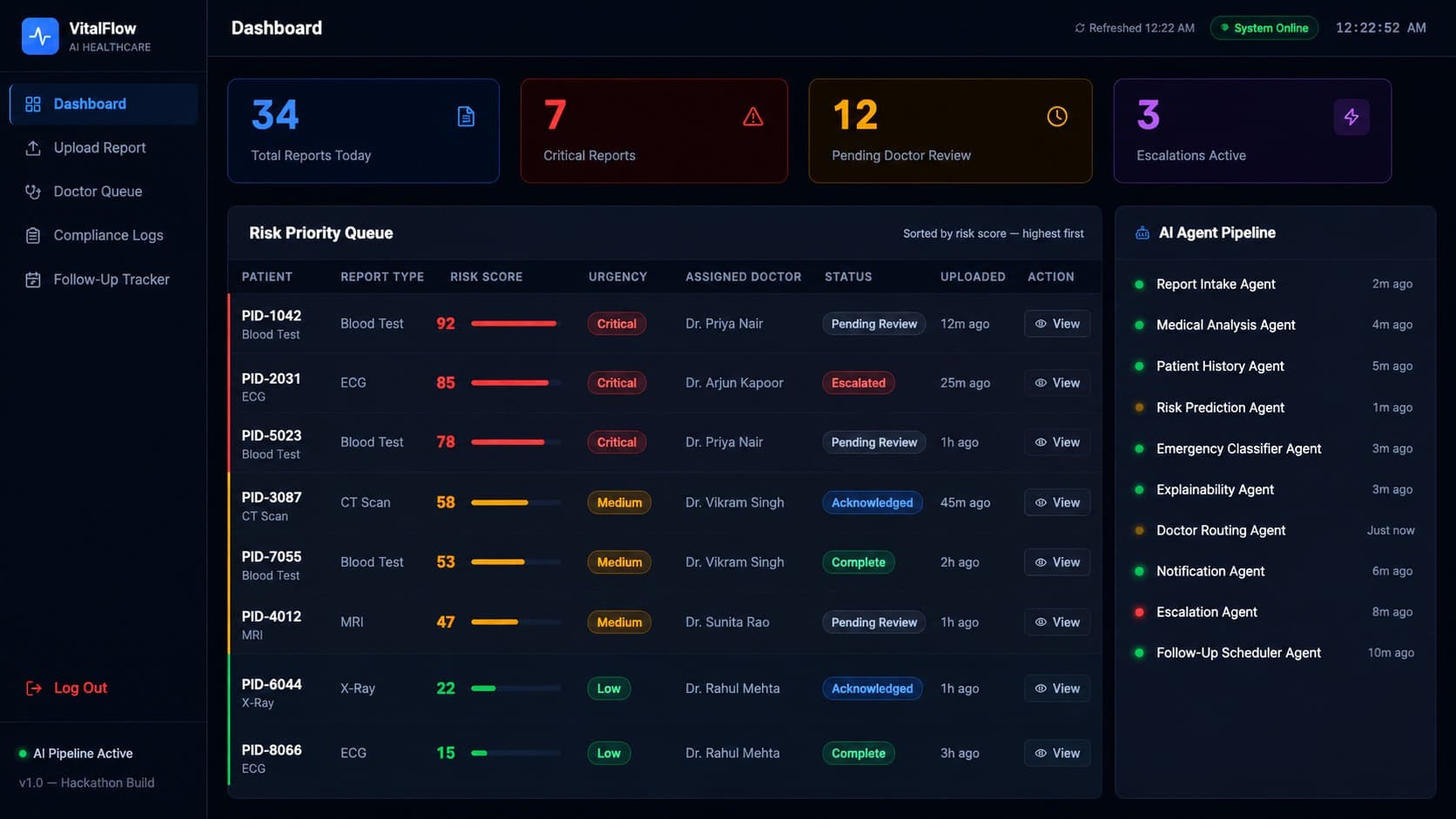
VitalFlow AI is a Band-powered Multi-Agent Clinical Intelligence System designed to transform clinical reports into timely care decisions. Healthcare institutions often struggle with delayed identification of critical cases, manual report triaging, inefficient doctor assignment, missed follow-ups, and compliance tracking challenges. VitalFlow AI addresses these problems through a collaborative network of specialized AI agents that automate the entire report-to-care workflow. The platform processes diagnostic reports, extracts medical findings, evaluates patient risk, prioritizes urgent cases, routes patients to the most suitable specialists, generates explainable recommendations, schedules follow-ups, and tracks compliance activities. The system consists of 10 specialized AI agents: • Report Intake Agent • Medical Analysis Agent • Patient History Agent • Knowledge Retrieval Agent • Risk Prediction Agent • Emergency Classification Agent • Explainability Agent • Doctor Routing Agent • Notification Agent • Follow-Up Scheduler Agent Key Features: • AI Risk Assessment • Intelligent Doctor Routing • Explainable AI Decisions • Follow-Up Management • Compliance Monitoring • Escalation Management Technology Stack: Frontend: Next.js, TypeScript, Tailwind CSS Backend: FastAPI, Python Database: MongoDB Deployment: Vercel & Render AI Layer: Band Framework Multi-Agent Architecture Impact: • Faster report processing • Better prioritization of critical patients • Reduced manual workload • Improved care coordination • Enhanced compliance visibility VitalFlow AI enables hospitals, doctors, administrators, and patients to benefit from a smarter, faster, and more transparent healthcare workflow.

GPT4All