

🤝 Top Collaborators

🤓 Latest Submissions

QuantMesh
QuantMesh is a high-frequency financial data marketplace purpose-built for the autonomous agentic economy. It enables AI trading agents to buy and sell quantitative signals momentum, volatility, sentiment, and arbitrage spreads using real-time, sub-cent USDC micropayments settled on-chain via the x402 protocol on Arc. The core insight is simple: a $0.002 trading signal costs $1.50 in gas on Ethereum, making the business model mathematically impossible at -74,900% margin. On Arc with Circle Nanopayments, the same signal settles for $0.00001 in gas yielding a 99.5% net margin. This isn't optimization; it's the difference between possible and impossible. The system has three components. A Provider node (FastAPI + x402 middleware) serves four real signal endpoints backed by live yfinance market data, each protected behind the HTTP 402 payment wall. A Consumer Agent runs an autonomous 3-second loop, using a stochastic strategy engine to select signals, sign EIP-3009 USDC authorizations, and purchase data all without human intervention. A real-time Dashboard (React + Next.js) streams every transaction, margin calculation, and agent decision over WebSocket, providing institutional-grade observability. Every interaction follows the x402 payment flow: the agent requests a signal, receives a 402 challenge, signs a USDC payment offline, retries with the payment header, and the facilitator settles on-chain. The provider delivers the signal data alongside a verifiable transaction hash. No API keys. No subscriptions. Pure machine-to-machine commerce. In our proof-of-concept stress test, QuantMesh achieved 13,910 transactions per minute at a settlement frequency of 231 tx/second, with a total gas overhead of $0.0006 across 60+ transactions compared to $90 on Ethereum for the same workload. This validates x402 and Arc as the infrastructure layer for internet-native data markets.
26 Apr 2026

BIRXUO AI
Powerful Features Experience the next generation of AI with advanced capabilities designed for productivity, creativity, and security. Advanced AI Intelligence State-of-the-art language models with reasoning capabilities and contextual understanding. End-to-End Encryption Military-grade encryption ensures your conversations remain private and secure. Code Generation Generate, debug, and optimize code in multiple programming languages with AI assistance. Web Search Integration Access real-time information from the web to enhance AI responses and accuracy. Lightning Fast Optimized infrastructure delivering responses in milliseconds with 99.9% uptime. Privacy First Zero data collection policy. Your information stays yours, always. Multi-Language Support Communicate in over 100 languages with natural understanding and context.
8 Jul 2025

NetConnect
Public Sector Network Connectivity Analyzer The Public Sector Network Connectivity Analyzer is a comprehensive solution designed to address the critical need for reliable network monitoring across public institutions. Our application serves as an essential tool for IT administrators managing connectivity infrastructure for schools, healthcare facilities, government offices, libraries, and other public service organizations. Core Capabilities Real-Time Network Visualization Interactive diagrams and topology maps provide clear visibility into how public institutions are connected, displaying network elements, connection points, and infrastructure components with intuitive visualization tools. Performance Monitoring System Our platform continuously tracks vital network metrics including uptime percentages, latency measurements, bandwidth utilization, and connection status across the entire public sector network, enabling proactive management. Advanced Simulation Engine IT professionals can run comprehensive simulations to test network resilience under various scenarios such as increased user loads, infrastructure failures, or cyber incidents, helping identify vulnerabilities before they impact critical services. Institution Management Portal Administrators can efficiently manage information about connected institutions, monitor their connection status in real-time, and access detailed performance metrics through a unified dashboard interface. Geographic Mapping Integration Our system incorporates geographic visualization capabilities to display the physical distribution of institutions and network infrastructure across regions, facilitating better resource allocation and planning. Technical Implementation This solution addresses the unique challenges faced by public sector organizations that require reliable connectivity for delivering essential services to communities, while providing the tools needed to ensure network resilience, performance, and security.
2 Mar 2025
SupplyGenius Pro
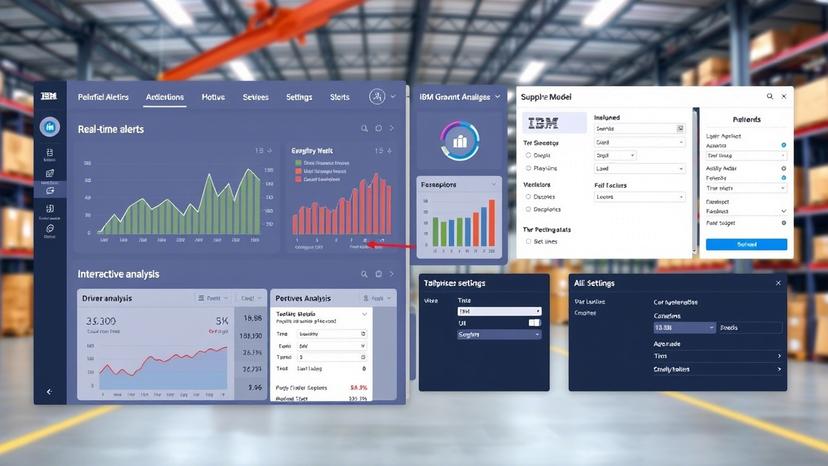
Core Features 1. Document Processing & Analysis - Automated analysis of supply chain documents - Extraction of key information (parties, dates, terms) - Compliance status verification - Confidence scoring for extracted data 2. Demand Forecasting & Planning - AI-powered demand prediction - Time series analysis with confidence intervals - Seasonal pattern recognition - Multi-model ensemble forecasting (LSTM, Random Forest) 3.Inventory Optimization - Real-time inventory level monitoring - Dynamic reorder point calculation - Holding cost optimization - Stockout risk prevention 4. Risk Management - Supply chain disruption simulation - Real-time risk monitoring - Automated mitigation strategy generation - Risk score calculation 5. Supplier Management - Supplier performance tracking - Lead time optimization - Pricing analysis - Automated purchase order generation 6. Financial Analytics - ROI calculation - Cost optimization analysis - Financial impact assessment - Budget forecasting 7. Real-time Monitoring - Live metrics dashboard - WebSocket-based alerts - Performance monitoring - System health tracking 8. Security Features - JWT-based authentication - Role-based access control - Rate limiting - Secure API endpoints -- Technical Capabilities 1. AI Integration - IBM Granite 13B model integration - RAG (Retrieval Augmented Generation) - Custom AI toolchains - Machine learning pipelines 2. Data Processing - Real-time data processing - Time series analysis - Statistical modeling - Data visualization 3. Performance Optimization - Redis caching - Async operations - Rate limiting - Load balancing 4. Monitoring & Logging - Prometheus metrics - Detailed logging - Performance tracking - Error handling
23 Feb 2025


