Top Builders

Explore the top contributors showcasing the highest number of app submissions within our community.

Kraken WebSocket API

The Kraken WebSocket API provides event-driven, real-time access to Kraken's spot and futures markets. Version 2 (v2) is the current API, offering public feeds for market data (no authentication required) and private authenticated feeds for account events and order management. WebSocket v2 consolidates order status and fill events into a single executions channel, replacing the separate streams from v1.

General
DeveloperKraken (Payward Inc.)
TypeWebSocket API (real-time streaming)
LicenseCommercial API (free with Kraken account)
Documentationdocs.kraken.com
GitHubkrakenfx/api-go

Core Features

  • Public feeds (no auth): ticker, order book (L2), and trade streams available without a Kraken account.
  • Private authenticated feeds: execution events, balance updates, and order management.
  • Configurable order book depth: 10, 25, 100, 500, or 1,000 levels with CRC32 checksum for integrity verification.
  • Level 3 data: per-order orders channel (authenticated) for full depth-of-market.
  • Multi-symbol subscriptions: subscribe to multiple instruments in a single message.
  • Request/response correlation: req_id field for matching responses to requests.
  • Futures support: separate WebSocket endpoint for futures market data and order management.

Endpoints

EndpointURL
Public (spot, v2)wss://ws.kraken.com/v2
Private (spot, v2)wss://ws-auth.kraken.com/v2
Futureswss://futures.kraken.com/ws/v1
Colocation (spot)colo-london.vip-ws.kraken.com

Public Channels

ChannelDescription
tickerBest bid/offer, last trade price, 24h OHLCV, VWAP, and price change percentage
bookAggregated order book (L2) with configurable depth and CRC32 integrity checksum
tradeTrade events with side, quantity, price, order type, trade ID, and RFC3339 timestamp

Snapshots are sent on subscription by default ("snapshot": true). The ticker channel supports "bbo" (best bid/offer changes) or "trades" as the event trigger.


Private Channels (Authenticated)

ChannelDescription
executionsOrder status updates and fill events (replaces v1 openOrders and ownTrades)
balancesAccount balance changes in real time
User TradingAdd, amend, and cancel orders via WebSocket without a REST roundtrip

Authentication for private feeds:

  1. Call GET /0/private/GetWebSocketsToken via REST using your API credentials
  2. Use the returned token (valid 15 minutes) in the subscribe message
  3. Include the token as: {"event": "subscribe", "subscription": {"name": "...", "token": "..."}}

Tools and Resources


Ecosystem and Integrations

  • Rate limits are shared across REST, WebSocket, and FIX for the same API key.
  • Colocation endpoints are available via the Beeks Group for institutions requiring sub-millisecond access.
  • Commercial redistribution of market data streams requires prior approval from marketdata@kraken.com.
  • The official Go SDK supports both Spot and Derivatives WebSocket under a single import.

Subscribe to public feeds immediately at wss://ws.kraken.com/v2 without any authentication. For private feeds, generate a WebSocket token first via the REST token endpoint.

kraken Kraken Websocket api AI technology Hackathon projects

Discover innovative solutions crafted with kraken Kraken Websocket api AI technology, developed by our community members during our engaging hackathons.
ATRIO Boardroom

ATRIO Boardroom

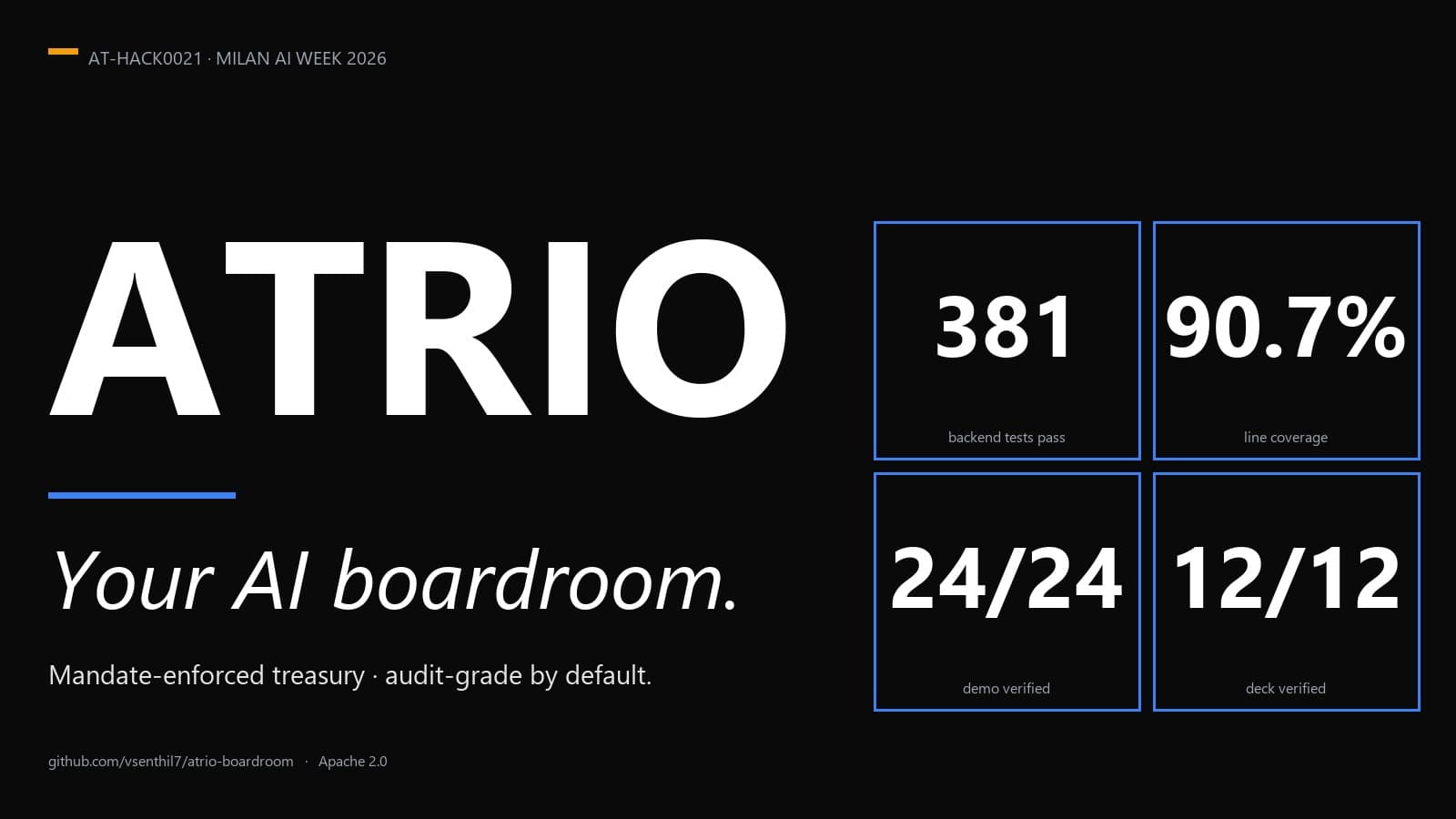
**Founders and family offices decide alone.** Big calls get either delegated to a single advisor (fast, single point of failure) or convened with a committee (slow, hard to schedule, hard to audit). ATRIO Boardroom is the middle option: an AI boardroom that holds a real debate, enforces a per-tenant mandate at machine speed, and replays every decision in six months. ## Try the live demo **URL:** http://45.77.52.54:8080 (Vultr, Frankfurt) Click **Demo founder** on the sign-in screen — one click, no email — then type a boardroom question. Watch 5 specialist AI agents stream real Gemini 2.5 reasoning live, ~25 s. Go to Treasury, propose a SHV-xStock buy, try to self-second-sign (API refuses), open a new tab as **Demo CEO**, second-authorise, trade executes against Kraken paper. Download the board-pack PDF. Open the audit log. Six minutes, full lifecycle. ## The wedge - **Debate**, not consensus-on-rails. Six personas with distinct system prompts, distinct model assignments (Gemini 2.5 Flash for specialists, 2.5 Pro for Counsel), and dissent-driven turn-taking. - **Enforce**, at the API. A per-tenant `Mandate v1` (permitted instruments, daily loss limit, single-instrument max, permitted side) is the only path to a treasury action. Two-party auth cannot be bypassed by the UI. - **Audit**, by default. Every turn, vote, model call, and state transition writes to an append-only log. Exportable as JSONL + manifest. ## Why this isn't slideware - **381 / 381** backend tests pass at **90.68 %** coverage - **24 / 24** demo-video structural + **14 / 14** OCR verification - **54 / 54** pitch-deck structural + **12 / 12** OCR verification - **5 / 5** live multi-agent debate against real Gemini in ~25 s (no mocks) - **19** real bugs found and root-caused during the sprint ## Sponsors used Vultr · Google Gemini · Featherless · Speechmatics · Kraken xStocks · LiveKit. License: Apache 2.0.

ATLAS - Enterprise Multi-Agent Governance

ATLAS - Enterprise Multi-Agent Governance

ATLAS is an enterprise multi-agent system where every agentic decision is inspected, signed, and auditable. THE PROBLEM Goldman Sachs CIO said publicly: "We don't know what controls we need for agentic AI." Enterprise LLM agents make decisions affecting databases, APIs, financial records. There is no infrastructure that makes these decisions inspectable, auditable, and compliant. WHAT ATLAS DELIVERS - 29/29 scientific test suite PASS in under 1 second - All 5 sponsors integrated end-to-end (real API calls, not mocked): · Speechmatics for voice transcription · Featherless for open-source model routing (MiniMax-M2.5, DeepSeek-V3.2, Kimi-K2.5, Llama-3.3-70B) · Google Gemini 2.0 Flash for orchestration and synthesis · Vultr for infrastructure layer · Kraken for financial action layer - SOUF AI DPI inline governance: every prompt inspected in 0.079ms avg (well under 1ms ceiling) - Ed25519-signed audit chain with SHA-256 Merkle tamper-evidence - 8 signed records per full pipeline request, chain verified - Isaac Adams (Featherless judge): "confidence is what enterprise AI needs" — ATLAS is that confidence layer ARCHITECTURE 6-layer governed pipeline: Voice → Speechmatics → SOUF AI DPI gate → Gemini orchestrator → Featherless router → Tool executor (Search/Database/Kraken/Vultr) → Ed25519 audit trail → Gemini synthesis. REPRODUCIBILITY git clone https://github.com/SRKRZ23/atlas cd atlas && pip install -r requirements.txt python3 src/test_atlas.py → 29/29 PASS in under 1 second ECOSYSTEM ATLAS is the routing layer of a 4-product AI safety ecosystem: SOUF AI provides DPI, FORGE generates policies, CITADEL evaluates models, ATLAS calls them all. Same Ed25519 audit chain across four products. MIT licensed. Lobster Trap is the floor. ATLAS is the agent governance ceiling. Built solo by Sardor Razikov, Tashkent.

War Room

War Room

War Room is a voice-first multi-agent crisis command center built for high-stakes enterprise decision making. Instead of giving a user a single chatbot, War Room assembles a live room of specialist AI advisors, each with a distinct role, incentive, and point of view. A chairman can speak naturally into the system and War Room turns that live voice input into coordinated analysis, agent debate, escalation handling, and actionable recommendations. The product is designed for situations where speed, clarity, and cross- functional alignment matter: cyber incidents, public relations failures, operational outages, regulatory exposure, and fast-moving internal crises. As soon as a scenario is introduced, War Room generates the crisis context, creates the right agent roster, and starts a real-time collaborative workflow. Legal can protect exposure, communications can protect trust, operations can protect continuity, and observer agents can score risk, contradiction, and consensus as the situation evolves. Speechmatics is central to the experience. Real-time transcription and turn detection make the interaction feel like a live command room rather than a form or chatbot. LiveKit provides the low-latency voice runtime, while OpenAI powers reasoning, scenario generation, and structured response drafting. The frontend shows the crisis board, agent roster, live feed, and synchronized state updates so the user can both hear and see the room thinking. What makes War Room different is that it is not just voice-enabled and not just multi-agent. It is built around coordinated enterprise utility. The agents do not simply answer questions; they maintain positions, disagree, react to escalations, and help drive a decision under pressure. The result is a more realistic and valuable decision-support experience for organizations that need faster, better-aligned responses when the cost of confusion is high.