.png&w=256&q=75)
🤓 Latest Submissions
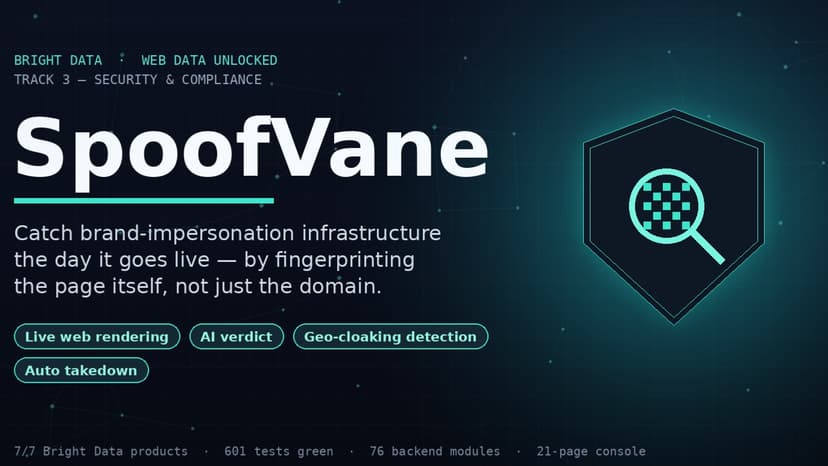
SpoofVane — AI Brand-Impersonation Defense
/ 600 chars, max 2000 chars) Paste this (≈1,950 chars): SpoofVane catches brand-impersonation infrastructure the day it goes live by fingerprinting the page itself, not just the domain name. The problem: phishing kits clone a brand's login and payment pages, hide behind Cloudflare, geo-target the victim country, and actively block security scanners. Domain-only tools miss them. How it works: 1. Discovery — 8 sources surface suspect URLs per brand sweep: Google SERP + paid ads, certificate-transparency logs, newly-registered-domain deltas, app stores and APK sideloads, GitHub kit leaks, Telegram kit marketplaces, and social-platform impersonation. 2. Inspection — Bright Data's Scraping Browser, Web Unlocker, and geo-pinned residential proxies render each suspect page in real Chrome from the victim's country, reaching adversarial pages ordinary scanners can't. Multi-region rendering detects geo-cloaking. 3. Scoring — perceptual image hashing, DOM-tree similarity, logo detection, and favicon matching, plus phishing-kit family fingerprinting (16Shop, EvilProxy, Tycoon-2FA and more). 4. AI verdict — Claude reasons over the screenshot, DOM, and metadata to return a structured phish / suspicious / benign verdict with evidence and a drafted takedown notice. 5. Triage copilot — an agentic, read-only Claude tool-use loop an analyst works in natural language; it queries the alert store autonomously and cites alert IDs, but never sends a takedown — a human owns that gate. 6. Delivery — multi-tenant SOC console, evidence-pack PDFs, SIEM/SOAR webhooks (ServiceNow, Sentinel, Splunk, PagerDuty, STIX/TAXII, Slack), and an MCP server so analysts can query SpoofVane from inside Claude. Why Bright Data is essential: of any Track 3 entry, SpoofVane has the most load-bearing dependency. Without the adversarial-access stack it literally cannot reach the pages it exists to find. 7/7 Bright Data products integrated; 601 tests green; 76 backend modules.
31 May 2026
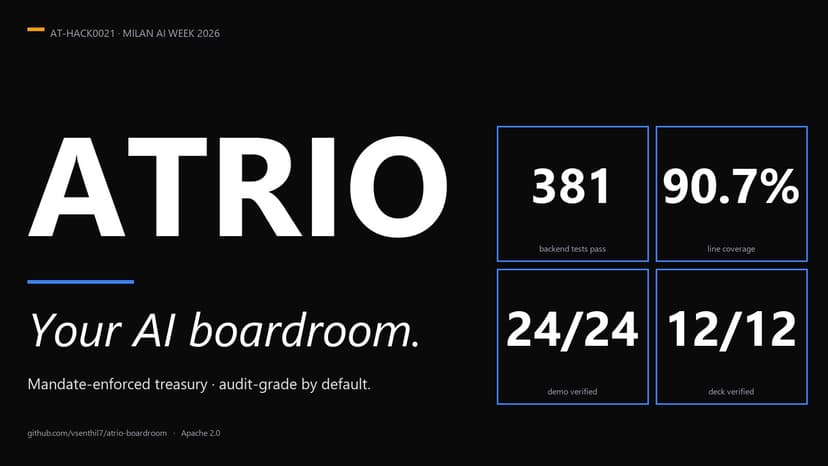
ATRIO Boardroom
**Founders and family offices decide alone.** Big calls get either delegated to a single advisor (fast, single point of failure) or convened with a committee (slow, hard to schedule, hard to audit). ATRIO Boardroom is the middle option: an AI boardroom that holds a real debate, enforces a per-tenant mandate at machine speed, and replays every decision in six months. ## Try the live demo **URL:** http://45.77.52.54:8080 (Vultr, Frankfurt) Click **Demo founder** on the sign-in screen — one click, no email — then type a boardroom question. Watch 5 specialist AI agents stream real Gemini 2.5 reasoning live, ~25 s. Go to Treasury, propose a SHV-xStock buy, try to self-second-sign (API refuses), open a new tab as **Demo CEO**, second-authorise, trade executes against Kraken paper. Download the board-pack PDF. Open the audit log. Six minutes, full lifecycle. ## The wedge - **Debate**, not consensus-on-rails. Six personas with distinct system prompts, distinct model assignments (Gemini 2.5 Flash for specialists, 2.5 Pro for Counsel), and dissent-driven turn-taking. - **Enforce**, at the API. A per-tenant `Mandate v1` (permitted instruments, daily loss limit, single-instrument max, permitted side) is the only path to a treasury action. Two-party auth cannot be bypassed by the UI. - **Audit**, by default. Every turn, vote, model call, and state transition writes to an append-only log. Exportable as JSONL + manifest. ## Why this isn't slideware - **381 / 381** backend tests pass at **90.68 %** coverage - **24 / 24** demo-video structural + **14 / 14** OCR verification - **54 / 54** pitch-deck structural + **12 / 12** OCR verification - **5 / 5** live multi-agent debate against real Gemini in ~25 s (no mocks) - **19** real bugs found and root-caused during the sprint ## Sponsors used Vultr · Google Gemini · Featherless · Speechmatics · Kraken xStocks · LiveKit. License: Apache 2.0.
19 May 2026
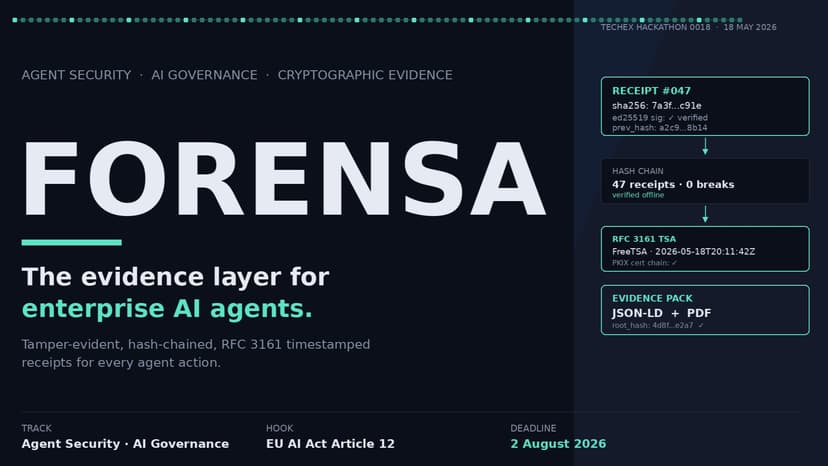
Forensa — Evidence Layer for AI Agents
Every enterprise AI vendor is building enforcement — guardrails, policy engines, control planes. None is building evidence. After enforcement fires, who can prove what the agent actually did, on whose authority, against which policy version? EU AI Act Article 12 makes this question non-negotiable from August 2026, and DORA, NIST AI RMF, and ISO 42001 already demand it. Forensa is the black-box flight recorder for enterprise AI agents. Every agent decision — input, reasoning, policy verdict, output — is captured as a cryptographic Receipt: SHA-256 canonical hash, Ed25519 signed by the tenant key and the agent identity, chained to the previous receipt, and anchored daily to an RFC 3161 timestamp authority (FreeTSA) with full PKIX certificate-chain verification. The chain is offline-verifiable in any language. Compliance officers query Forensa six months after an incident. The console surfaces the receipts in scope, Gemini 2.5 Pro generates a regulator-readable narrative (with four-layer prompt-injection defence), and the system exports a JSON-LD + PDF evidence pack with a single root hash binding the entire pack. Auditors can verify offline. Regulators get a legally admissible artifact. M&A acquirers get 90-day diligence in hours, not months. Built in 6 days for TechEx Hackathon 0018. Real cryptography end-to-end — no mocks. FastAPI + Python 3.14 + Postgres + Next.js 16 console. Strict Pydantic v2, 100% test coverage gate, pytest + vitest. Sponsor stack: Veea Lobster Trap (policy enforcement → evidence sink), Gemini 2.5 Pro (live narrative), Google AI Studio (export templates), OpenTelemetry GenAI (wire format), AWS data pipeline. 20 of 24 user stories IMPLEMENTED+TESTED. 13 business requirements traced to code, tests, and 9 regulatory frameworks. Demo-ready.
19 May 2026
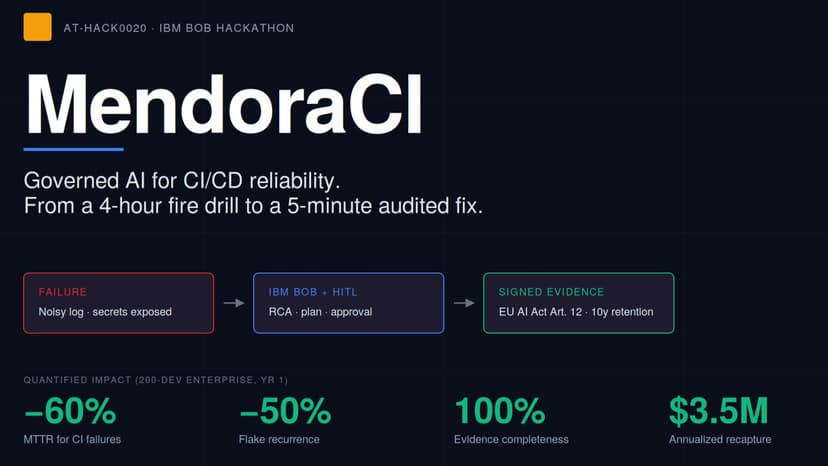
MendoraCI
The problem CI/CD failures are a tax engineering teams pay daily. DORA 2025 shows that AI-assisted coding increases delivery instability — pipelines fail more, debugging gets noisier, and the trail of who-fixed-what-and-why dissolves into Slack threads. For regulated industries, this becomes a compliance liability the moment EU AI Act Article 12 logging obligations bind in August 2026. What MendoraCI does MendoraCI is an enterprise-grade reliability platform that sits beside the CI runner — not inside it — ingesting failure artifacts from GitHub Actions, Jenkins, CircleCI, GitLab CI, and Buildkite. For each failure it produces: Deterministic secret masking before any AI ever sees the log Root-cause classification across 12 classes, powered by IBM Bob Repair plan with hypothesis, steps, blast-radius and rollback — never auto-applied HITL approval ledger with HMAC-signed records and 20-character justification Immutable evidence ZIP with hash-chained manifest, 10-year object-lock retention Why IBM Bob Bob's repo-aware reasoning is structurally load-bearing — only an LLM with context over the full repo + log + history can classify a novel error shape and propose a defensible repair plan. A rules-only fallback (rca_fallback_v1) ships as a safety net but caps at ~58% accuracy vs. the 92% EVAL-001 target. Quantified value (per 200-developer enterprise, year 1) −60% MTTR on CI failures (4.2h → 1.7h) −50% flake recurrence at 90 days 100% evidence completeness for SOC 2 / ISO 27001 / EU AI Act audits ~$3.5M annualized recapture across MTTR, debugging effort, audit prep, and approval cycle time Compliance posture Mapped to EU AI Act Articles 12, 14, and 18; SOC 2 CC1–CC9; ISO 27001 and 42001:2023; GDPR. Per-tenant KMS DEKs, Postgres RLS, deny-on-fail masking, signed approvals, signed evidence packs — all verifiable offline.
17 May 2026
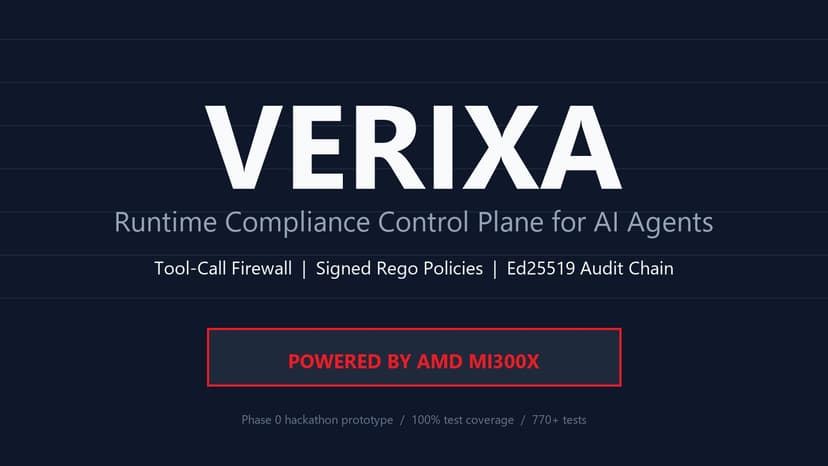
Verixa — Runtime Compliance Control Plane
AI agents are starting to take real-world actions in regulated industries — initiating payments, modifying patient records, filing returns. There is no trust layer between them and the systems they touch. When something goes wrong, regulators ask "who decided what, on what evidence, and can you replay it?" — and there is no answer. Verixa is a runtime control plane that sits between an AI agent and a regulated system. Every governed action passes through Verixa's gateway, which applies four layers in sequence: a tool-call firewall (allow-list with stable error codes and JSON-Schema-subset argument-bounds validation), an Open Policy Agent engine running Ed25519-signed Rego bundles (PII redaction, workflow-role binding, financial transfer-amount limits with PSD2 anchor), a risk engine that classifies the request LOW/MEDIUM/HIGH/CRITICAL, and a decision router that emits ALLOW / ESCALATE / DENY. Every decision is committed to a SHA-256 hash chain with Ed25519 signatures and is offline-verifiable through a CLI tool. The output creates evidence to demonstrate and support EU AI Act Annex IV obligations. The agent reasoning layer runs on AMD MI300X. We deployed Qwen3-0.6B on vLLM-on-ROCm to a live droplet at 165.245.133.120:8000 and the gateway's OpenAI-compatible /v1/chat/completions endpoint forwards through the governance pipeline before reaching the model. Validated end-to-end from local via requests.post() and from inside the runtime via httpx.MockTransport tests. This submission is Phase 0 — a hackathon prototype. What's working today: 7 Postgres schemas, 40 Python modules + 1 TS module at 100% line+branch coverage across 770+ unit tests and 5 live integration tests against a Redis testcontainer and the live MI300X droplet. What's next on the roadmap: triad review engine (CP-10), evidence validator (CP-11), replay vault (CP-12), Annex IV-aligned dossier export (CP-13), and Next.js 14 control-plane UI (CP-15). Honest scope, real engineering.
10 May 2026


