Top Builders

Explore the top contributors showcasing the highest number of app submissions within our community.

Band Control Plane

The Interaction Control Plane is the second of Band's two platform layers. While the Agentic Mesh handles agent-to-agent and agent-to-human collaboration, the Control Plane governs it: enforcing who can talk to whom, what they are allowed to do, and keeping a record of every interaction for audit.

General
DeveloperBand (Thenvoi AI Ltd.)
TypeAgent governance and security layer
Documentationdocs.band.ai

Core Features

  • Capability-bound execution: agents can only perform actions they are explicitly allowed to, preventing lateral movement or privilege escalation.
  • Three-tier isolation: personal, organization, and global scopes keep agents and their data isolated by default.
  • Authentication and access control: RBAC, OAuth2/JWT, and encrypted API keys secure access to agents and chat rooms.
  • Runtime visibility: teams can see which agent did what, when, and under whose authority, with full delegation chain visibility.
  • Policy enforcement: rules are applied at runtime, with audit trails on every interaction and the ability to intervene when policies are violated.

Tools and Resources

  • App / Console: app.band.ai for managing agents, contacts, and chat room permissions.
  • Platform overview: band.ai/platform describes how the Control Plane works alongside the Agentic Mesh.
  • Documentation: docs.band.ai for core concepts on agents, contacts, and chat room routing.

Ecosystem and Integrations

  • Sits underneath the Agentic Mesh, applying authority boundaries and audit logging to every message and delegation that crosses the mesh.
  • Enforced for agents connected through any of Band's framework adapters, the Python and TypeScript SDKs, or the MCP server.

Read the platform overview to see how the Agentic Mesh and Control Plane work together, or book a demo to discuss enterprise governance requirements.

Band AI Band Control Plane AI technology Hackathon projects

Discover innovative solutions crafted with Band AI Band Control Plane AI technology, developed by our community members during our engaging hackathons.
Coder – AI Software Engineering Team

Coder – AI Software Engineering Team

Coder is a mobile-first and desktop-capable AI software engineering platform designed to function as a complete AI development team rather than a traditional chatbot. Instead of relying on a single AI model, Coder uses four specialized agents working together through Band.ai's multi-agent collaboration system. The Planner Agent analyzes user requirements and creates a structured development plan. The Engineer Agent generates project architecture, files, and implementation code. The Reviewer Agent performs syntax validation, dependency verification, import checking, and build-readiness analysis. The Verifier Agent performs UI/UX review, functionality validation, requirement matching, and final quality assurance before delivery. Coder combines these agents inside a unified IDE experience built with Flutter. Users can open projects, browse files, edit code, preview applications, connect GitHub repositories, and export completed projects from a single workspace. The platform supports modern web development technologies including HTML, CSS, JavaScript, React, Tailwind CSS, TypeScript, Node.js, Flutter, and related frontend technologies. Unlike standard AI coding assistants, Coder introduces a configurable three-step verification pipeline that allows generated code to pass through multiple validation stages before being accepted. Users can enable or disable verification directly from the settings panel depending on their workflow requirements. Band.ai serves as the collaboration and orchestration layer, allowing all agents to communicate through shared rooms and agent-to-agent messaging. AIMLAPI and Featherless AI provide access to multiple large language models, enabling flexible model selection and cost-efficient execution. Markdown-based technical knowledge resources can be attached to agents to provide framework-specific guidance and coding standards.

Apohara VOUCH

Apohara VOUCH

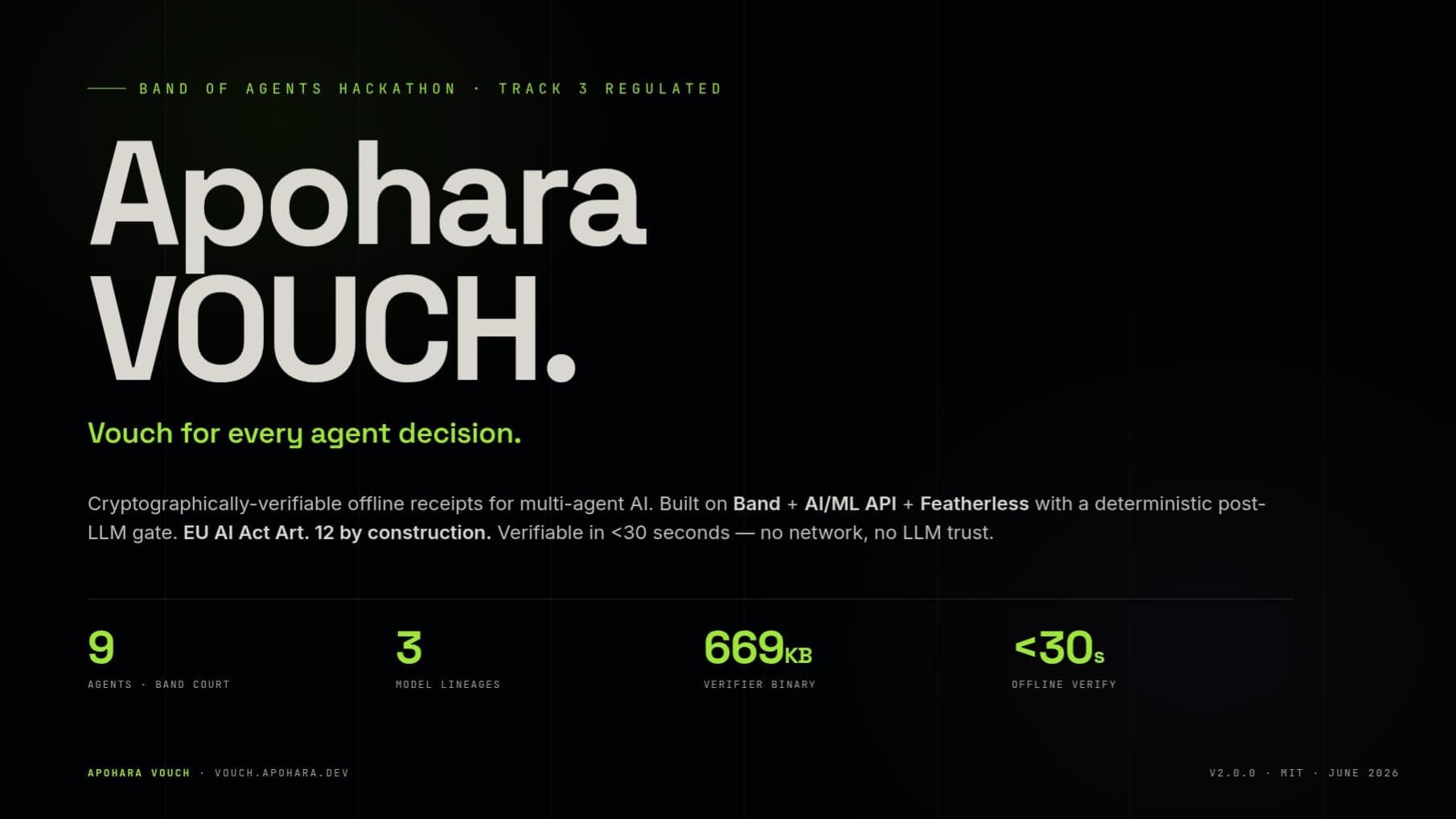
Apohara VOUCH turns multi-agent decisions into cryptographically-verifiable offline receipts — signed, hash-chained, timestamped, and audit-ready in under 30 seconds. Built on 3 production LLM sponsors (Band SDK + AI/ML API + Featherless AI) with a deterministic post-LLM gate (BAAAR) that fails-closed on five auditable halt conditions. EU AI Act Art. 12 by construction. **When AI agents make a regulated decision, you can't trust the decision — and you can't prove it either.** Procurement, lending, hiring, and customer escalation are now mediated by multi-agent systems: 5–10 LLMs coordinate through chat rooms, hand off state, vote, and reach a verdict. Three failures follow: 1. **No audit trail.** When a regulator asks "who decided this, and why?", you have a chat log — not an evidence packet. Logs can be edited. Screenshots can be forged. LLM weights are opaque. 2. **No failure mode.** The agents coordinate, but if one hallucinates a vendor ID, the room reaches the wrong verdict anyway. Multi-agent consensus is consensus on the wrong answer. 3. **No offline verifiability.** The regulator asks for proof. You re-run the agents. They produce a different answer. The room is no longer reproducible. The EU AI Act Art. 12 (record-keeping), DORA Art. 16 (ICT incident logs), NIST AI RMF (Manage), and OWASP Agentic all require verifiable, tamper-evident, offline-checkable evidence. None of the existing solutions — vector stores, prompt logs, evals — satisfy all three. **Apohara VOUCH** is the first multi-agent substrate that produces EU AI Act Art. 12 evidence packets by construction, verified offline in under 30 seconds, with no LLM in the critical path. **Apohara VOUCH — vouch for every agent decision.**

Quorum: Governed Business Intelligence

Quorum: Governed Business Intelligence

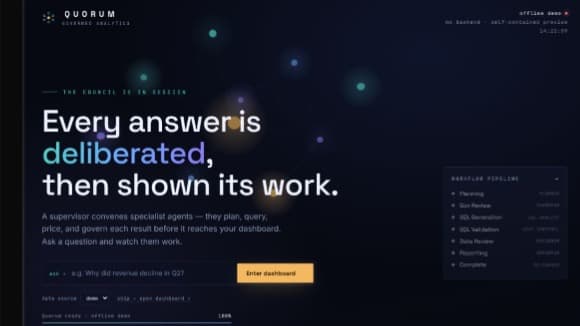
Quorum is a Band-powered governed analytics platform that turns natural-language business questions into trustworthy, auditable answers. Instead of relying on a single AI model, Quorum uses a council of specialized agents that collaborate through a structured governance workflow. A Planner creates an investigation strategy, a Plan Guardian reviews the approach before execution, a SQL Analyst generates and executes queries, a Cost Sentinel validates cost and plan compliance, a Governance Guardian reviews correctness after execution, and a Decision Reporter converts findings into actionable recommendations. Quorum supports two investigation modes. Governed Chain answers descriptive questions such as "What happened?" through a sequential review process. Investigation Board tackles diagnostic questions such as "Why did revenue decline?" by launching multiple investigators in parallel and using an adjudicator to evaluate competing explanations before reaching a conclusion. Built on Band's multi-agent framework, Quorum enables structured collaboration between agents, allowing them to plan, review, challenge, validate, and justify outputs before a result reaches the user. This creates a transparent decision-making process rather than a black-box AI response. A core innovation is Quorum's governance-first design. Every plan, SQL query, agent decision, cost estimate, compliance review, revision request, and final recommendation is captured in a complete audit trail. Users can inspect investigation timelines, generated SQL, governance decisions, and supporting evidence behind every answer. The platform combines FastAPI, Next.js, PostgreSQL/SQLite, and LiteLLM-based model routing with support for Groq, AI/ML API, Featherless, OpenAI-compatible providers, and Ollama. By combining Band's collaborative agent orchestration with enterprise governance controls, Quorum delivers explainable AI-powered analytics that organizations can confidently use for business decision-making.