
.png&w=256&q=75)
🤓 Latest Submissions
Audisor-amd-track1
This project is a Track 1 benchmark agent designed for the AMD Developer Hackathon Act II. It reads the provided /input/tasks.json, classifies each task, applies deterministic local tools when correctness is provable, and falls back to Fireworks AI only when a task requires model inference or local validation cannot safely accept the result. The runtime enforces the contest contract by writing a valid /output/results.json with exact task_id and answer fields. Remote calls use only FIREWORKS_BASE_URL, FIREWORKS_API_KEY, and models from ALLOWED_MODELS at runtime. The goal is to pass the accuracy gate while keeping recorded Fireworks token usage low.
11 Jul 2026
ProofGate
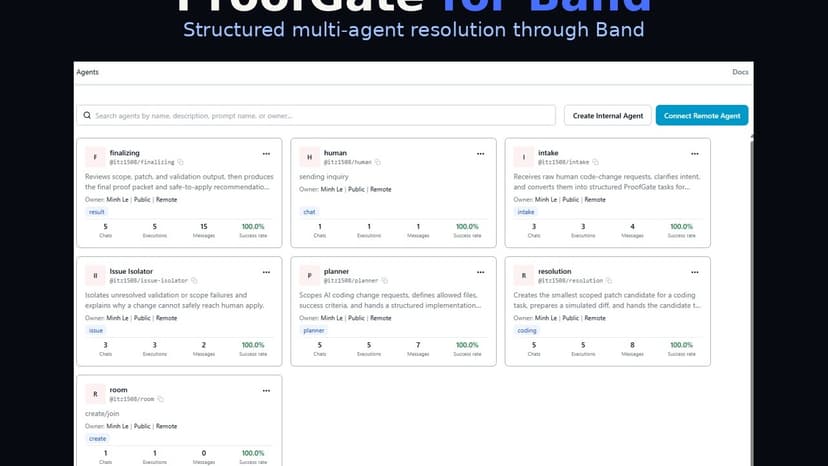
Software teams often rely on one opaque AI response to interpret a request, decide what to do, perform the work, and explain the result. That makes failures difficult to trace and retries easy to repeat without learning from the first attempt. ProofGate separates the work into five clear roles connected through Band. A human starts with a normal request. Intake converts it into a structured task. Planning defines scope, constraints, and measurable success requirements. Resolution performs the requested work and checks whether every requirement was met. When the result succeeds, Finalizing delivers the completed result and closes the workflow. When Resolution fails, ProofGate does not restart the entire workflow or repeat the same attempt. Issue Isolation identifies the exact failure location and cause, preserves the work that already succeeded, and creates a new focused handoff. That handoff can return to the Resolution Agent or be sent to a configured specialist such as Claude Code or Codex. Only one retry is allowed. The final result is then delivered as completed, resolved after isolation, blocked, or failed. Band provides the agent identities, room communication, and targeted handoffs. ProofGate provides the structured packet, deterministic routing, one controlled retry, and terminal delivery model.
19 Jun 2026

