

TALHA ABID@talha_abid380
7
Events attended
4
Submissions made
Pakistan
2+ years of experience
About me
AI specialist and BSAI student at the University of Central Punjab, focused on agentic AI, RAG workflows, and speech processing. Experience includes ML/DL for stroke prediction, Python/C++ development, and containerized workflows with Docker. Open to collaborations and hiring opportunities.
🤝 Top Collaborators


🤓 Latest Submissions
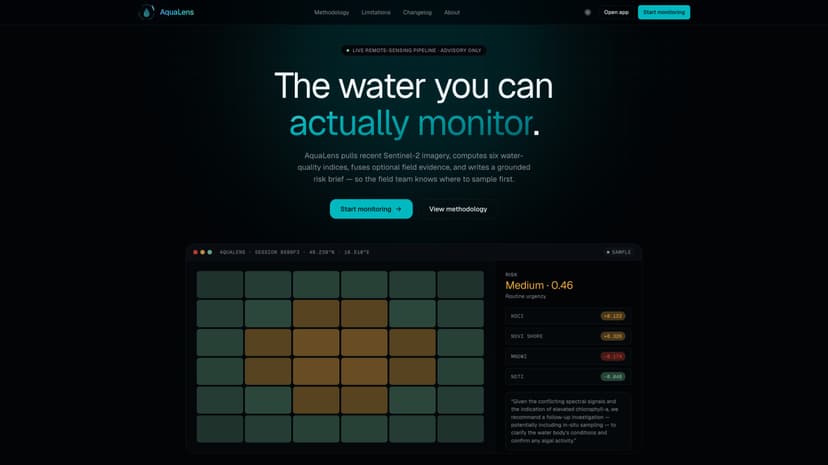
AquaLens: Autonomous Freshwater Monitoring Agent
AquaLens helps environmental teams decide where to investigate first when they cannot sample every freshwater site manually. A user selects an area of interest through search, coordinates, or the map. The system creates an approximate 1 km area, checks whether the area is water, mixed, or land, fetches suitable Sentinel-2 L2A imagery through Microsoft Planetary Computer, computes six spectral indices, and produces a deterministic 0–100 advisory risk score with a low, medium, or high level and an urgency tier. The agent layer is intentionally constrained. Gemini agents can choose inputs, inspect scene quality, gather context, write recommendations, critique the brief, and produce a citizen-facing summary, but they cannot change the deterministic risk score. Every agent action is captured in a per-session trace with tool calls, structured outputs, latency, token usage, and fallback behavior. If the agent layer fails, the deterministic pipeline still produces a usable advisory brief. AquaLens is not a certified water-safety system and does not replace laboratory testing. It is built as a triage and decision-support tool: it helps civic teams, researchers, NGOs, and water-body managers prioritize where to sample or inspect next, with transparent limitations and reproducible numerical evidence. AquaLens is a strong fit for the Agentic Workflows track, with additional relevance to Intelligent Reasoning, Multimodal Intelligence, Collaborative Systems, and Enterprise Utility. It is not a chatbot wrapper but an autonomous monitoring workflow where a deterministic remote-sensing core runs first and a Gemini agent layer performs scene inspection, context gathering, recommendation drafting, critique, reporting, and fallback handling. This directly supports the hackathon theme of autonomous agents that move beyond copilots into useful decision-making systems.
19 May 2026
AquaLens: Autonomous Freshwater Monitoring Agent
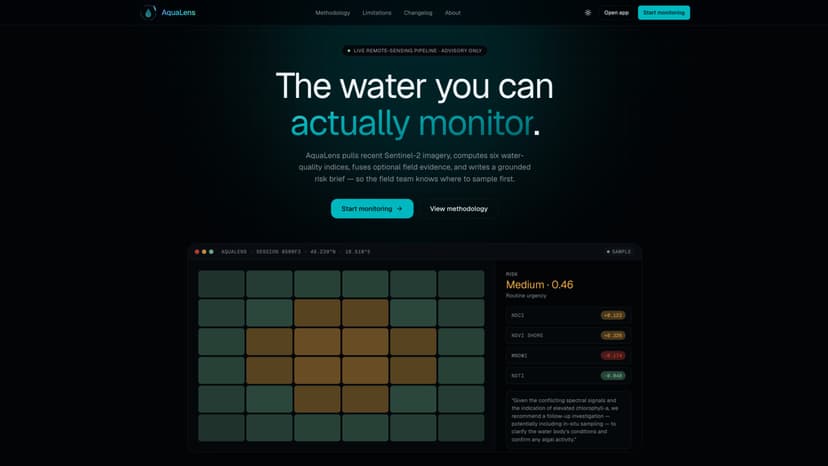
AquaLens helps environmental teams decide where to investigate first when they cannot sample every freshwater site manually. A user selects an area of interest through search, coordinates, or the map. The system creates an approximate 1 km area, checks whether the area is water, mixed, or land, fetches suitable Sentinel-2 L2A imagery through Microsoft Planetary Computer, computes six spectral indices, and produces a deterministic 0–100 advisory risk score with a low, medium, or high level and an urgency tier. The agent layer is intentionally constrained. Gemini agents can choose inputs, inspect scene quality, gather context, write recommendations, critique the brief, and produce a citizen-facing summary, but they cannot change the deterministic risk score. Every agent action is captured in a per-session trace with tool calls, structured outputs, latency, token usage, and fallback behavior. If the agent layer fails, the deterministic pipeline still produces a usable advisory brief. AquaLens is not a certified water-safety system and does not replace laboratory testing. It is built as a triage and decision-support tool: it helps civic teams, researchers, NGOs, and water-body managers prioritize where to sample or inspect next, with transparent limitations and reproducible numerical evidence. AquaLens is a strong fit for the Agentic Workflows track, with additional relevance to Intelligent Reasoning, Multimodal Intelligence, Collaborative Systems, and Enterprise Utility. It is not a chatbot wrapper but an autonomous monitoring workflow where a deterministic remote-sensing core runs first and a Gemini agent layer performs scene inspection, context gathering, recommendation drafting, critique, reporting, and fallback handling. This directly supports the hackathon theme of autonomous agents that move beyond copilots into useful decision-making systems.
19 May 2026

Withdrawn
This project submission has been intentionally withdrawn and should not be considered as an active or valid entry in the Deriv AI Talent Sprint. It was originally created during the hackathon, but the team has decided not to move forward with this particular direction and does not want it to influence judging, rankings, or prize deliberations in any way. We are keeping this page only as a placeholder so that the platform does not break or display errors, but it does not represent a product we intend to maintain, ship, or present as part of this event. There is no expectation of evaluation, feedback, or scoring for this submission. If possible, we kindly request that organizers and judges skip this project entirely during review and treat it as formally withdrawn from the hackathon.
7 Feb 2026

Qubic Sentinel
Qubic Sentinel is the watchtower of the Qubic ecosystem—designed to bring clarity to a fast, tick‑based network where high‑impact moves often happen quietly. It continuously ingests tick data from Qubic RPC nodes, filters for high‑value events (like transactions exceeding 1 Billion QUBIC), decodes QX DEX smart‑contract interactions to surface buy/sell flows, and enriches every event with live USD valuations via CoinGecko. An Intelligence Engine assigns dynamic risk scores (Low/Medium/High) based on volume, counterparty, and destination patterns, then routes rich embeds to Discord for instant community awareness and logs structured rows to Google Sheets for historical analysis and research. The architecture embodies an EasyConnect ethos: orchestrated in n8n, leveraging JavaScript for logic, and connecting out‑of‑the‑box services (Discord, Google Sheets, CoinGecko) to deliver reliable, transparent monitoring without proprietary lock‑in or cost. It’s open‑source, reproducible, and optimized for quick setup—import the workflow, connect your accounts, and activate. Sentinel turns opaque, market‑moving signals into actionable intelligence the community can actually use—live.
7 Dec 2025


