

Areef Rasool@areef_rasool89
1
Events attended
1
Submissions made
Pakistan
1 year of experience
About me
Artificial Intelligence undergraduate at University of Central Punjab Lahore passionate about Machine Learning, Computer Vision, and building impactful AI solutions. Constantly learning, experimenting, and turning ideas into real-world projects.
🤝 Top Collaborators


🤓 Latest Submissions
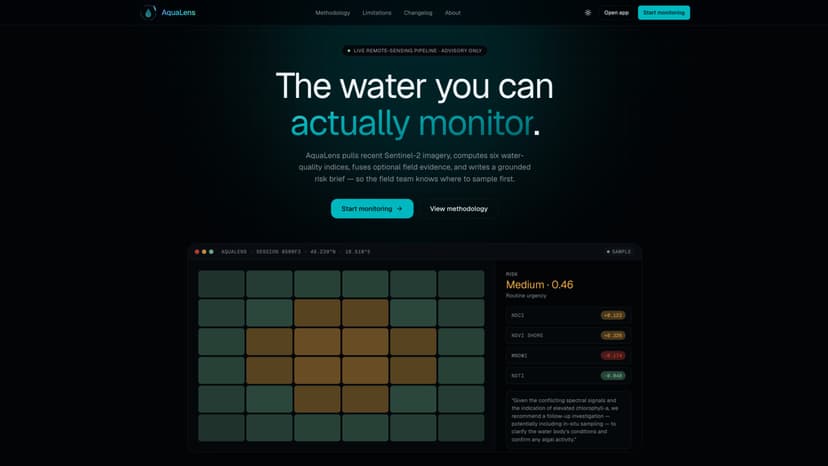
AquaLens: Autonomous Freshwater Monitoring Agent
AquaLens helps environmental teams decide where to investigate first when they cannot sample every freshwater site manually. A user selects an area of interest through search, coordinates, or the map. The system creates an approximate 1 km area, checks whether the area is water, mixed, or land, fetches suitable Sentinel-2 L2A imagery through Microsoft Planetary Computer, computes six spectral indices, and produces a deterministic 0–100 advisory risk score with a low, medium, or high level and an urgency tier. The agent layer is intentionally constrained. Gemini agents can choose inputs, inspect scene quality, gather context, write recommendations, critique the brief, and produce a citizen-facing summary, but they cannot change the deterministic risk score. Every agent action is captured in a per-session trace with tool calls, structured outputs, latency, token usage, and fallback behavior. If the agent layer fails, the deterministic pipeline still produces a usable advisory brief. AquaLens is not a certified water-safety system and does not replace laboratory testing. It is built as a triage and decision-support tool: it helps civic teams, researchers, NGOs, and water-body managers prioritize where to sample or inspect next, with transparent limitations and reproducible numerical evidence. AquaLens is a strong fit for the Agentic Workflows track, with additional relevance to Intelligent Reasoning, Multimodal Intelligence, Collaborative Systems, and Enterprise Utility. It is not a chatbot wrapper but an autonomous monitoring workflow where a deterministic remote-sensing core runs first and a Gemini agent layer performs scene inspection, context gathering, recommendation drafting, critique, reporting, and fallback handling. This directly supports the hackathon theme of autonomous agents that move beyond copilots into useful decision-making systems.
19 May 2026
