
🤝 Top Collaborators


🤓 Latest Submissions
Emergent Negotiation Arena
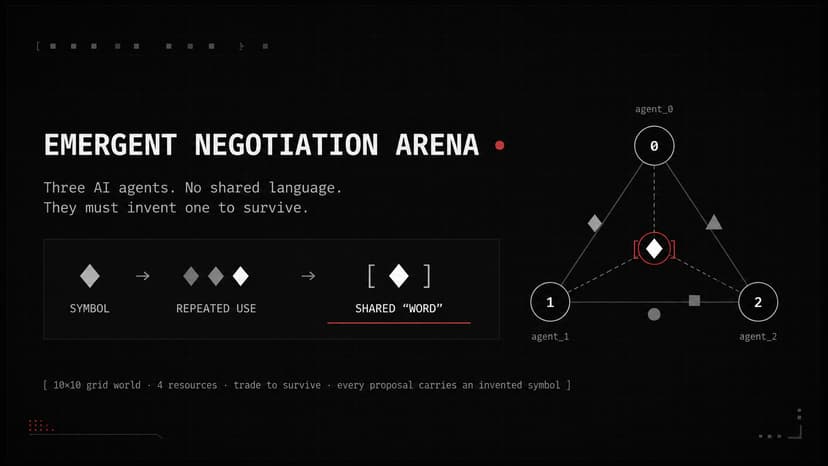
Emergent Negotiation Arena is an interactive multi-agent AI experiment that explores how communication can emerge from necessity. Three autonomous agents enter a resource-scarce 10×10 grid world with no shared language or predefined vocabulary. To survive, they must negotiate trades. Instead of communicating with ordinary words, the agents invent and exchange symbols. As the simulation progresses, the system tracks how often those symbols are reused, in which trade contexts they appear, and whether multiple agents begin assigning them the same meaning. When a symbol consistently stabilizes across agents for the same context, it becomes an emergent shared “word.” The project supports multiple execution modes. Fireworks enables live LLM-powered agents, while heuristic mode provides a rule-based live simulation and replay mode lets judges inspect a recorded run without consuming API credits. A real-time Gradio dashboard visualizes the world, agent activity, trade outcomes, vocabulary formation, emergent words, and benchmark data. The project is designed as both an AI research experiment and an accessible interactive demo. It demonstrates how coordination, negotiation, and primitive language can emerge without giving agents a shared vocabulary in advance. The application includes a tested multi-agent simulation engine, parallel agent execution, live AI integration, replayable experiment artifacts, and 84/84 passing tests.
13 Jul 2026
AquaLens: Autonomous Freshwater Monitoring Agent
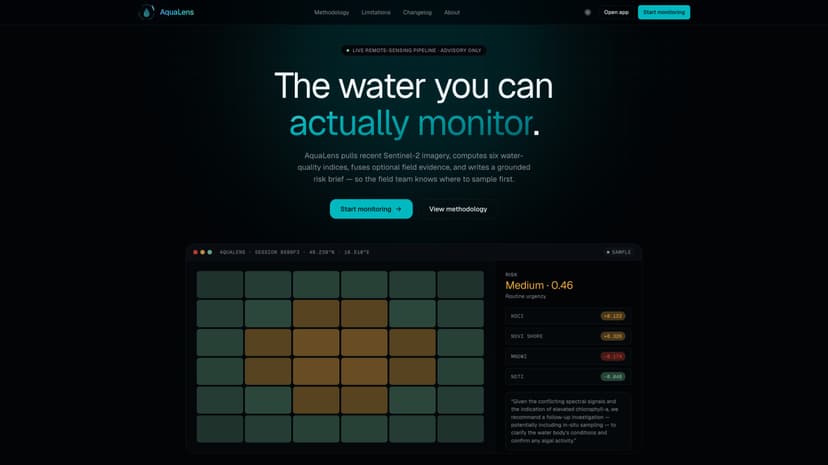
AquaLens helps environmental teams decide where to investigate first when they cannot sample every freshwater site manually. A user selects an area of interest through search, coordinates, or the map. The system creates an approximate 1 km area, checks whether the area is water, mixed, or land, fetches suitable Sentinel-2 L2A imagery through Microsoft Planetary Computer, computes six spectral indices, and produces a deterministic 0–100 advisory risk score with a low, medium, or high level and an urgency tier. The agent layer is intentionally constrained. Gemini agents can choose inputs, inspect scene quality, gather context, write recommendations, critique the brief, and produce a citizen-facing summary, but they cannot change the deterministic risk score. Every agent action is captured in a per-session trace with tool calls, structured outputs, latency, token usage, and fallback behavior. If the agent layer fails, the deterministic pipeline still produces a usable advisory brief. AquaLens is not a certified water-safety system and does not replace laboratory testing. It is built as a triage and decision-support tool: it helps civic teams, researchers, NGOs, and water-body managers prioritize where to sample or inspect next, with transparent limitations and reproducible numerical evidence. AquaLens is a strong fit for the Agentic Workflows track, with additional relevance to Intelligent Reasoning, Multimodal Intelligence, Collaborative Systems, and Enterprise Utility. It is not a chatbot wrapper but an autonomous monitoring workflow where a deterministic remote-sensing core runs first and a Gemini agent layer performs scene inspection, context gathering, recommendation drafting, critique, reporting, and fallback handling. This directly supports the hackathon theme of autonomous agents that move beyond copilots into useful decision-making systems.
19 May 2026
AquaLens: Autonomous Freshwater Monitoring Agent
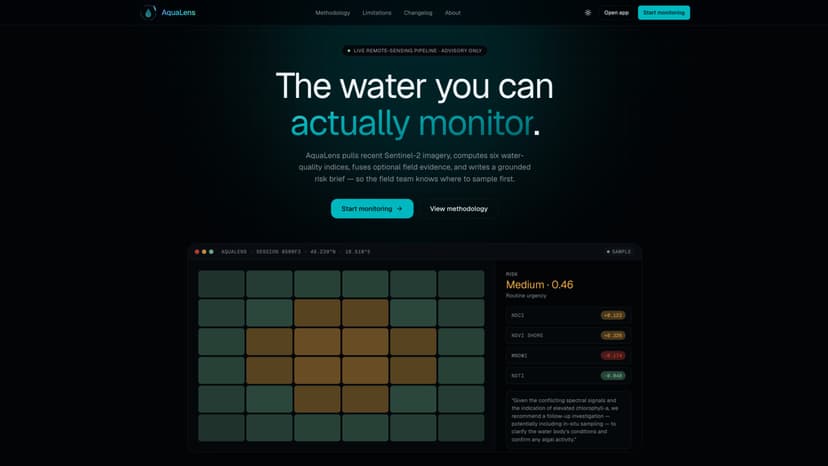
AquaLens helps environmental teams decide where to investigate first when they cannot sample every freshwater site manually. A user selects an area of interest through search, coordinates, or the map. The system creates an approximate 1 km area, checks whether the area is water, mixed, or land, fetches suitable Sentinel-2 L2A imagery through Microsoft Planetary Computer, computes six spectral indices, and produces a deterministic 0–100 advisory risk score with a low, medium, or high level and an urgency tier. The agent layer is intentionally constrained. Gemini agents can choose inputs, inspect scene quality, gather context, write recommendations, critique the brief, and produce a citizen-facing summary, but they cannot change the deterministic risk score. Every agent action is captured in a per-session trace with tool calls, structured outputs, latency, token usage, and fallback behavior. If the agent layer fails, the deterministic pipeline still produces a usable advisory brief. AquaLens is not a certified water-safety system and does not replace laboratory testing. It is built as a triage and decision-support tool: it helps civic teams, researchers, NGOs, and water-body managers prioritize where to sample or inspect next, with transparent limitations and reproducible numerical evidence. AquaLens is a strong fit for the Agentic Workflows track, with additional relevance to Intelligent Reasoning, Multimodal Intelligence, Collaborative Systems, and Enterprise Utility. It is not a chatbot wrapper but an autonomous monitoring workflow where a deterministic remote-sensing core runs first and a Gemini agent layer performs scene inspection, context gathering, recommendation drafting, critique, reporting, and fallback handling. This directly supports the hackathon theme of autonomous agents that move beyond copilots into useful decision-making systems.
19 May 2026

Withdrawn
This project submission has been intentionally withdrawn and should not be considered as an active or valid entry in the Deriv AI Talent Sprint. It was originally created during the hackathon, but the team has decided not to move forward with this particular direction and does not want it to influence judging, rankings, or prize deliberations in any way. We are keeping this page only as a placeholder so that the platform does not break or display errors, but it does not represent a product we intend to maintain, ship, or present as part of this event. There is no expectation of evaluation, feedback, or scoring for this submission. If possible, we kindly request that organizers and judges skip this project entirely during review and treat it as formally withdrawn from the hackathon.
7 Feb 2026


