

🤝 Top Collaborators


.png&w=640&q=75)

🤓 Latest Submissions
Rehaby
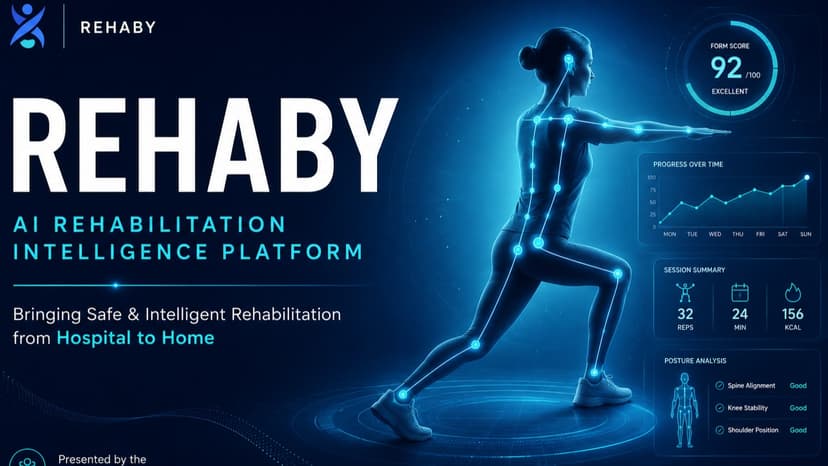
Rehaby is an AI-powered rehabilitation intelligence platform designed to bridge the gap between hospital-based physiotherapy and home recovery. Many patients receive proper monitoring and rehabilitation support while admitted in hospitals, but after discharge, rehabilitation often becomes unsupervised. Patients may perform exercises incorrectly, lose motivation, misunderstand instructions, or skip therapy sessions completely. This problem is especially common among elderly, post-surgical, orthopedic, neurological, and cardiovascular rehabilitation patients who may also face difficulties traveling long distances for short clinical follow-ups. Improper rehabilitation can increase recovery time, risk of re-injury, and workload on healthcare professionals. Rehaby addresses this challenge through an intelligent AI-driven rehabilitation ecosystem that enables patients to safely continue physiotherapy exercises from home while remaining connected with clinicians. The platform combines computer vision, real-time posture tracking, and adaptive rehabilitation intelligence to analyze patient movements and provide immediate corrective feedback. Using technologies such as MediaPipe Pose, OpenCV, TensorFlow Lite, and FastAPI, Rehaby performs live joint angle analysis, posture correction, repetition counting, and movement scoring directly through a web-based interface. The patient-side application offers real-time camera posture tracking, skeleton overlays, AI voice guidance, visual corrective feedback, and session summaries to improve exercise accuracy and adherence. On the clinician side, a mobile dashboard allows healthcare professionals to monitor patient progress remotely through analytics, form score trends, session histories, and recovery performance insights. The system also supports Urdu voice interaction and low-bandwidth accessibility to improve usability for diverse patient populations.
19 May 2026
PulseGuard
PulseGuard: Powered by the HIPAA-Halt Engine. An enterprise-grade AI governance and privacy orchestrator built for zero-trust data compliance is an automated HIPAA compliance auditing platform that secures sensitive patient data through a unique hybrid "Air-Lock" architecture. It intercepts and redacts medical records locally before utilizing AI The Problem Healthcare organizations are trapped between AI innovation and absolute data liability. Unprotected Patient Health Information (PHI) entered into public AI models leads to permanent exposure and catastrophic HIPAA violations, with data breaches costing healthcare systems an average of $10.93M per incident. Security teams routinely ground high-value AI initiatives out of sheer "black-box" anxiety. The Solution PulseGuard is an enterprise-grade AI Governance and Zero-Trust Data Privacy Orchestrator that acts as a real-time compliance shield right at the local network edge. Before a single byte of data leaves the internal network, PulseGuard intercepts unstructured clinical text via a 5-Layer Secure Pipeline. It runs high-speed regular expressions alongside an advanced local Named Entity Recognition (NER) engine to strip out all 18 HIPAA identifiers, replacing them with anonymous tracking tokens while preserving the underlying text utility for deep AI analysis. To guarantee absolute data sovereignty, all token-to-data mappings live entirely in-memory within a thread-safe .NET Core repository. With a zero-persistent footprint on disk or cloud databases, these sensitive links evaporate the split second the session closes.
19 May 2026

Redress
Most people have a legitimate complaint against a bank, telco, utility provider, landlord, or government agency but have no idea how to formally escalate it. They either give up, send an ineffective email, or don't know which regulatory body to contact. Redress solves that. Redress is a full stack web application powered by an AI agent that guides users through a three-stage complaint resolution flow. In the first stage, the agent understands the complaint by asking up to three targeted clarifying questions to gather the key details. In the second stage, it generates a professionally structured formal complaint letter with the correct recipient, recommended sending channel, and relevant regulatory body details for that country and sector. In the third stage, if the user indicates their complaint was ignored, the agent generates an escalation letter addressed directly to the regulatory body, including step-by-step filing instructions. Every letter is displayed on screen and available as a downloadable PDF. Users can manage multiple complaints, view their full history, and track the stage of each case. The agent uses Tavily web search to fetch live regulatory body contact details, making it accurate for any country and any sector including banking, telecom, utilities, housing, government services, and e-commerce. Built with Next.js 16 App Router, MongoDB, NextAuth with Google OAuth, Zustand, Tavily, and jsPDF. The agent logic lives entirely in server-side Next.js API routes calling the LLM, with the AMD Developer Cloud API as the intended provider. Note: AMD Developer Cloud credits were applied for on May 5th but were not received before the submission deadline despite following all required steps. The agent is fully compatible with AMD's OpenAI-compatible API and can be switched by updating two environment variables.
10 May 2026


