
🤝 Top Collaborators


.png&w=640&q=75)
🤓 Latest Submissions
Rehaby
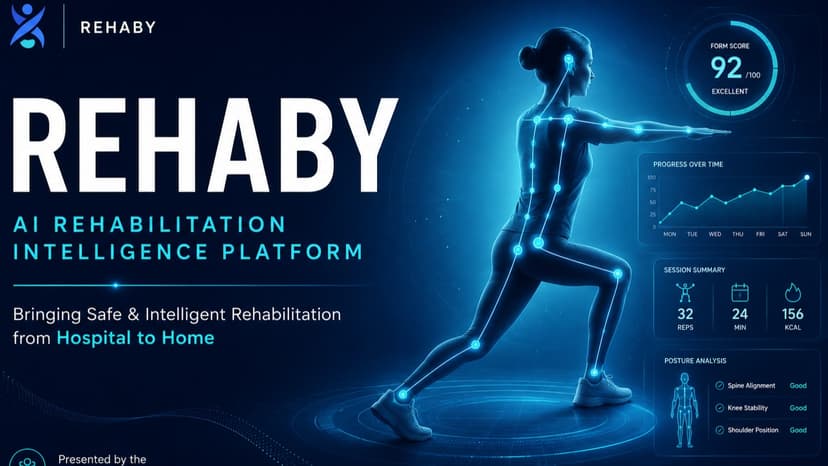
Rehaby is an AI-powered rehabilitation intelligence platform designed to bridge the gap between hospital-based physiotherapy and home recovery. Many patients receive proper monitoring and rehabilitation support while admitted in hospitals, but after discharge, rehabilitation often becomes unsupervised. Patients may perform exercises incorrectly, lose motivation, misunderstand instructions, or skip therapy sessions completely. This problem is especially common among elderly, post-surgical, orthopedic, neurological, and cardiovascular rehabilitation patients who may also face difficulties traveling long distances for short clinical follow-ups. Improper rehabilitation can increase recovery time, risk of re-injury, and workload on healthcare professionals. Rehaby addresses this challenge through an intelligent AI-driven rehabilitation ecosystem that enables patients to safely continue physiotherapy exercises from home while remaining connected with clinicians. The platform combines computer vision, real-time posture tracking, and adaptive rehabilitation intelligence to analyze patient movements and provide immediate corrective feedback. Using technologies such as MediaPipe Pose, OpenCV, TensorFlow Lite, and FastAPI, Rehaby performs live joint angle analysis, posture correction, repetition counting, and movement scoring directly through a web-based interface. The patient-side application offers real-time camera posture tracking, skeleton overlays, AI voice guidance, visual corrective feedback, and session summaries to improve exercise accuracy and adherence. On the clinician side, a mobile dashboard allows healthcare professionals to monitor patient progress remotely through analytics, form score trends, session histories, and recovery performance insights. The system also supports Urdu voice interaction and low-bandwidth accessibility to improve usability for diverse patient populations.
19 May 2026
OnboardIQ: AI-Powered Codebase Onboarding
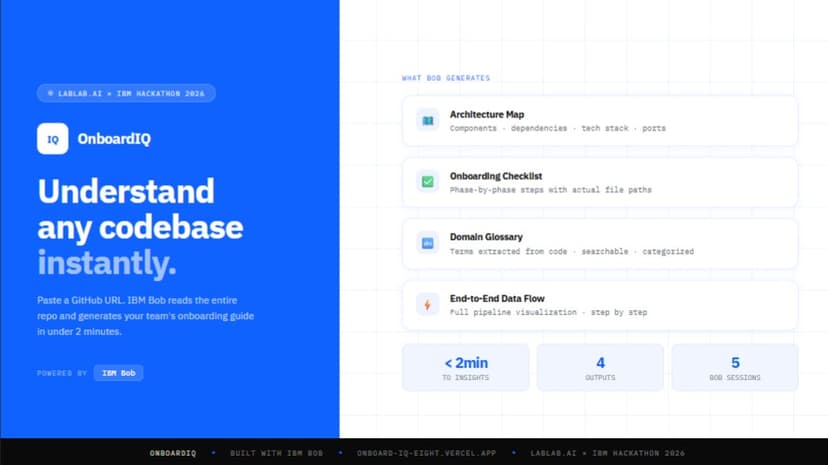
Every developer knows the pain of joining a new project. You spend days reading code you don't understand, asking questions that slow the whole team down, and piecing together an architecture nobody documented properly. OnboardIQ solves this with IBM Bob. HOW IT WORKS: Paste any public GitHub repository URL into OnboardIQ. IBM Bob reads the entire codebase — every file, every module, every dependency — and generates a structured onboarding report with four sections: 1. DATA FLOW — A visual end-to-end pipeline showing how the system works from input to output 2. ARCHITECTURE MAP — Every component mapped with its technology stack, key files, port, and dependencies 3. ONBOARDING CHECKLIST — A prioritized, phase-by-phase guide telling a new developer exactly where to start and what to read first 4. GLOSSARY — Domain terms, technical concepts, and project-specific jargon extracted directly from the code HOW IBM BOB IS USED: Bob is the intelligence engine behind every report. Using Bob IDE's full repository context, we ran 5 agentic analysis sessions against a real production codebase (a real-time auction analytics pipeline). Bob analyzed the architecture, extracted domain terminology, generated onboarding steps, and explained key files — all exported as session reports now living in /bob_sessions in our GitHub repo. The Next.js application then normalizes Bob's structured JSON output into a clean, interactive UI that any developer can navigate in minutes. IMPACT: Onboarding a developer to a complex codebase typically takes 2-4 weeks. OnboardIQ compresses that to under 2 minutes for the initial orientation. IBM's own data shows 45-70% time savings with Bob — OnboardIQ makes that accessible to every developer on any team.
17 May 2026


