

🤝 Top Collaborators


.png&w=640&q=75)
🤓 Latest Submissions
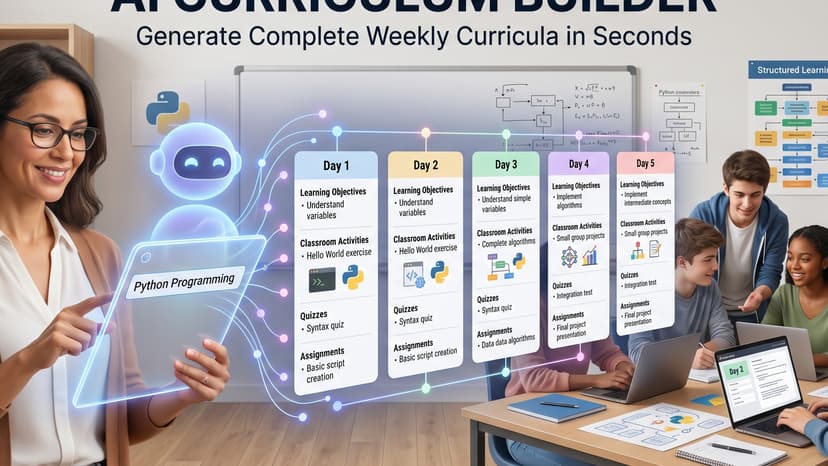
Curriculum Builder Agent
Teachers spend 6+ hours every week planning curriculum — writing lesson plans, designing quizzes, sequencing difficulty, and adapting for students with different learning needs. Most of this time goes into applying pedagogical frameworks like Bloom's Taxonomy and Universal Design for Learning, expertise that not every teacher has time to develop. Curriculum Builder Agent solves this with a multi-step AI reasoning pipeline. A teacher enters a topic, grade level, difficulty, and optional accessibility needs (dyslexia, ADHD, ELL, visual/hearing impairment). In under a minute, the agent generates: 5 learning objectives mapped to Bloom's Taxonomy levels (Remember → Create) 5 detailed 50-minute lesson plans using the 5E instructional model 15 quiz questions (3 per day) with explanations, aligned to each day's cognitive level 5 hands-on activities with curated resources A weekly capstone project with a grading rubric A difficulty progression chart grounded in Cognitive Load Theory The pipeline runs Step 1 (objectives) sequentially, then Steps 2–5 (lesson plans, quizzes, activities, progression) in parallel using Promise.allSettled, cutting generation time roughly in half. Every step is grounded using Microsoft Foundry IQ, which retrieves pedagogical knowledge (Bloom's Taxonomy, Vygotsky's ZPD, Sweller's Cognitive Load Theory, CAST's UDL guidelines) and injects it into each prompt — reducing hallucination on educational content and satisfying the hackathon's Microsoft IQ integration requirement. The system is a full-stack MVC application: a React frontend communicating with a Node.js/Express REST API via Server-Sent Events for real-time generation progress. Teachers can export the curriculum as a PDF, view a print-ready A4 layout, take the quizzes interactively, and revisit previously generated curricula from auto-saved history. Built solo in four days for the Reasoning Agents track, targeting Best Reasoning Agent, Best Use of IQ Tools, and Accessibility awards.
19 Jun 2026
Vision-Link AI: Genomic & CRISPR Agent
Vision-Link AI Hub presents an innovative, autonomous AI-Agent system specifically architected for precision genomics and CRISPR analysis tailored for Sub-Saharan African communities. Built using IBM watsonx.ai and advanced multi-agent workflows, the platform accelerates genomic data interpretation and guide-RNA design. To minimize hallucinations in critical biomedical analysis, the system integrates Retrieval-Augmented Generation (RAG) anchored to verified genomic data. Furthermore, it addresses local accessibility gaps by featuring a multilingual natural language interface (supporting Hausa and Swahili) and offline synchronization capabilities, ensuring researchers in low-resource environments can effectively access life-saving genetic intelligence.
17 May 2026

VISION-LINK AI: Offline CRISPR Diagnostic Hub
Vision-Link AI Hub: Revolutionizing Rural Diagnostics The Problem: In many rural areas across the Global South, access to advanced molecular diagnostics is limited by poor internet connectivity and high costs. Medical practitioners lack the tools to interpret complex CRISPR and genomic data locally. Our Solution: Vision-Link AI is a lightweight, offline-first AI agent designed for the AMD AI ecosystem. It enables healthcare workers to perform rapid molecular diagnostic assistance without needing a cloud connection. By utilizing optimized Small Language Models (SLMs), we bring the power of bioinformatics to the edge. Key Features: Offline Inference: Runs locally on AMD hardware using ROCm, ensuring data privacy and accessibility. CRISPR Analysis: Specialized logic to assist in interpreting molecular diagnostic results. Multilingual Support: Designed to serve diverse global populations. Technical Stack: Built with Python and Next.js, leveraging the Qwen2.5-0.5B model for its high efficiency-to-size ratio. Optimized for AMD accelerators to ensure low latency in critical medical scenarios.
10 May 2026
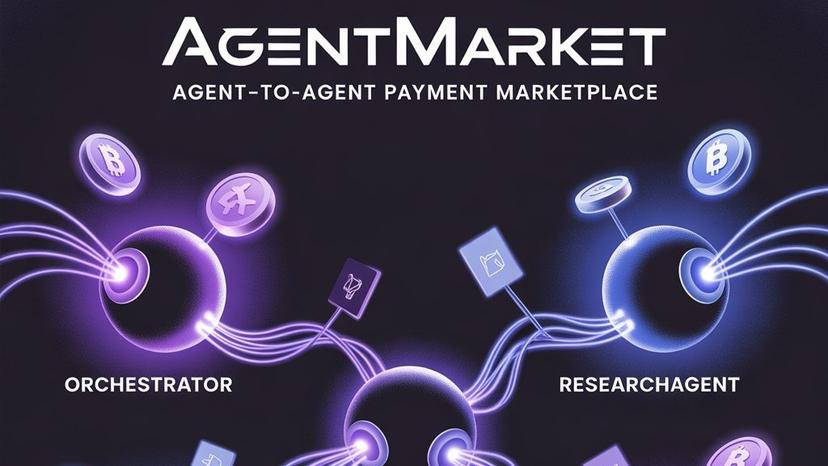
Agent market
AgentMarket is an autonomous agent-to-agent payment marketplace built on Arc blockchain using Circle Nanopayments and USDC. It solves a core problem in the agentic economy: AI agents cannot pay each other on traditional blockchains because gas fees ($2–$5 per transfer on Ethereum) make sub-cent transactions completely unviable. Arc with Circle Nanopayments eliminates this — enabling $0.001 per-job settlements that are profitable at scale. How it works: A user submits a prompt. The Orchestrator agent breaks it into subtasks and autonomously hires three specialists. The ResearchAgent gathers information. The WriterAgent produces polished content. The AnalystAgent scores quality with a structured evaluation. Each hire triggers one Circle Nanopayment on Arc — three on-chain transactions per request at $0.003 USDC total. Every agent has its own Circle wallet on Arc. Payments flow wallet-to-wallet between agents, creating a genuine decentralized agent labor market. All transactions are verifiable on the Arc Block Explorer in real time via Socket.io live feed. Stack: Node.js, Express, React 18, MongoDB, Socket.io — full MERN with MVC architecture. Circle Wallets API provisions one wallet per agent and per user. Circle Nanopayments handles sub-cent USDC transfers. Gemini 1.5 Flash powers agent intelligence. Business model: 10% platform fee on agent payments. At one million jobs per day at $0.001 each, that is $1,000 daily volume generating $100 passive revenue — only possible because Arc makes gas costs negligible. AgentMarket proves the agentic economy is real and it runs on Arc.
26 Apr 2026
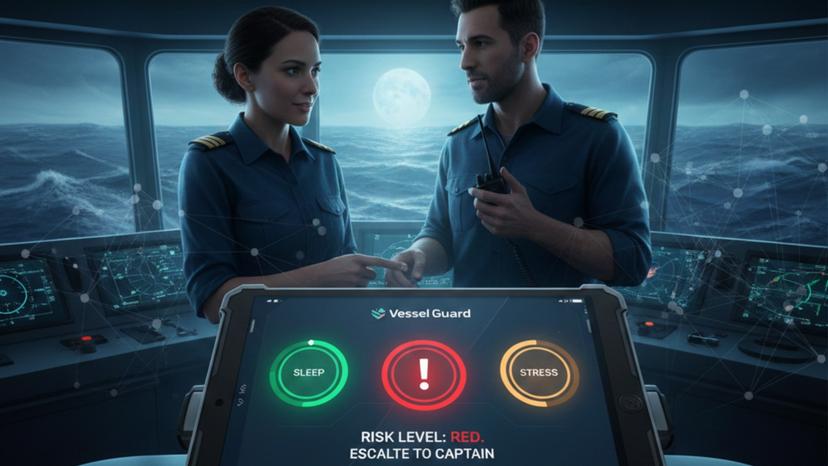
Vessel Guard-AI Based Human Factor Risk Detection
Vessel Guard is an AI-assisted maritime safety system designed to prevent human-error-related accidents caused by fatigue, stress, and reduced operational readiness onboard vessels. Life at sea exposes crew members to shift work, sleep fragmentation, vibration, isolation, and high-risk tasks in deck, engine, and bridge operations. While many shipping companies provide access to teletherapy with reactive tools and disconnected from daily operational safety decisions. They do not integrate fatigue thresholds, maritime regulations, or structured escalation to command. Vessel Guard addresses this by combining short daily crew check-ins with a deterministic rules engine based on MLC fatigue standards and wellbeing scales. The system translates human factors into operational risk levels ) and escalates only high-risk cases to the Captain or designated officer. The AI layer does not diagnose or classify risk. It extracts structured data and generates safety-focused summaries, while final decisions remain human-controlled. This human-in-the-loop design ensures regulatory alignment, privacy protection, and institutional credibility. Vessel Guard is designed for maritime sector seeking proactive duty-of-care compliance, improved safety culture, and measurable reduction of fatigue-related incidents—without adding administrative burden to crew.
15 Feb 2026
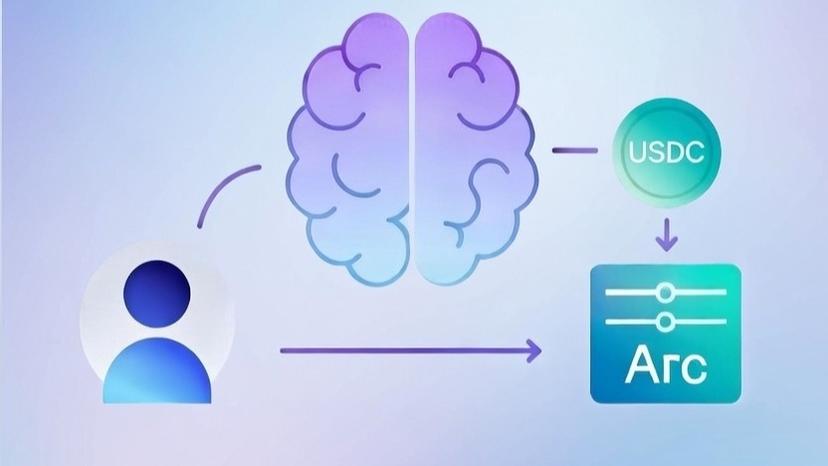
Trustless AI Agent for Pay-Per-Task on Arc
Trustless AI Agent is a demonstration of agentic commerce, showing how autonomous AI systems can transparently price tasks and settle payments in USDC on the Arc blockchain using Circle’s developer infrastructure. The project addresses a common problem in AI services: pricing trust. Users often do not know how much a task should cost, while developers struggle to implement fair, usage-based billing. This challenge becomes more important in agentic systems, where AI agents act autonomously and interact with financial infrastructure. In this system, a user submits a task through a simple frontend. The backend calls Gemini to analyze the input and classify its complexity as LOW, MEDIUM, or HIGH. Based on this classification, the AI suggests whether the task should be free or paid and proposes a USDC amount. To keep the system trustless, the AI never directly controls payments. The backend enforces deterministic guardrails using a fixed pricing table. Even if the AI output is incorrect or attempts to overcharge, the backend corrects it before any transaction occurs, ensuring predictable and auditable behavior. If payment is required, the backend executes a USDC transfer using Circle Developer-Controlled Wallets, settling the transaction on Arc Testnet. Wallet balances can be queried to verify that funds were transferred correctly, demonstrating real onchain settlement. Circle Product Feedback This project uses Arc Testnet, USDC, and Circle Developer-Controlled Wallets. Circle Wallets enable secure, programmable wallet management suitable for autonomous agents, while USDC provides stable pricing for pay-per-task models. Wallet creation, balance checks, and transfers worked well. The main challenge was limited Arc-specific end-to-end examples. More agent-focused reference implementations would improve the developer experience.
24 Jan 2026


