
Abhishek J S@abhiGeniusMan
3
Events attended
3
Submissions made
India
1 year of experience
About me
I am Abhishek J S, a Software Development Engineer with a background in Computer Science and Engineering. I have hands-on experience in both software and embedded systems, with a strong focus on C/C++, backend development, and system-level programming. I began my professional journey with a one-year apprenticeship in Qt development, where I built desktop applications and worked with multimedia tools such as FFmpeg. Since then, I have developed multiple projects, including a NES emulator using Qt and C++, a screen recording application, and a feature-rich Tetris game using SFML. I also have practical experience in embedded systems and digital design, working with technologies such as VHDL, Verilog, and FPGA-based systems. My knowledge extends to high-speed interfaces like DDR memory, Ethernet, SPI, UART, and I2C, along with tools like KiCad and others. I am particularly interested in backend development, system design, and low-level programming. Currently, I am preparing for PGCET 2026 while continuing to strengthen my skills in System Architecture, Computer Science and Engineering, and related domains.
🤝 Top Collaborators


.png&w=640&q=75)
🤓 Latest Submissions
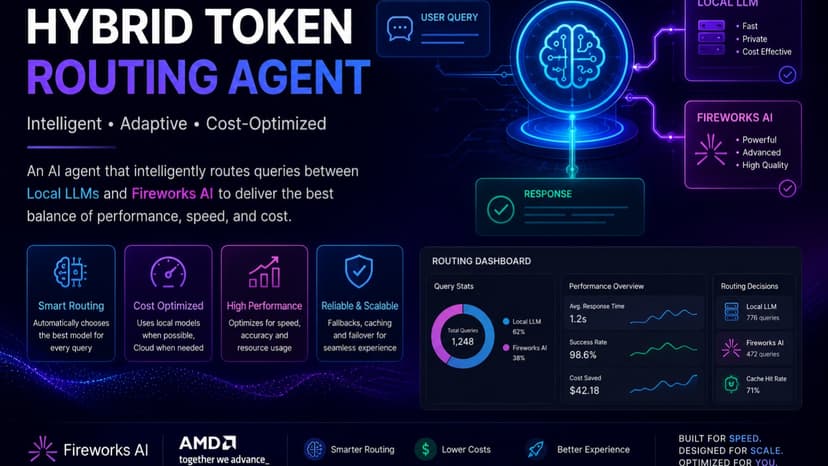
Hybrid Token-Efficient AI Routing Agent
Hybrid Token-Efficient AI Routing Agent is an intelligent multi-model routing system designed to optimize large language model (LLM) inference by dynamically selecting the most appropriate AI model for each user prompt. Instead of sending every request to a large, expensive model, the system analyzes the prompt's intent and complexity, estimates the required reasoning capability, and routes it to the most cost-effective model available. It incorporates confidence scoring and quality validation, automatically escalating complex or low-confidence responses to more capable models when necessary. Built with FastAPI, React, and TypeScript, the application integrates with Fireworks AI to access powerful open-source models such as GPT-OSS-120B, enabling scalable and efficient AI inference on AMD infrastructure. The system also provides token usage analytics, routing metrics, and model selection transparency through an interactive web interface. By reducing unnecessary token consumption, lowering inference latency, and optimizing API costs while maintaining response quality, the Hybrid Token-Efficient AI Routing Agent demonstrates an efficient approach to deploying AI applications in production. This project showcases intelligent AI orchestration, dynamic model routing, and practical optimization techniques for real-world generative AI systems.
13 Jul 2026
Vision-Link AI: Genomic & CRISPR Agent
Vision-Link AI Hub presents an innovative, autonomous AI-Agent system specifically architected for precision genomics and CRISPR analysis tailored for Sub-Saharan African communities. Built using IBM watsonx.ai and advanced multi-agent workflows, the platform accelerates genomic data interpretation and guide-RNA design. To minimize hallucinations in critical biomedical analysis, the system integrates Retrieval-Augmented Generation (RAG) anchored to verified genomic data. Furthermore, it addresses local accessibility gaps by featuring a multilingual natural language interface (supporting Hausa and Swahili) and offline synchronization capabilities, ensuring researchers in low-resource environments can effectively access life-saving genetic intelligence.
17 May 2026

VISION-LINK AI: Offline CRISPR Diagnostic Hub
Vision-Link AI Hub: Revolutionizing Rural Diagnostics The Problem: In many rural areas across the Global South, access to advanced molecular diagnostics is limited by poor internet connectivity and high costs. Medical practitioners lack the tools to interpret complex CRISPR and genomic data locally. Our Solution: Vision-Link AI is a lightweight, offline-first AI agent designed for the AMD AI ecosystem. It enables healthcare workers to perform rapid molecular diagnostic assistance without needing a cloud connection. By utilizing optimized Small Language Models (SLMs), we bring the power of bioinformatics to the edge. Key Features: Offline Inference: Runs locally on AMD hardware using ROCm, ensuring data privacy and accessibility. CRISPR Analysis: Specialized logic to assist in interpreting molecular diagnostic results. Multilingual Support: Designed to serve diverse global populations. Technical Stack: Built with Python and Next.js, leveraging the Qwen2.5-0.5B model for its high efficiency-to-size ratio. Optimized for AMD accelerators to ensure low latency in critical medical scenarios.
10 May 2026


