ilya indra@indra
3
Events attended
2
Submissions made
Poland
2+ years of experience
About me
Indra here, with Soma.ai. Turn branding from a challenge into a joyful journey. Be a part of brand new revolution. Join & Radiate the Joy! 💖
I built with
ElevenLabs🤝 Top Collaborators

.png&w=640&q=75)
🤓 Latest Submissions
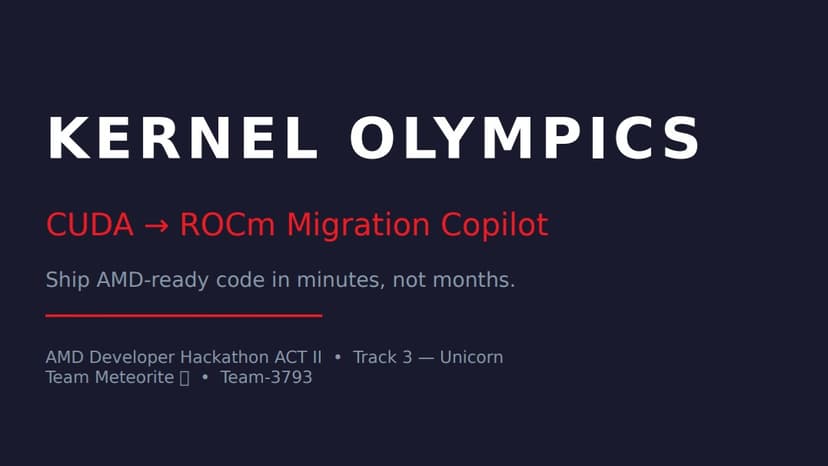
Kernel Olympics — CUDA→ROCm Migration Copilot
Problem AMD MI300X GPUs offer better price-performance than NVIDIA GPUs, but many enterprises remain locked into CUDA because about 20% of custom kernels cannot be migrated with hipify. These kernels contain warp-sensitive logic, shfl operations, and CUDA-specific APIs that require weeks of manual engineering, making migration the biggest barrier to ROCm adoption. Solution Kernel Olympics is a four-LLM pipeline that automates CUDA-to-ROCm migration using DeepSeek v4, GLM-5.2, Kimi-K2.7, and Gemma. It classifies kernels, generates HIP code, validates correctness, verifies execution on AMD hardware, and produces migration reports. Hipify-clang converts about 96.7% of CUDA syntax, while our classifiers detect high-risk patterns such as warp and wavefront divergence. A custom strip_to_kernel_only preprocessing step removes host code, improving translation accuracy. Generated code passes through three validation stages. The lexical gate rejects non-code output, the structural gate checks syntax and symbol preservation, and the semantic gate runs 31 tests with under 1% false positives. Failed outputs automatically retry with targeted feedback. A trigram-based pattern cache reuses previous solutions, reducing repeated migrations from about 12-second LLM calls to 0.2 ms lookups. Migrated kernels are compiled with hipcc on AMD MI300X using ROCm 7.2, executed, and compared byte-for-byte against CUDA outputs. Gemma then generates a plain-English migration summary. Key Innovations * Four-LLM autonomous workflow. * strip_to_kernel_only preprocessing. * Three-stage validation pipeline. * Pattern memory with 60,000× faster lookups. * Deterministic debug tracing. Performance Typical runtime is 105 seconds per kernel at $0.02-$0.05. The system migrates over 30 kernels per hour, performs 0.2 ms cache lookups, and maintains under 1% validation false positives.
13 Jul 2026
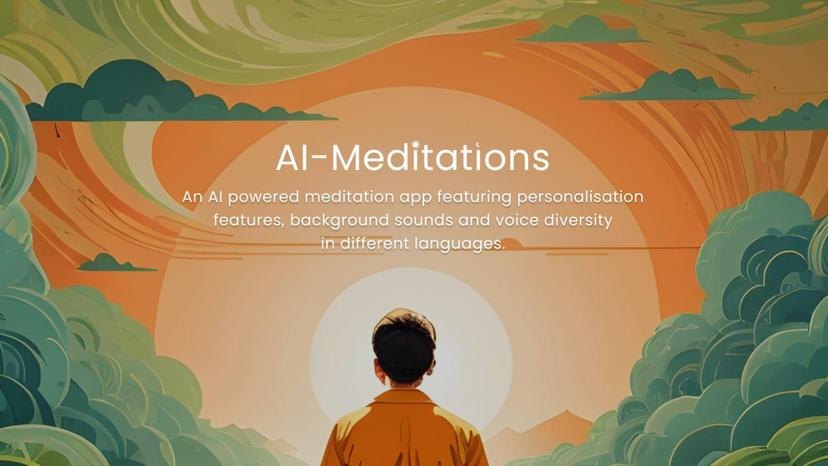
AI Meditations App
AI Meditations app empowers individuals to take control of their mental well-being and life and achieve their goals, easily through personalized meditations. Our distinct proposition lies in the mix of meditation with self-programming techniques, all powered by AI. We intend to make this app a trustworthy friend in everyone's mindfulness journey, enabling each user to create a unique meditation tailored to their specific requests. Our app includes the set of customizable features such as voice diversity, language preferences, and background music. In the future, we will add duration, more advanced music library and voice emotions. Our primary audience covers health-conscious individuals, mindfulness enthusiasts, and professionals seeking stress relief. The market potential is in favor, there are very few direct competitors, and demand for mental health boost is growing (see the slide 23 in the presentation). Our goal within one year of launch is to garner 30-50k users with an engagement rate of at least 30%. We aim for a user base comprising 85% free users and 15% paid users. Our mission is to enhance individual well-being, embodying our slogan, 'You are the director of your meditation!' On the technical front, the app is built using Python, leveraging the OpenAI API for AI functionalities and Eleven Labs' text-to-voice feature to deliver a cool meditation experience. As for a frontend, we used React to make the user interface intuitive and friendly.
1 Aug 2023