.png&w=256&q=75)
🤝 Top Collaborators
.png&w=640&q=75)
.png&w=640&q=75)
🤓 Latest Submissions

SafeHands AI: Compliance Orchestrator
The Problem Logistics and freight insurance fraud costs enterprises billions annually. Currently, human adjusters must manually read a driver's transcript (e.g., "the cargo was completely destroyed") and cross-reference it against photographic evidence to approve or reject a claim. This process is slow, expensive, and highly prone to error. Our Solution: SafeHands AI SafeHands AI completely automates this process using a distributed multi-agent system built on the Band network. We ingeniously divided the cognitive load across three specialized, independent remote agents that collaborate over Band WebSockets to make high-stakes financial decisions: 1. The Intake Agent (Powered by Featherless Llama 3.1 8B): Listens to the driver's unstructured voice dictation, parses the messy input, and extracts structured JSON containing the claimed cargo type and claimed damage severity. 2. The Vision Agent (Powered by Featherless Qwen2.5-VL 72B): Acts as the "eyes" of the operation. It analyzes the uploaded cargo image, detects the physical cargo type, and independently estimates the actual damage percentage using multi-modal visual reasoning. 3. The Compliance Agent (Powered by AI/ML API Llama 3.3 70B): The central decision-maker. It receives the context from both the Intake and Vision agents via Band and cross-references them to catch discrepancies. If a driver claims 100% damage but the Vision agent detects only 30% damage, the Compliance Agent instantly flags the discrepancy and REJECTS the claim, logging the decision to an immutable ledger. If the evidence matches, the claim is APPROVED. Why it fits the Hackathon SafeHands AI was built specifically for Track 3: Regulated & High-Stakes Workflows. Band is not just a wrapper in our project; it is the absolute backbone coordination layer allowing our independent Python agent processes to discover each other, divide work, and seamlessly share context across different LLM provider frameworks.
19 Jun 2026

Anti-Greenwashing Scorecard
Brands increasingly use words like "Conscious," "Eco-Friendly," and "Sustainable" as marketing buzzwords to sell products, without backing them up with transparent supply chains or verifiable certifications. This is known as Greenwashing. Consumers find it nearly impossible to manually verify the reality behind these claims while shopping online. The Anti-Greenwashing Scorecard acts as an instant auditor. By simply pasting an e-commerce product URL into the dashboard, our multi-agent AI system: Bypasses anti-bot protections on e-commerce sites to extract the raw product text and claims using Bright Data's Scraping Browser infrastructure. Analyzes the extracted claims against a massive LLM knowledge base (Google Gemini 2.5 Pro) to check for authentic ESG practices versus vague buzzwords. Generates an instant "Trust Score" and breaks down the brand's sustainability across 5 key metrics: Materials, Labor, Carbon, Transparency, and Circularity, displayed on an interactive Radar Chart. We focused heavily on building a premium, cinematic user experience. Built with Next.js and Framer Motion, the dashboard features a live "Multi-Agent Terminal" that visually simulates the backend AI scraping and thought processes in real-time, providing transparency into how the AI is evaluating the brand.
31 May 2026

Cerberus Gate
CerberusGate addresses a critical gap in enterprise LLM deployment: vulnerability to semantic attacks and indirect prompt injections within raw data processing. Built on an autonomous multi-agent pipeline using Gemini 3 Flash, the platform implements a strict defense-in-depth framework across three core pillars: 1. The Sentry Agent actively reads incoming document payloads to parse heuristic patterns and flag adversarial overrides, outputting a dynamic threat index score to trigger system circuit breakers. 2. The Worker Agent processes core operational tasks inside an isolated context instruction set, rendering safe business value without data leakage risk. 3. The Auditor Agent enforces strict compliance by validating final outputs against deterministic Pydantic JSON contracts to eliminate structural drift and hallucinations. By combining low-latency orchestrations with rigid schema enforcement, Cerberus Gate protects complex enterprise data pipelines from direct manipulation while providing transparent, auditable security logs.
19 May 2026
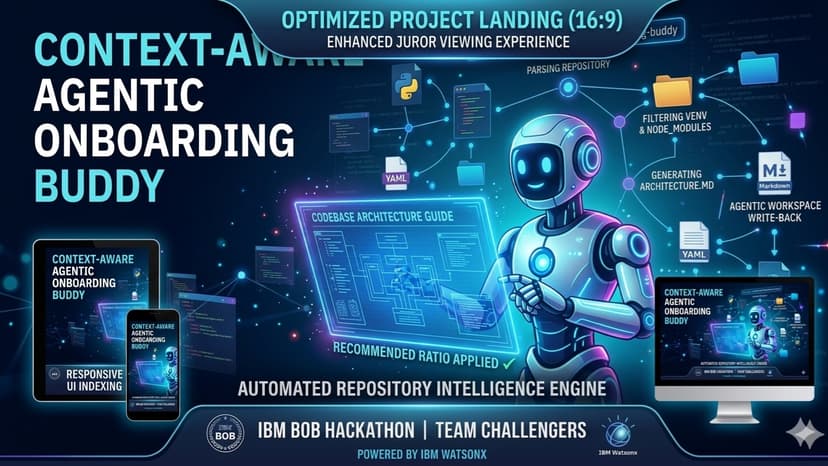
Context-Aware Agentic Onboarding Buddy
The Context-Aware Agentic Onboarding Buddy is an innovative developer experience (DX) tool created to eliminate the friction and delay typically associated with onboarding developers onto legacy or complex multi-file codebases. By leveraging local lightweight Python scripting alongside the multi-file reasoning capabilities of IBM Bob, this utility solves a massive industry pain point: outdated, manually maintained repository guides. The technical workflow operates seamlessly in three separate layers. First, a local ingestion engine built in Python crawls the repository root directory, applying intelligent directory exclusion matrices to filter out virtual environments, dependency folders, and temporary build caches. This isolates only active core code files and prints an optimized structural payload template. Second, this compressed metadata template is fed directly into IBM Bob under a custom 'ArchitectureArchitect' mode, bypassing token limits and local noise. Third, IBM Bob executes a multi-step planning loop, parsing codebase interdependencies, configuration scripts, and components. It then automatically writes a permanent, clean architectural guide ('ARCHITECTURE.md') directly back into the repository disk workspace. This automation bridges the gap between active development and up-to-date documentation. It replaces manual, error-prone mapping sessions with a 5-second automated asset, giving engineers instant clarity on Component routers, configurations, and core application structures.
17 May 2026


