
Hamna Munir@HamnaMunir
4
Events attended
4
Submissions made
1 year of experience
About me
I am an aspiring AI/ML Engineer and Software Engineering student with hands-on experience through an AI/ML internship. My skills span machine learning, deep learning, generative AI, data engineering, and MLOps. Passionate about solving real-world problems with AI, I am building a strong portfolio of projects while preparing to grow into industry-level roles. I value continuous learning, collaboration, and contributing to innovative technology solutions.
🤝 Top Collaborators

.png&w=640&q=75)
.png&w=640&q=75)
🤓 Latest Submissions
PaperBand AI
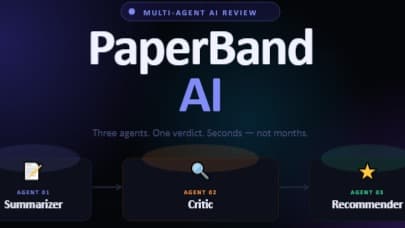
PaperBand AI is a multi-agent research paper review system built for academics, students, and conference organizers who need fast, structured feedback on academic work. Instead of waiting weeks for peer review, users simply upload any research PDF and three specialized AI agents go to work collaboratively. Agent 1 (Summarizer) reads the full paper and extracts the title, authors, research problem, methodology, key results, and conclusion into a clean structured format. Agent 2 (Critic) receives that summary through a shared Band Room message bus and performs a rigorous peer-review-style analysis — identifying strengths, weaknesses, missing experiments, and limitations. Agent 3 (Recommender) reads both the summary and critique, then scores the paper from 1 to 10 and issues a formal publication decision: Accept, Accept with Minor Revisions, Major Revisions Required, or Reject — with a written justification and future research suggestions. All three agents communicate through a custom BandRoom, a shared in-process message bus that simulates real agent collaboration. The entire pipeline runs on Groq's free LLaMA 3.3 70B model, making it blazing fast and completely free to use. The frontend is built in Streamlit with a custom dark academic UI, and the project is structured as a clean modular Python codebase with separate agent classes, a PDF reader utility, and secure API key management via dotenv. PaperBand AI was built in one day as a hackathon project by Team IDEA — a five-person team specializing in Data and Agentic AI.
19 Jun 2026

VanGuard - Open Web Theart Intelligence
VANGUARD is an AI-powered open web threat intelligence platform built to fill the blind spots that traditional security tools miss. While SIEMs and firewalls protect the perimeter, they can't see credential dumps on paste sites, silent regulatory updates, or vendor breaches spreading across the open web. VANGUARD solves this by running three parallel detection modules — a Threat Surface Monitor, a Regulatory Change Tracker, and a Vendor Risk Radar — that continuously scan the open web for signals relevant to your organization. All findings are fed into Groq's LLaMA-3.3-70B model, which classifies each alert by severity, extracts indicators of compromise, and generates actionable recommendations in under 30 seconds. Built with React and Vite on the frontend and deployed on Netlify, VANGUARD delivers a cinematic, real-time threat dashboard that turns raw open-web noise into a structured, severity-ranked intelligence report — giving security teams the early warning system they've always needed, powered entirely by AI.
31 May 2026
PromptGuard-AI
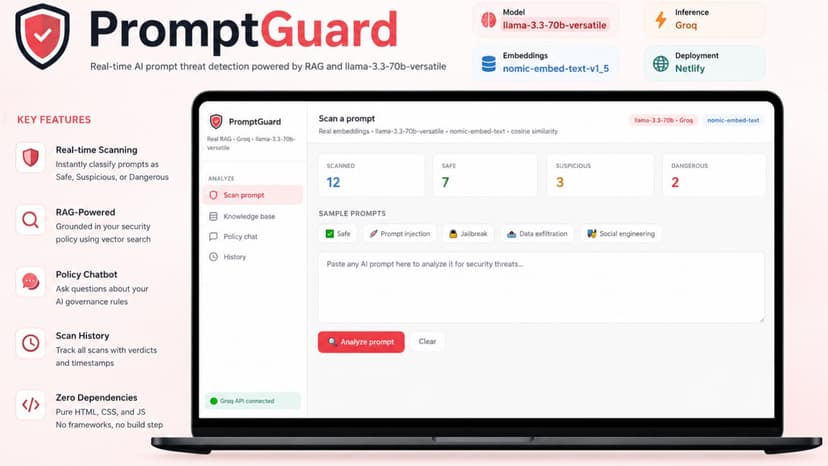
PromptGuard is an AI security platform built to protect LLM-based applications from adversarial prompts. It analyzes user inputs in real-time and classifies them as Safe, Suspicious, or Dangerous using Meta's llama-3.3-70b-versatile model running on Groq's ultra-fast inference API. What sets it apart is its RAG pipeline — organizations can upload their own security policies, which get chunked, embedded into 768-dimensional vectors using nomic-embed-text, and searched via cosine similarity at query time, so every verdict is grounded in your actual rules. It also includes a policy Q&A chatbot for natural language queries against your knowledge base. Built as a zero-dependency single HTML file and deployed on Netlify, PromptGuard requires no build step and goes live in under 60 seconds.
19 May 2026
RepoPilot-AI
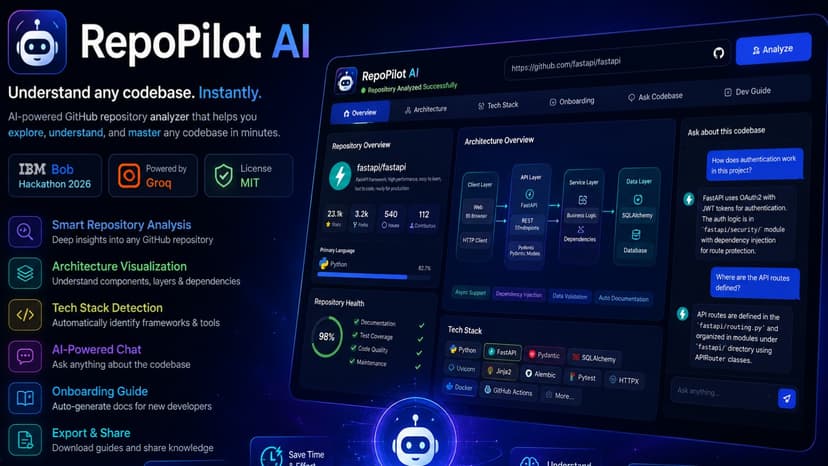
RepoPilot AI is an AI-powered web application designed to help developers quickly understand and analyze GitHub repositories. Built for the IBM Bob Hackathon 2026, the platform simplifies the process of exploring unfamiliar codebases by using artificial intelligence to generate insights about a repository’s architecture, technologies, and overall structure. Instead of manually reading hundreds of files, developers can instantly receive organized explanations and summaries, making onboarding and project understanding significantly faster. The application works as a single-page web app, meaning everything runs inside the browser without requiring complicated installation steps or backend setup. Users simply provide the URL of a public GitHub repository, and RepoPilot AI automatically fetches repository data using the GitHub API. It then processes the information with the help of Groq large language models to generate intelligent analyses. This allows developers to quickly identify frameworks, libraries, dependencies, and architectural patterns used in a project. One of the main strengths of RepoPilot AI is its ability to visualize and explain software architecture. The platform helps users understand how different parts of a project are connected, including system layers, modules, and dependencies. This is especially useful for developers joining a new team or contributing to open-source projects, as it reduces the time needed to understand complex codebases. The application also includes an AI-powered chat feature that allows users to ask questions directly about the repository. Developers can interact with the codebase conversationally by asking questions such as how authentication works, where APIs are defined, or which technologies are used in the project. The AI responds with context-aware answers, creating an experience similar to having a knowledgeable assistant explain the repository in real time.
17 May 2026


