.png&w=256&q=75)
sadia usman@Frost_Flashlog3
11
Events attended
11
Submissions made
Pakistan
1 year of experience
About me
I am Sadia Usman, a motivated and detail-oriented individual with a strong interest in Data Science. I have hands-on experience in Python, SQL, Machine Learning, Project Management and a passion for solving real-world problems through innovative solutions. I have worked on projects such as “developing a heart disease prediction model using ML” or “building a water billing management system with Flask. These experiences have helped me strengthen my expertise in [list 2–3 major skills]. My goal is to grow as a python developer and machine learning and contribute to impactful projects that make a difference.
🤝 Top Collaborators


🤓 Latest Submissions
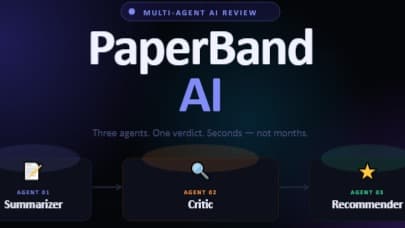
PaperBand AI
PaperBand AI is a multi-agent research paper review system built for academics, students, and conference organizers who need fast, structured feedback on academic work. Instead of waiting weeks for peer review, users simply upload any research PDF and three specialized AI agents go to work collaboratively. Agent 1 (Summarizer) reads the full paper and extracts the title, authors, research problem, methodology, key results, and conclusion into a clean structured format. Agent 2 (Critic) receives that summary through a shared Band Room message bus and performs a rigorous peer-review-style analysis — identifying strengths, weaknesses, missing experiments, and limitations. Agent 3 (Recommender) reads both the summary and critique, then scores the paper from 1 to 10 and issues a formal publication decision: Accept, Accept with Minor Revisions, Major Revisions Required, or Reject — with a written justification and future research suggestions. All three agents communicate through a custom BandRoom, a shared in-process message bus that simulates real agent collaboration. The entire pipeline runs on Groq's free LLaMA 3.3 70B model, making it blazing fast and completely free to use. The frontend is built in Streamlit with a custom dark academic UI, and the project is structured as a clean modular Python codebase with separate agent classes, a PDF reader utility, and secure API key management via dotenv. PaperBand AI was built in one day as a hackathon project by Team IDEA — a five-person team specializing in Data and Agentic AI.
19 Jun 2026
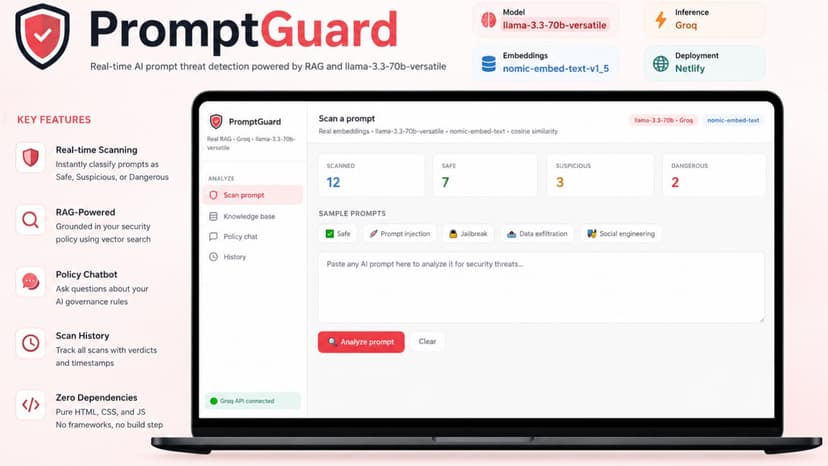
PromptGuard-AI
PromptGuard is an AI security platform built to protect LLM-based applications from adversarial prompts. It analyzes user inputs in real-time and classifies them as Safe, Suspicious, or Dangerous using Meta's llama-3.3-70b-versatile model running on Groq's ultra-fast inference API. What sets it apart is its RAG pipeline — organizations can upload their own security policies, which get chunked, embedded into 768-dimensional vectors using nomic-embed-text, and searched via cosine similarity at query time, so every verdict is grounded in your actual rules. It also includes a policy Q&A chatbot for natural language queries against your knowledge base. Built as a zero-dependency single HTML file and deployed on Netlify, PromptGuard requires no build step and goes live in under 60 seconds.
19 May 2026
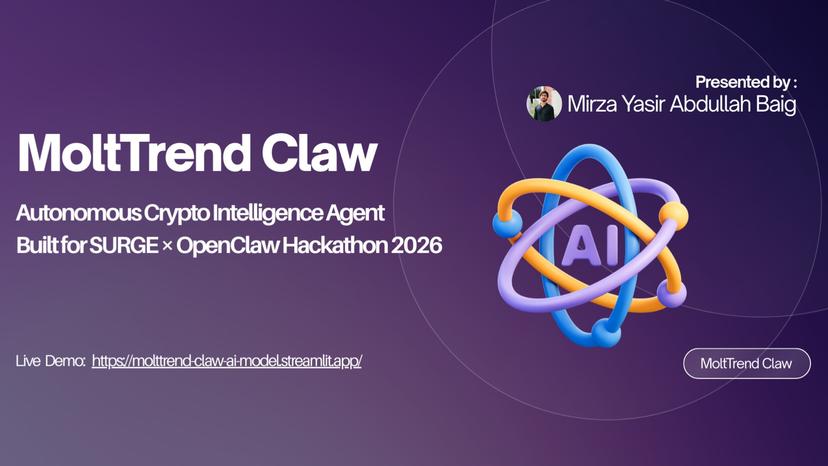
MoltTrend Claw
MoltTrend Claw is a privacy-first autonomous crypto intelligence agent developed for the SURGE × OpenClaw Hackathon. Built on the OpenClaw sovereign, local-first runtime, the agent continuously monitors live cryptocurrency trends using the CoinGecko API and applies advanced AI reasoning through Gemini to detect emerging market narratives. It analyzes sentiment shifts, identifies momentum patterns, and transforms raw market data into structured, actionable insights without requiring constant human supervision. Designed with persistent memory and long-term analytical capabilities, MoltTrend Claw stores historical trend data in JSON to track narrative evolution over time. Through its multi-page Streamlit dashboard, users can explore real-time trend metrics, visual analytics, and historical agent-generated reports. By combining autonomous execution, intelligent forecasting, and structured memory, the project demonstrates how AI agents can support smarter, data-driven crypto decision-making while maintaining user privacy and local control.
28 Feb 2026
SmartStore-AI
SmartStore AI is a simulation-based robotics startup prototype built to address one of retail’s most common and costly challenges: inefficient shelf monitoring and delayed restocking. Retail stores frequently experience out-of-stock situations that lead to lost sales and poor customer experience due to manual and reactive monitoring processes. SmartStore AI solves this by introducing an AI-driven system that continuously monitors shelf status, tracks customer traffic intensity, and measures how long shelves remain empty. Using a priority-based decision engine, the system automatically generates restocking tasks and simulates an autonomous robot executing them through a structured workflow (Dock → Shelf → Restock → Return). Built with Python and Streamlit, the platform includes a live interactive dashboard that displays shelf conditions, traffic levels, robot position, restocking activity, and performance metrics in real time. Designed as a simulation-first solution, SmartStore AI validates autonomous retail operations in a safe and scalable environment, while laying the foundation for future expansion into multi-robot systems, digital twin environments, computer vision integration, and demand forecasting. The project represents a production-minded, startup-ready robotics solution that bridges AI, automation, and retail intelligence.
15 Feb 2026

DevBug-AI
DevBug-AI is an AI-powered system that automates bug classification and developer recommendation for software teams. As applications scale, bug triage becomes slow and error-prone due to unclear reports, inconsistent categorization, and manual assignment. DevBug-AI removes this bottleneck by intelligently analyzing bug reports and assigning them to the most suitable developers. Using natural language processing and machine learning, the system classifies bugs from their title and description and recommends the top three developers based on historical bug data, domain, and tech stack. Confidence scores are provided to support reliable decision-making. The solution is built as a Streamlit web app with a unified ML pipeline. It uses TF-IDF and sentence embeddings for text understanding, Scikit-learn for bug classification, and LightGBM for developer recommendation. The system is trained on 50,000+ real bug reports and gracefully handles unseen technologies by mapping them to an “Other” category. DevBug-AI reduces triage time, improves assignment accuracy, and enables data-driven bug management at scale. Future work includes integrations with Jira and GitHub, workload-aware recommendations, and LLM-based bug summarization—making it a practical, production-oriented AI solution for modern engineering teams.
7 Feb 2026

AgentPay
AgentPay-AI is a proof-of-concept platform that demonstrates how Generative AI services can be monetized using pay-per-use, token-based billing—similar to real-world AI APIs. Built with Streamlit and Google Gemini, the system simulates a USDC-style wallet that estimates token usage, deducts balance per request, and only executes AI tasks when sufficient funds are available. This project addresses a major gap in AI demos: cost transparency and usage accountability. AgentPay-AI showcases how AI-as-a-Service (AIaaS), agent marketplaces, and crypto-enabled AI platforms can implement realistic billing logic. Key Highlights: Token-based cost estimation Simulated USDC wallet per session Controlled AI execution based on balance Google Gemini / PaLM integration Simple, intuitive UI Designed as a hackathon and portfolio project for GenAI, SaaS, and Web3 applications.
24 Jan 2026
AdmitWise
An AI-powered interactive web application built with Streamlit that predicts whether a candidate will get placed in a job (or admitted) based on academic performance and other features. The model simplifies decision-making for students, HR teams, and academic advisors by providing data-driven placement predictions. The user inputs academic and background features, including: SSC percentage HSC percentage Degree percentage MBA percentage Work experience Specialization Gender And more Inputs are one-hot encoded for categorical features. A Logistic Regression model (trained offline) is loaded using Pickle. The model outputs a binary prediction: “Placed” or “Not Placed”. The result is displayed on the Streamlit app in a clear, user-friendly format.
7 Dec 2025

AskTheWeb AI Website QnA Assistant
AskTheWeb: AI-Powered Website Question Answering System AskTheWeb (also known as WebMind AI) is an advanced Question-Answering application designed to tackle information overload by transforming static websites into interactive, conversational experiences. Built using Streamlit, the application leverages the speed and intelligence of Google Gemini 2.0 Flash to understand and synthesize web content in real-time. The core functionality relies on a robust RAG (Retrieval-Augmented Generation) pipeline designed for accuracy and persistence. When a user inputs a URL, the system employs Requests and BeautifulSoup to scrape and clean the HTML data, acting as an efficient ETL transformer to remove messy code and script tags. This cleaned text is converted into high-dimensional vector embeddings using Google’s GenAI SDK and stored in ChromaDB, which acts as the application's "Long-Term Memory". This architecture allows users—such as students, researchers, and analysts—to ask complex natural language questions and receive instant answers that are grounded specifically in the context of the provided URL. Unlike standard chatbots, AskTheWeb ensures that answers are relevant to the specific source material provided. We also addressed significant technical challenges during development, specifically ensuring compatibility with cloud environments. We implemented a custom solution using pysqlite3-binary to patch SQLite version incompatibilities on Streamlit Cloud, ensuring the vector database runs smoothly in production. The result is a scalable, modular tool that makes researching the web faster and more intuitive.
19 Nov 2025
AgentFlow AI-Powered Productivity
AgentFlow: AI for Productivity A smart to-do list that prioritizes tasks into 4 quadrants: Urgent & Important | Important, Not Urgent | Urgent, Not Important | Not Urgent, Not Important AI agents provide instant resources & tools for each task. Users can add custom agents or discover new ones from lablab.ai How It Works Tech Stack: Frontend: Next.js + TailwindCSS AI: Gemini 2.5 Flash Deployment: Vercel Process: User creates a task. AgentFlow assigns it to the right priority box. AI recommends best agents/resources (e.g., blog writer, code assistant). Task can be tracked, updated, or deleted once done.
21 Sep 2025


