
🤝 Top Collaborators


🤓 Latest Submissions
Vertex Real Time Ad Verification
As many know, Digital Advertising is as billion dollar industry and there are huge corporations all with their own advertising tech built to take value at every step. If you want to put your ad online for your customers to see? You better be ready to pay Google, to pay Amazon, Pay Meta just for the opportunity say nothing of the effectiveness. And if you want your ad to be seen by someone who is actually relevant to your business? That costs extra. All advertisers want to ensure they are showing up on the right content and they want to be doubly sure they are not showing up on the wrong content. That’s why companies like DoubleVerify and IAS have built massive business models around this concept, largely driven by fear and the unknown. Vertex Verified Ads demystifies and simplifies this process making it accessible to all. So what makes us different than the other guys doing Ad verification? 1. We unify the stack on both the Buy Side and the Sell Side which mean no more extra fees, and no more double paying for the same verification. 2. We execute in Real-Time while charging as low of a fee as physically possible, peace of mind shouldnt be complicated or expensive. This means we are actually doing more than the traditional model with less resources, we are able to catch more bad actors and do it at a lower cost and are thus able to pass on those savings 3. With advanced automation and Bright Data tools we enable even basic users to access the same premium verification services at any scale as all major Advertisers and Publishers Because of this setup modern stacks like this can really blow legacy software out of the water; so much so that I see major companies desperately trying to modernize using some of the same tools you see here in this demo, except they want to charge even more for it on top of the current fees. Vertex verified ads is really about democratizing ad verification and bringing access to safe and scalable programmatic advertising to all.
31 May 2026
Vertex Verifed Ads Platform
Digital Advertising is as billion dollar industry and there are huge corporations all with their own advertising tech built to take value at every step. If you want to put your ad online for your customers to see? You better be ready to pay Google, to pay Amazon, Pay Meta just for the opportunity say nothing of the effectiveness. And if you want your ad to be seen by someone who is actually relevant to your business? That costs extra. All advertisers want to ensure they are showing up on the right content and they want to be doubly sure they are not showing up on the wrong content. That’s why companies like DoubleVerify and IAS have built massive business models around this concept, largely driven by fear and the unknown. Vertex Verified Ads demystifies and simplifies this process making it accessible to all. So what makes us different than the other guys doing Ad verification? 1. We unify the stack on both the Buy Side and the Sell Side which mean no more extra fees, and no more double paying for the same verification. 2. We execute in Real-Time while charging as low of a fee as physically possible, peace of mind shouldnt be complicated or expensive. This means we are actually doing more than the traditional model with less resources, we are able to catch more bad actors and do it at a lower cost and are thus able to pass on those savings 3. With Automation we enable even basic users to access the same premium verification services at any scale as all major Advertisers and Publishers Because of this setup and the tools we have available to us today, modern stacks can really blow legacy software out of the water. So much so that I see these companies desperately trying to modernize using some of the same tools you see here in this demo, except they want to charge even more for it on top of the current fees. Vertex verified ads is really about democratizing ad verification and bringing access to safe and scalable programmatic advertising to anyone.
19 May 2026

Intellect — Intelligence Brokerage
Data brokers are a $300B industry built on one broken assumption: that data has to move to be useful. It doesn't. Intellect is a multi-agent intelligence brokerage where companies deploy an Intelligence Agent on top of their private data. External parties — investors, analysts, enterprise buyers — query in natural language and receive aggregated insights only. Raw records never leave the owning company's system. Every response passes through an 8-agent LangGraph pipeline: a Query Router (Gemini Flash) parses natural language into structured queries. An Intelligence Agent runs RAG over a private pgvector store using GROUP BY aggregates — SELECT * never executes. A Benchmark Agent enables cross-company sector comparisons with differential privacy. A Query Explainer justifies every answer in plain English. A Pricing Agent charges by sensitivity tier ($0.01–$0.25). The Privacy Guard (Featherless open-source) is the structural last gate — k-anonymity ≥10, PII stripped, reconstruction attacks blocked. Two background agents handle data quality at ingest and real-time anomaly detection. LangGraph enforces Privacy Guard as the final node structurally — it is impossible to bypass in the graph. This is a correctness guarantee, not a convention. Voice queries stream through Speechmatics real-time STT directly into the pipeline. A Company Dashboard shows data owners their real-time revenue, query history, and anomaly alerts when attack patterns are detected. Built in 4 days by a solo developer. Deployed on Vultr. Powered by Google Gemini. Privacy Guard on Featherless open-source (MIT licensed). The data broker industry exists because data had to move to be useful. Intellect proves it doesn't.
19 May 2026
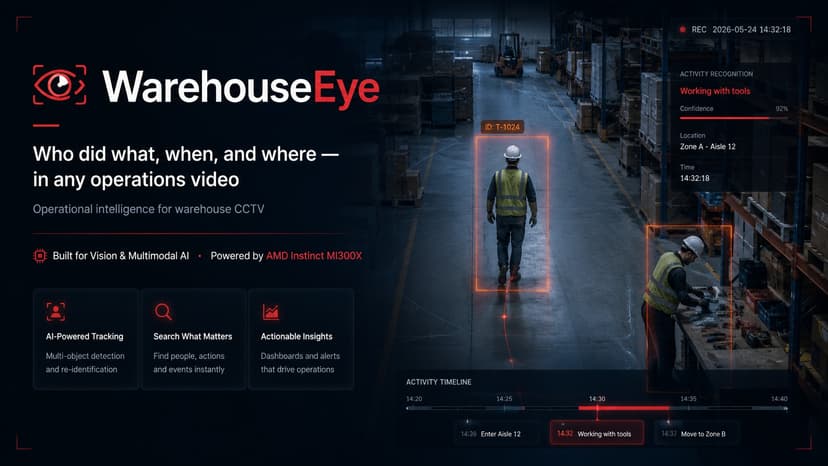
WarehouseEye: Inteligencia Operativa CCTV
WarehouseEye is an operational intelligence platform for warehouse CCTV, built to replace slow and expensive manual video review. Instead of watching hours of footage frame by frame, the system converts video into structured, queryable data that operations and safety teams can use immediately. The pipeline is designed as an end-to-end workflow: (1) frame extraction, (2) person detection with RT-DETRv2, (3) persistent multi-object tracking with ByteTrack to maintain identity continuity, (4) crop-level semantic enrichment using Qwen3-VL to classify activities, zones, and anomaly signals, and (5) SQLite-backed persistence exposed through a FastAPI backend and a Streamlit frontend for timeline exploration and natural-language querying. WarehouseEye also supports optional person Re-ID with pluggable backends (Qwen3-VL embeddings or OSNet) to recover identities after occlusions and temporary tracking loss. This improves continuity in real-world warehouse environments where visibility changes frequently. From a systems perspective, the project targets AMD MI300X deployment so heavy multimodal workloads can run on a single node with simplified operations. This architecture reduces orchestration complexity while keeping throughput practical for production-like scenarios. In internal repository benchmarks, WarehouseEye shows low per-video processing cost and estimated savings versus GPT-4V-style baselines, while preserving track-level traceability and visual evidence. The result is a practical open-source foundation for industrial video analytics: faster incident investigation, better operational visibility, and an extensible stack for safety, compliance, and process optimization use cases.
10 May 2026

Vertex Dynamic Ad Exchange
There are 3 main components of any Ad you see online: the buyer, the seller, and the exchange. Amazon, Meta, Google and more all have billion dollar tech stacks built to serve this transaction and they work really well for the top 20% of users. For the rest of the normal buyers and sellers, the majority, we’re left to fight for the scraps Vertex essentially uses the same components: a buyer, a seller and an exchange as everyone else with a few key differences: 1. We unify the Ad stack for both Buy and Sell Side Current billion dollar platforms like Google, Meta, etc. all extract value at every step and truly advanced ad tech adds even more costs. As mentioned this works pretty well for the top 20% of advertisers and publishers but maybe not so well for the rest of us. Vertex unifies the stack and with nanopayments we are able to charge fees that are a fraction of current models. 2. We execute Sub-Cent Settlement in Real-Time with no Gas Fees Nanopayments are executed in real-time once the auction is won and the ad served. This solution would fail with traditional gas costs because though small in absolute terms gas costs would be a large percentage of each transaction as the winning bids in Programmatic Ad auctions are at the sub-cent level already and thus at scale gas fees would be prohibitively expensive. 3. With Automation we enable even basic users to access the same RTB auction pricing/scale for digital ads as major Advertisers and Publishers. Another major barrier to entry in running Digital Ads is the complexity. DSPs, SSPs, Exchanges, DMPs, Ad servers, Tagging, etc. the whole process can be a lot for even the expert user. With AI technology we are able to simplify this process to a point where any user can explain in real terms what ads they want to run or what ad space they want to sell and with a few prompts to fill in any missing information they can have agents buying or selling ads in real time on our exchange across the entire Open Internet.
26 Apr 2026


