Top Builders

Explore the top contributors showcasing the highest number of app submissions within our community.

Speechmatics Flow

Speechmatics Flow is a speech-to-speech API for building real-time conversational AI agents. Announced in July 2024, it combines Speechmatics' speech recognition with an LLM and text-to-speech into a single API connection, removing the need to stitch together separate transcription, inference, and synthesis services. Flow handles the real-time challenges of two-way voice conversations, including turn detection, interruption management, and multi-speaker isolation.

General
AnnouncedJuly 30, 2024
DeveloperSpeechmatics
TypeVoice agent API (speech-to-speech)
LicenseCommercial API
Documentationdocs.speechmatics.com/voice-agents-flow
GitHubspeechmatics/speechmatics-flow

Core Features

  • End-to-end speech-to-speech pipeline: STT, LLM, and TTS via a single API call.
  • Smart turn detection: uses a small language model (SLM) to decide when a speaker's turn has ended, reducing false triggers.
  • Interruption handling: ignores unintentional interruptions, handles intentional ones gracefully.
  • Speaker locking: isolates a target speaker and filters out background voices in multi-speaker environments.
  • Function calling: connects agents to external tools, APIs, databases, and validation services.
  • Internet search: agents can query live web data (weather, news) during conversations.
  • 55+ language support: same multilingual coverage as Speechmatics' STT API.
  • Conversation moderation: real-time transcript analysis to flag or filter content.
  • Flexible deployment: private SaaS cloud or on-premises.
  • Security: ISO/IEC 27001:2022 certified, GDPR compliant.

Pricing

TierIncluded
FreeUp to 50 hours/month
EnterpriseCustom pricing, contact Speechmatics

Tools and Resources


Ecosystem and Integrations

  • Works with Vapi for no-code voice agent deployments.
  • Works with LiveKit for WebRTC-based real-time infrastructure.
  • Works with Pipecat for open-source voice pipeline orchestration.
  • Supports contact center, healthcare, drive-thru, educational assistant, and smart device use cases.

Get started with the free tier (50 hours/month) or contact Speechmatics for enterprise access at flow-help@speechmatics.com.

speechmatics Speechmatics flow AI technology Hackathon projects

Discover innovative solutions crafted with speechmatics Speechmatics flow AI technology, developed by our community members during our engaging hackathons.
Apohara Synthex

Apohara Synthex

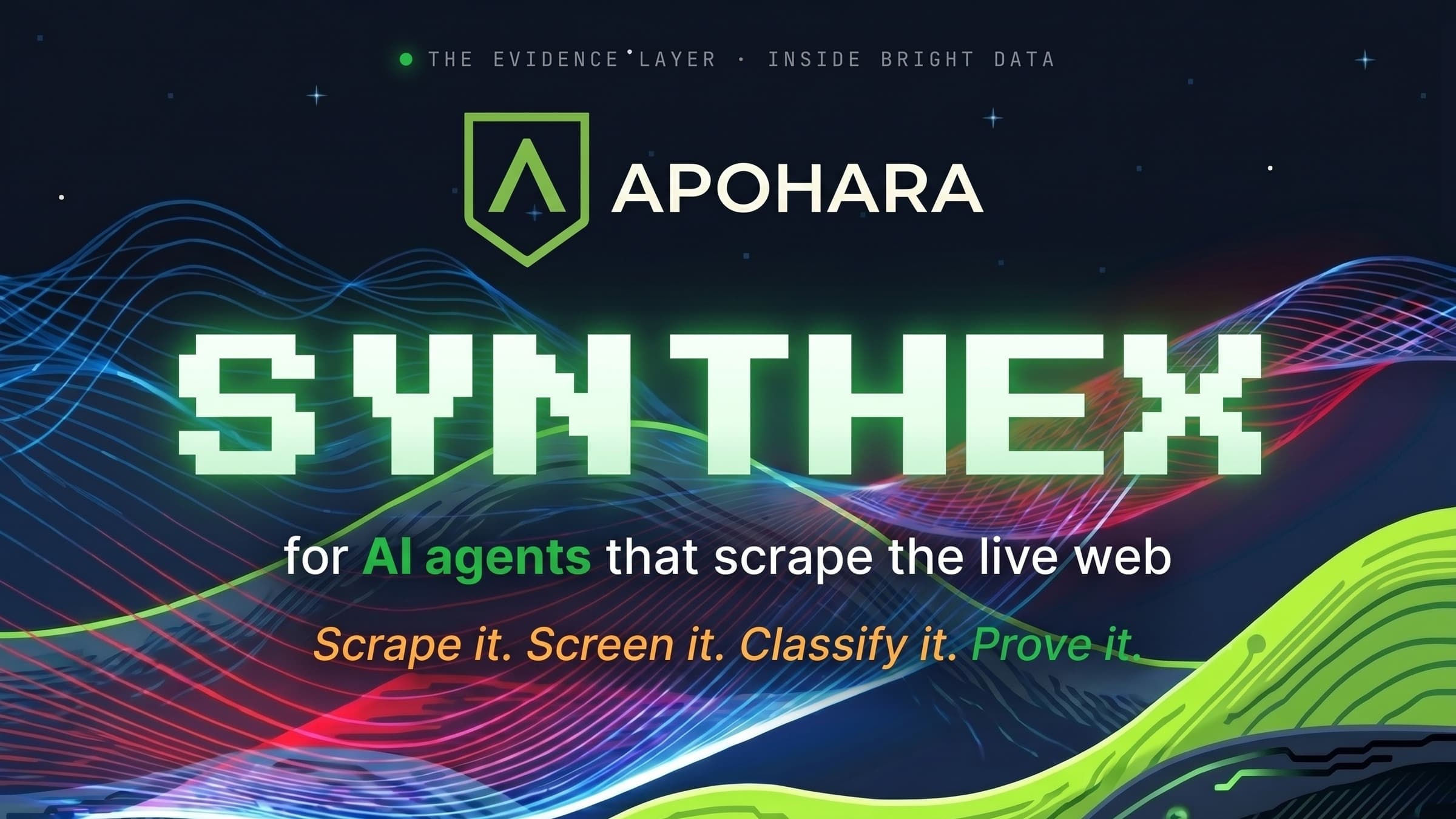
AI agents now run on the live web, but prompt injection is the number-one risk on the OWASP LLM Top 10, and most teams cannot prove what their agents ingested, or that it was safe. Apohara Synthex fixes that. Synthex is the provenance and security layer for the web data an AI agent consumes. It fetches across the full Bright Data spectrum: Web Unlocker, the Web Scraper API, SERP API, Scraping Browser, and the MCP Server. We didn't just use Bright Data; we improved it, contributing PR #140 upstream. Every fetch runs a layered defense before anything reaches a model. A deterministic regex pass and Qwen3Guard on Featherless form a high-recall net; NVIDIA's NemoGuard, selected by a measured benchmark, is the low-false-positive block gate; and a reasoning model on the AI/ML API knows the difference between describing an attack and executing one. Clean content is classified across four lenses, then sealed into an enterprise Evidence Report. The seal is real and shipped: an Ed25519 signature, an RFC 3161 DigiCert timestamp, an offline-verifiable Sigstore Rekor transparency log, and C2PA Content Credentials. Anyone can verify it in seconds with openssl, the industry's own c2patool, and a public ledger. No trust required. Cognee adds memory across re-scrapes, TriggerWare turns it into an automated monitor, and Kiro runs our continuous test and QA hooks. Synthex spans all three tracks, Security & Compliance, Finance & Market Intelligence, and GTM Intelligence, built for the CISO, CFO, compliance lead, and underwriter who need evidence they can defend to a board or a regulator. The average data breach costs 4.44 million dollars; Synthex seals an evidence artifact for a fraction of a cent. Everything signed, nothing trusted, and every number ships with a command to reproduce it.

EROS - External Reality OS

EROS - External Reality OS

EROS (External Reality Operating System) is a next-generation enterprise intelligence platform designed to help organizations understand and navigate the constantly changing external world. While companies have ERP systems for internal operations, CRM systems for customer relationships, and BI platforms for internal analytics, they lack a unified system capable of continuously monitoring, interpreting, and reasoning about external reality. Critical business signals such as competitor movements, supplier risks, market shifts, regulatory changes, pricing updates, technology adoption, and emerging opportunities already exist across the web, but they remain fragmented, unstructured, and difficult to operationalize. EROS solves this challenge by leveraging Bright Data's web intelligence infrastructure to collect, structure, and analyze public information at scale. The platform creates a living External Reality Twin for every monitored entity, including customers, prospects, vendors, suppliers, competitors, technologies, industries, and markets. Using a layered intelligence architecture, EROS transforms raw web data into evidence, evidence into signals, signals into events, and events into actionable business intelligence. The platform combines knowledge graphs, organizational memory, causal reasoning, pattern detection, and future-ready multi-agent intelligence to help organizations answer critical questions: What changed? Why did it change? How confident are we? What evidence supports this conclusion? What is likely to happen next? What action should we take? By turning the internet into a continuously updated intelligence layer, EROS enables sales teams to identify buying signals earlier, procurement teams to reduce supplier risk, security teams to detect external threats faster, and executives to make strategic decisions with real-time context. EROS transforms the web from a source of information into a system of enterprise intelligence.

RevenueOS

RevenueOS

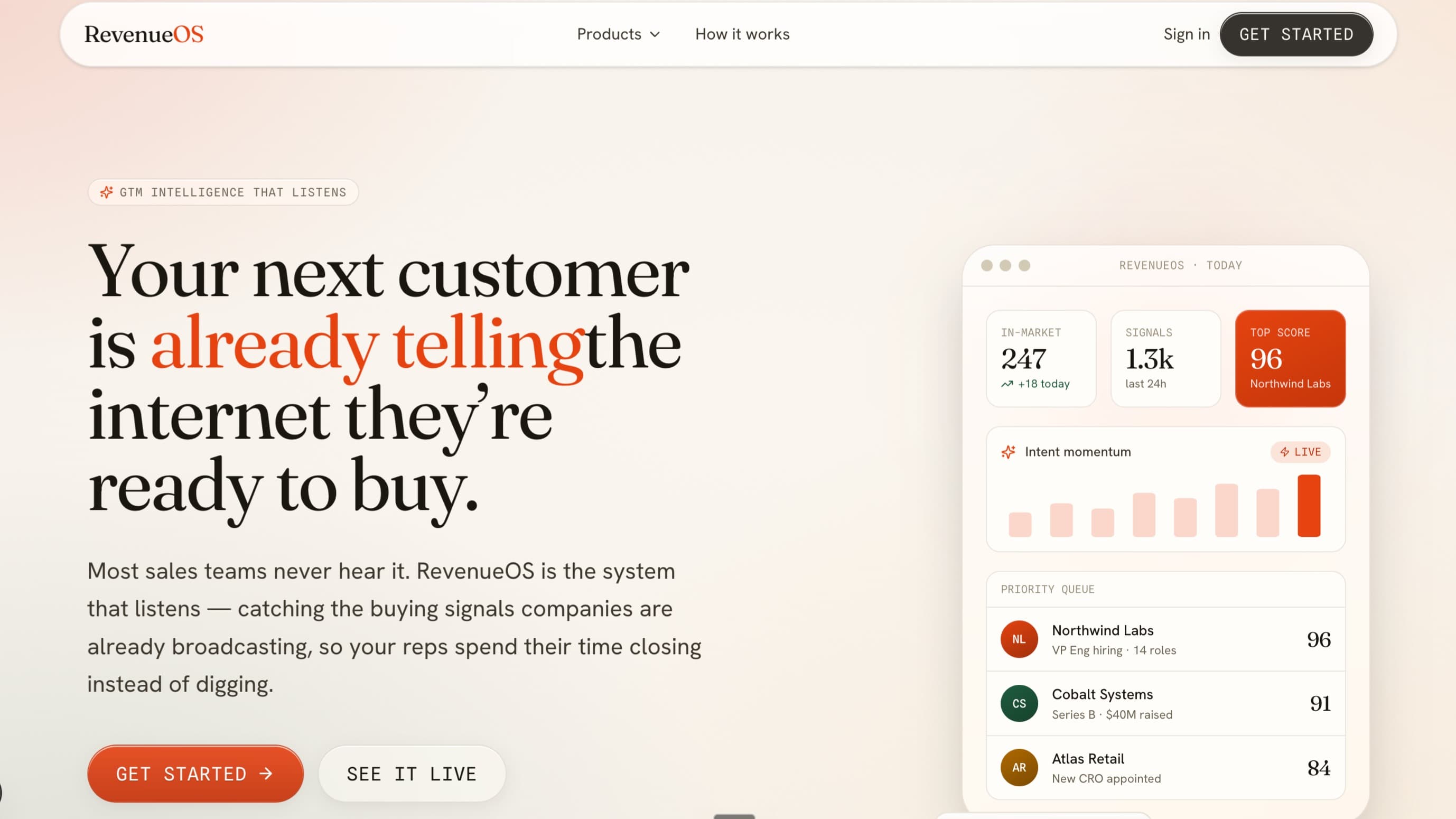
RevenueOS — AI-Native GTM Workspace a RevenueOS is an AI outbound platform built on one belief: companies don't have a lead problem, they have an attention problem. Every prospect is already broadcasting buying intent on the open web — hiring sprees, funding rounds, product launches, pricing changes, new executives — but revenue teams can't read the whole internet, so the best opportunities go ignored. RevenueOS listens, prioritizes, and acts end to end. A rep enters a company (or describes an ICP in plain English), and the platform researches it live, detects and scores buying signals, ranks accounts by fit, intent, timing, and risk, writes hyper-personalized outreach, runs multi-channel sequences, places browser-based calls with a real-time copilot, and produces coaching scorecards — answering "who do I contact today, why now, and what do I say?" Every sponsor is load-bearing. Bright Data is the foundation — a real-time web-intelligence layer powering all prospecting, account research, enrichment, and signal discovery. Cognee is long-term memory: a knowledge graph storing every company, contact, signal, call, and email so agents reason over history instead of starting cold. Trigger.dev orchestrates durable account-monitoring, sequence automation, and follow-up workflows. LiveKit powers real-time browser calling and the AI SDR, while Speechmatics transcribes live calls for the copilot, objection detection, summaries, and coaching. Together they form a complete GTM Intelligence stack — Bright Data finds opportunities, Cognee remembers them, Trigger.dev acts, LiveKit enables the conversation, and Speechmatics understands it — naturally extending into Finance & Market Intelligence through hiring, funding, and growth signals.

Markster Recon: Be the First Call, Not the Fifth

Markster Recon: Be the First Call, Not the Fifth

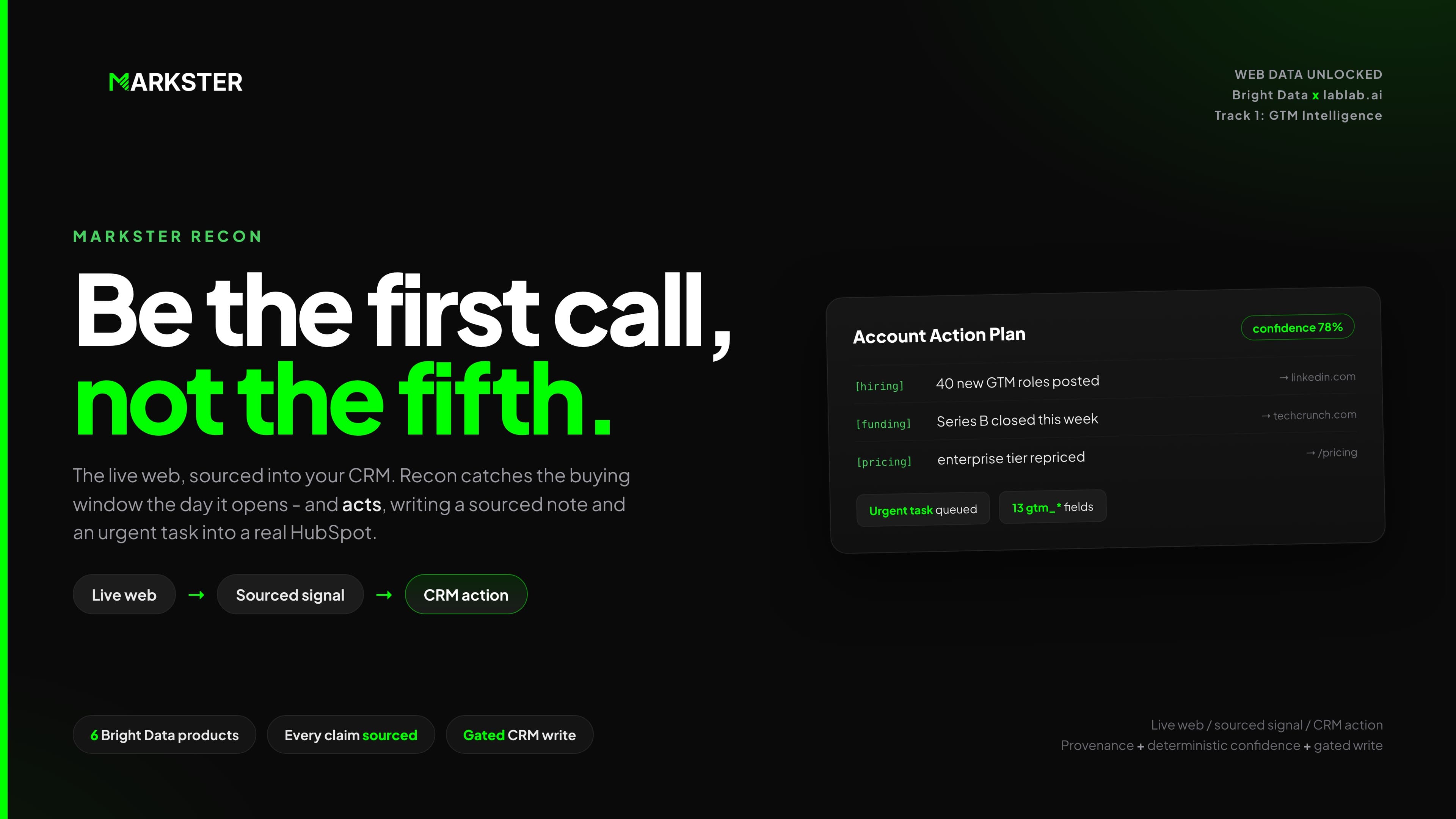
A rep opens the CRM Monday morning. A target account: "no recent activity." They move on. Meanwhile that same account just posted 40 sales roles, closed a round, and quietly repriced - on the open web, where the CRM never looks. That gap is where pipeline dies. (76% of companies say fewer than half their CRM records are accurate - Validity, 2025.) Markster Recon closes it. Point it at any company and it runs a real pipeline, not a prompt: COLLECT - six Bright Data products fire in parallel: LinkedIn hiring (Web Scraper API), news + funding (Web Unlocker), competitor landscape (Discover API), market results (SERP API), JS-rendered pricing (Browser API), and funding research (Deep Lookup). SOURCE - every datum carries provenance: source URL, timestamp, method. Click any claim and verify it live. Nothing is unattributed. SCORE - confidence is computed (coverage x signal strength), not guessed by a model. SYNTHESIZE - the LLM writes the Account Action Plan: the read, routes in, who shapes the decision, honest evidence gaps, next actions. It writes narrative only - it can never invent a signal. Then the part most projects skip: Recon acts. It writes the decision into a live HubSpot - gtm_* properties, a sourced note on the timeline, and an urgent task where an AI agent executes or prioritizes for the rep. And it polices itself: a thin or low-confidence run is gated to "review only," so a weak signal can never look like an approved action. It is a standing watch on your target list, not a one-time lookup: run the loop on a schedule and you catch the window the day it opens. Judge-testable, no login: any company returns a full plan plus a preview of exactly what hits the CRM. It runs on a real production CRM, and synthesis is provider-portable - Azure OpenAI, AI/ML API, or open-source via Featherless. Built by a team that runs GTM on this exact stack. Live web -> sourced signal -> CRM action. That's the loop.