Top Builders

Explore the top contributors showcasing the highest number of app submissions within our community.

Speechmatics

Founded in 2006 by Dr. Tony Robinson, a Cambridge University speech recognition pioneer, Speechmatics builds infrastructure to understand every voice globally. The company's core mission is inclusive, multilingual speech AI, covering transcription, real-time voice agents, and on-device deployment. Speechmatics serves enterprise clients across media, healthcare, financial services, and contact centers.

General
CompanySpeechmatics
Founded2006 by Dr. Tony Robinson
CEOKaty Wigdahl
HeadquartersCambridge, United Kingdom
Websitespeechmatics.com
Documentationdocs.speechmatics.com
GitHubgithub.com/speechmatics
TypeSpeech AI / B2B SaaS

Core Products

Speechmatics API (Speech-to-Text)

The Speechmatics API provides batch and real-time transcription across 55+ languages, powered by the Ursa 2 model released in October 2024. It supports speaker diarization, custom dictionaries, automatic translation, and Voice Intelligence add-ons (summarization, sentiment analysis, entity recognition) with no retraining required.

Speechmatics Flow

Flow is a voice agent API that combines Speechmatics' speech-to-text with an LLM and text-to-speech into a single real-time pipeline. Developers connect through a single API call to build conversational AI agents with smart turn detection, interruption handling, and function calling support.


Developer Resources

Speechmatics provides SDKs for Python, JavaScript/TypeScript, and .NET, along with a developer portal and free tier to get started without a credit card.

  • Documentation — official API reference, quickstarts, and integration guides
  • GitHub — open-source SDKs and client libraries
  • Developer Portal — API key management and usage dashboard
  • Pricing — free tier and pay-as-you-go rates

Key Features

Multilingual transcription across 55+ languages Speechmatics' Ursa 2 model leads accuracy benchmarks in 62% of supported languages on the FLEURS dataset, with 7.88% WER on Kincaid46 for English, surpassing human-level accuracy on that benchmark.

Flexible deployment Speechmatics runs on private SaaS cloud, on-premises, on-device, and via Docker or Kubernetes, making it suitable for data-sensitive industries like healthcare and finance.

Voice Intelligence add-ons Summarization, sentiment analysis, topic detection, chapter generation, and entity recognition layer on top of transcription without requiring additional integration work.


Use Cases

Contact center automation Real-time transcription and sentiment analysis during calls, combined with Flow for automated voice agent handling of common queries.

Clinical transcription Speechmatics' Medical Model (launched 2024) targets 93% real-time accuracy and 96% medical keyword recall for English, German, Danish, and Norwegian.

Media and broadcast Batch transcription of audio and video files for subtitling, archiving, and content search across multiple languages.

speechmatics AI Technologies Hackathon projects

Discover innovative solutions crafted with speechmatics AI Technologies, developed by our community members during our engaging hackathons.


Apohara Synthex

Apohara Synthex

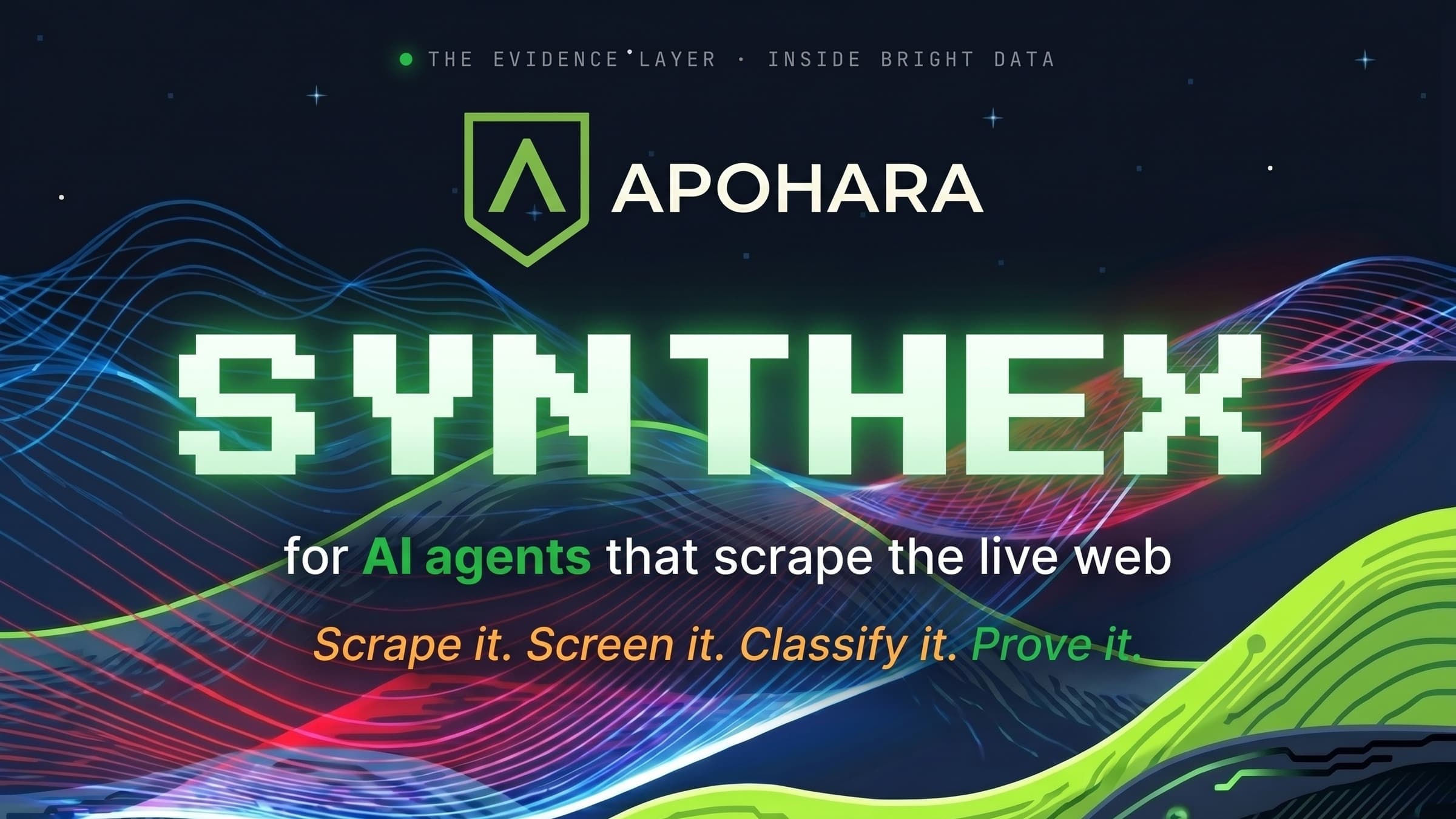
AI agents now run on the live web, but prompt injection is the number-one risk on the OWASP LLM Top 10, and most teams cannot prove what their agents ingested, or that it was safe. Apohara Synthex fixes that. Synthex is the provenance and security layer for the web data an AI agent consumes. It fetches across the full Bright Data spectrum: Web Unlocker, the Web Scraper API, SERP API, Scraping Browser, and the MCP Server. We didn't just use Bright Data; we improved it, contributing PR #140 upstream. Every fetch runs a layered defense before anything reaches a model. A deterministic regex pass and Qwen3Guard on Featherless form a high-recall net; NVIDIA's NemoGuard, selected by a measured benchmark, is the low-false-positive block gate; and a reasoning model on the AI/ML API knows the difference between describing an attack and executing one. Clean content is classified across four lenses, then sealed into an enterprise Evidence Report. The seal is real and shipped: an Ed25519 signature, an RFC 3161 DigiCert timestamp, an offline-verifiable Sigstore Rekor transparency log, and C2PA Content Credentials. Anyone can verify it in seconds with openssl, the industry's own c2patool, and a public ledger. No trust required. Cognee adds memory across re-scrapes, TriggerWare turns it into an automated monitor, and Kiro runs our continuous test and QA hooks. Synthex spans all three tracks, Security & Compliance, Finance & Market Intelligence, and GTM Intelligence, built for the CISO, CFO, compliance lead, and underwriter who need evidence they can defend to a board or a regulator. The average data breach costs 4.44 million dollars; Synthex seals an evidence artifact for a fraction of a cent. Everything signed, nothing trusted, and every number ships with a command to reproduce it.

Apohara Synthex

Apohara Synthex

AI agents now run on the live web, but prompt injection is the number-one risk on the OWASP LLM Top 10, and most teams cannot prove what their agents ingested, or that it was safe. Apohara Synthex fixes that. Synthex is the provenance and security layer for the web data an AI agent consumes. It fetches across the full Bright Data spectrum: Web Unlocker, the Web Scraper API, SERP API, Scraping Browser, and the MCP Server. We didn't just use Bright Data; we improved it, contributing PR #140 upstream. Every fetch runs a layered defense before anything reaches a model. A deterministic regex pass and Qwen3Guard on Featherless form a high-recall net; NVIDIA's NemoGuard, selected by a measured benchmark, is the low-false-positive block gate; and a reasoning model on the AI/ML API knows the difference between describing an attack and executing one. Clean content is classified across four lenses, then sealed into an enterprise Evidence Report. The seal is real and shipped: an Ed25519 signature, an RFC 3161 DigiCert timestamp, an offline-verifiable Sigstore Rekor transparency log, and C2PA Content Credentials. Anyone can verify it in seconds with openssl, the industry's own c2patool, and a public ledger. No trust required. Cognee adds memory across re-scrapes, TriggerWare turns it into an automated monitor, and Kiro runs our continuous test and QA hooks. Synthex spans all three tracks, Security & Compliance, Finance & Market Intelligence, and GTM Intelligence, built for the CISO, CFO, compliance lead, and underwriter who need evidence they can defend to a board or a regulator. The average data breach costs 4.44 million dollars; Synthex seals an evidence artifact for a fraction of a cent. Everything signed, nothing trusted, and every number ships with a command to reproduce it.

EROS - External Reality OS

EROS - External Reality OS

EROS (External Reality Operating System) is a next-generation enterprise intelligence platform designed to help organizations understand and navigate the constantly changing external world. While companies have ERP systems for internal operations, CRM systems for customer relationships, and BI platforms for internal analytics, they lack a unified system capable of continuously monitoring, interpreting, and reasoning about external reality. Critical business signals such as competitor movements, supplier risks, market shifts, regulatory changes, pricing updates, technology adoption, and emerging opportunities already exist across the web, but they remain fragmented, unstructured, and difficult to operationalize. EROS solves this challenge by leveraging Bright Data's web intelligence infrastructure to collect, structure, and analyze public information at scale. The platform creates a living External Reality Twin for every monitored entity, including customers, prospects, vendors, suppliers, competitors, technologies, industries, and markets. Using a layered intelligence architecture, EROS transforms raw web data into evidence, evidence into signals, signals into events, and events into actionable business intelligence. The platform combines knowledge graphs, organizational memory, causal reasoning, pattern detection, and future-ready multi-agent intelligence to help organizations answer critical questions: What changed? Why did it change? How confident are we? What evidence supports this conclusion? What is likely to happen next? What action should we take? By turning the internet into a continuously updated intelligence layer, EROS enables sales teams to identify buying signals earlier, procurement teams to reduce supplier risk, security teams to detect external threats faster, and executives to make strategic decisions with real-time context. EROS transforms the web from a source of information into a system of enterprise intelligence.

EROS - External Reality OS

EROS - External Reality OS

EROS (External Reality Operating System) is a next-generation enterprise intelligence platform designed to help organizations understand and navigate the constantly changing external world. While companies have ERP systems for internal operations, CRM systems for customer relationships, and BI platforms for internal analytics, they lack a unified system capable of continuously monitoring, interpreting, and reasoning about external reality. Critical business signals such as competitor movements, supplier risks, market shifts, regulatory changes, pricing updates, technology adoption, and emerging opportunities already exist across the web, but they remain fragmented, unstructured, and difficult to operationalize. EROS solves this challenge by leveraging Bright Data's web intelligence infrastructure to collect, structure, and analyze public information at scale. The platform creates a living External Reality Twin for every monitored entity, including customers, prospects, vendors, suppliers, competitors, technologies, industries, and markets. Using a layered intelligence architecture, EROS transforms raw web data into evidence, evidence into signals, signals into events, and events into actionable business intelligence. The platform combines knowledge graphs, organizational memory, causal reasoning, pattern detection, and future-ready multi-agent intelligence to help organizations answer critical questions: What changed? Why did it change? How confident are we? What evidence supports this conclusion? What is likely to happen next? What action should we take? By turning the internet into a continuously updated intelligence layer, EROS enables sales teams to identify buying signals earlier, procurement teams to reduce supplier risk, security teams to detect external threats faster, and executives to make strategic decisions with real-time context. EROS transforms the web from a source of information into a system of enterprise intelligence.