
Farzad Bagheri@FarzadSlash
12
Events attended
7
Submissions made
France
7+ years of experience
About me
Passionate full-stack developer specializing in React, .NET, secure APIs, and AI integrations (GPT, OpenAI). I develop modern, elegant, high-performance web applications focused on user experience—from frontend to backend. My skills include: • Modern frontend development (React, Angular, TypeScript, Tailwind) • Robust backend development (ASP.NET Core, Entity Framework, JWT, etc.) • AI integration (chatbots, intelligent assistants, GPT APIs, etc.) • SQL databases, dashboards, and secure systems
🤓 Latest Submissions
SpecTrace AI
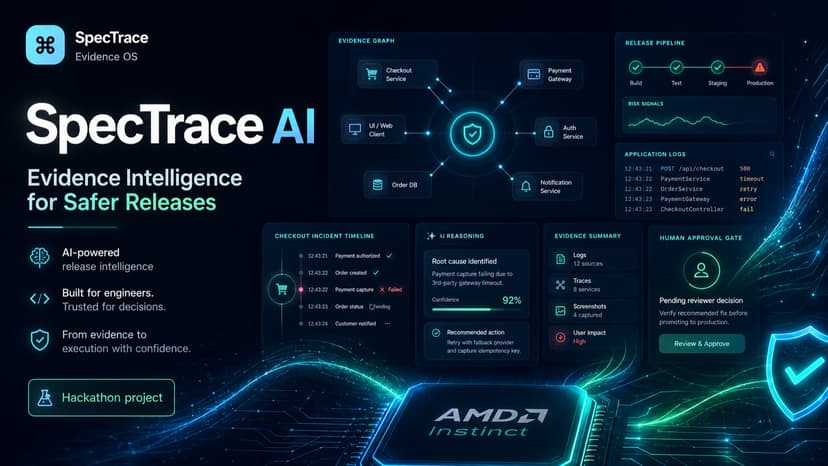
SpecTrace AI is an evidence intelligence platform for safer software releases. Engineering teams often make release decisions with fragmented evidence: application logs, screenshots, videos, QA notes, API traces, and customer-impact reports. SpecTrace brings this evidence into one traceable investigation and helps teams understand what happened, why it happened, what should be fixed, and whether the release should be approved, changed, or blocked. The demo focuses on a checkout regression where customers complete payment successfully but remain stuck on the processing screen without receiving an order confirmation. SpecTrace detects a payment response-contract mismatch: the frontend expects paymentIntentId, while the payment service returns transactionId. From that evidence, the system generates a root-cause hypothesis, evidence timeline, AI reviewer summary, engineering recommendation, release decision rationale, Playwright regression test draft, GitHub issue draft, and Given/When/Then acceptance criteria. SpecTrace uses a Next.js frontend, .NET API backend, Python FastAPI AI worker, Fireworks AI serverless enrichment, and deterministic fallback safety. The current live demo runs on Vercel and Render, with Fireworks AI used safely through serverless inference. The architecture is prepared for AMD Developer Cloud, ROCm, and Gemma-style inference when AMD GPU pod access is allocated. SpecTrace is not just an AI summary tool. It is a release intelligence workflow from evidence to engineering execution to human decision.
13 Jul 2026
TenderGuard AI
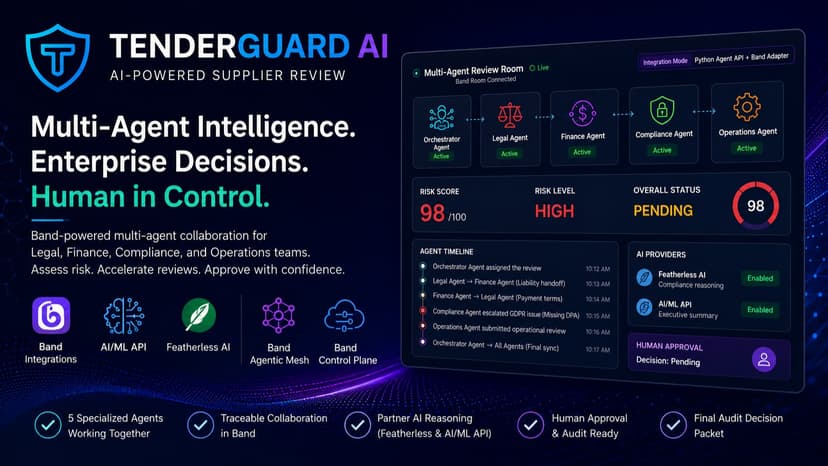
TenderGuard AI helps enterprises review supplier contracts faster and with better traceability. Procurement reviews often require multiple departments: legal, finance, compliance, operations, and management. These reviews are usually fragmented across emails and spreadsheets, making handoffs unclear and audit trails difficult to maintain. TenderGuard AI solves this with a multi-agent workflow coordinated through Band. The system includes five specialized agents: - Orchestrator Agent - Legal Agent - Finance Agent - Compliance Agent - Operations Agent Each agent contributes to the shared supplier review context. Agents communicate, hand off tasks, escalate issues, vote on the decision, and prepare a final audit packet. The frontend is built with React and TypeScript. The backend is built with .NET 8. The agent layer is built with Python FastAPI. Band is used as the collaboration layer. AI/ML API supports executive summary generation, and Featherless AI supports compliance reasoning. The result is a practical enterprise workflow that produces: - Risk score - Risk level - Agent timeline - Agent findings - Agent votes - Executive summary - Audit hash - Human decision - Final decision packet
19 Jun 2026
SignalWatch AI
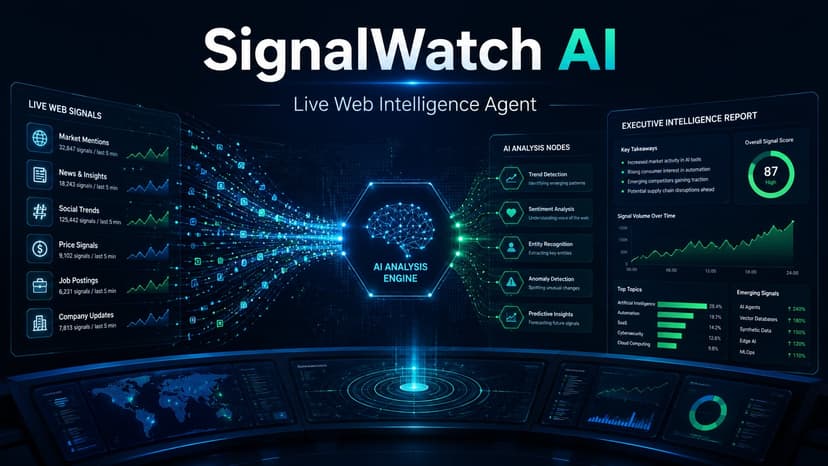
SignalWatch AI helps enterprise GTM, finance, strategy, and compliance teams unlock live public web data for decision-making. Users enter a target company, its website, competitors, a hackathon track, and a monitoring goal. The .NET 10 backend builds targeted search queries and uses Bright Data SERP API to collect live public web results. The backend filters low-value search/navigation results, classifies useful signals into GTM, Finance / Market, or Security / Compliance categories, and sends the structured signals to Gemini AI. Gemini generates an executive summary, risk score, opportunity score, and recommended business actions. The React dashboard displays the final report with source links, confidence scores, export-to-Markdown, and copy-summary actions. The result is a practical intelligence workflow: live public web data → AI analysis → executive-ready report.
31 May 2026
AgentOps 360
AgentOps 360 is an autonomous enterprise operations agent that transforms unstructured business input into structured execution plans. In many companies, meetings create a lot of information, but decisions, tasks, risks, owners, and follow-up messages are still handled manually. AgentOps 360 solves this by turning meeting notes, uploaded documents, PDFs, and audio transcripts into a clear business dashboard. The system uses a multi-agent workflow with five specialized agents: an Intake Agent, Reasoning Agent, Planning Agent, Communication Agent, and Audit Agent. Together, they analyze the input, extract decisions, generate action tasks with owners and priorities, detect risks with mitigation strategies, draft professional follow-up emails, and create an auditable agent trace. AgentOps 360 is powered by Gemini for reasoning and structured analysis, Speechmatics for audio transcription, PdfPig for PDF text extraction, React and TypeScript for the frontend, and ASP.NET Core with SQL Server for the backend and persistence. Each analysis is saved in the database, allowing users to reopen previous runs, track execution history, and export a structured executive report. The app also includes a fallback engine to keep the workflow reliable if the AI provider is temporarily unavailable. AgentOps 360 is designed for managers, founders, operations teams, HR teams, sales teams, and customer support teams who need to move faster from conversation to execution.
19 May 2026
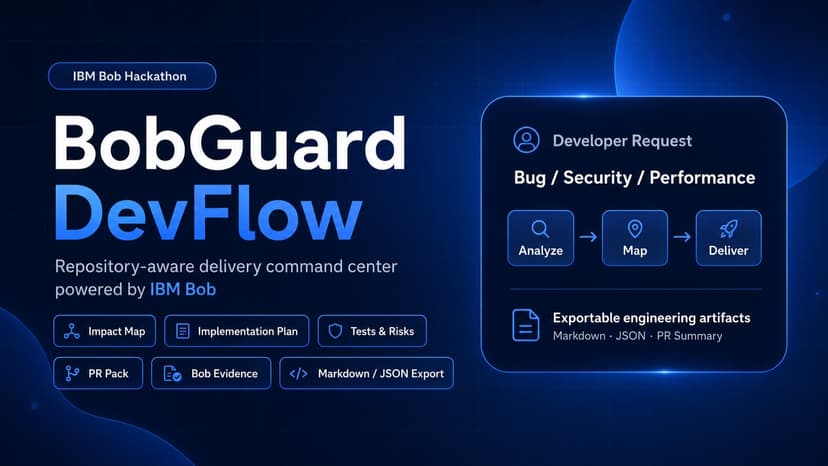
BobGuard DevFlow
BobGuard DevFlow is a repository-aware delivery command center powered by IBM Bob. Modern developers often receive messy bug reports, feature requests, refactoring goals, security concerns, or performance issues, then spend time manually transforming them into implementation plans, tests, risks, and pull request notes. BobGuard DevFlow turns that unclear input into a structured engineering delivery package. The app supports five realistic developer scenarios: Bug, Feature, Refactor, Security, and Performance. Each scenario generates a specific result with analysis metadata, scenario label, confidence score, estimated time saved, executive summary, repository impact map, implementation plan, test strategy, risk radar, pull request pack, IBM Bob workflow, recommended next Bob prompts, and exportable Markdown/JSON reports. IBM Bob was used throughout the project as an AI development partner. Bob helped review the backend architecture, frontend cockpit design, output quality, demo mode, final demo flow, repository structure, and testing validation. The repository includes exported IBM Bob reports in the bob-reports folder as evidence. BobGuard DevFlow is not another chatbot. It is a practical workflow layer that turns IBM Bob-assisted repository reasoning into repeatable engineering artifacts that can be reviewed, shared, exported, and attached to a real development process.
17 May 2026
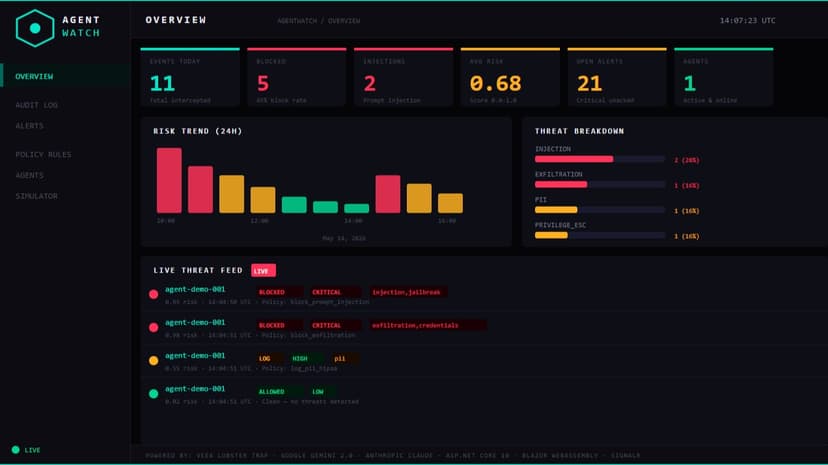
AgentWatch — AI Agent Security Platform
AgentWatch is a real-time AI agent security platform built on Veea Lobster Trap, securing both Google Gemini and Anthropic Claude backends equally. THE PROBLEM: AI agents read files, hit APIs, and trigger actions in production — but guardrails haven't kept up. A single malicious prompt can leak credentials or exfiltrate data. Most teams have zero visibility into what their agents are doing. WHAT WE BUILT: Deep Prompt Inspection: Every prompt analyzed for injection attempts, jailbreak signatures, PII, credential leakage, and exfiltration patterns via Lobster Trap DPI. Risk scores 0.0–1.0 in real-time. Multi-LLM Security: AgentWatch secures both Gemini 2.0 Flash, Gemini 2.0 Pro, and Claude Sonnet. The same Lobster Trap security layer applies to all backends equally — switch models without losing governance. Policy Enforcement: First-match-wins YAML rules compatible with Lobster Trap. Actions: ALLOW, DENY, LOG, HUMAN_REVIEW, QUARANTINE, RATE_LIMIT. HIPAA, SOC2, and finance packs included. Real-Time Dashboard: Blazor WebAssembly plus SignalR — every attack and alert appears live. Risk trend charts, threat breakdowns, live event feed. Full Audit Trail: Every interaction logged with declared vs detected intent, risk score, and threat flags. CSV export for regulators. LIVE DEMO RESULTS: - Prompt Injection: 0.95 risk → BLOCKED - Data Exfiltration: 0.98 risk → BLOCKED - PII Detected: 0.55 risk → LOGGED - Intent Mismatch: 0.78 risk → HUMAN_REVIEW - Clean Request: 0.02 risk → ALLOWED STACK: ASP.NET Core 10, Blazor WebAssembly, SignalR, SQLite, Google Gemini API, Anthropic Claude, Veea Lobster Trap. Lobster Trap is the floor. AgentWatch is the ceiling.
19 May 2026
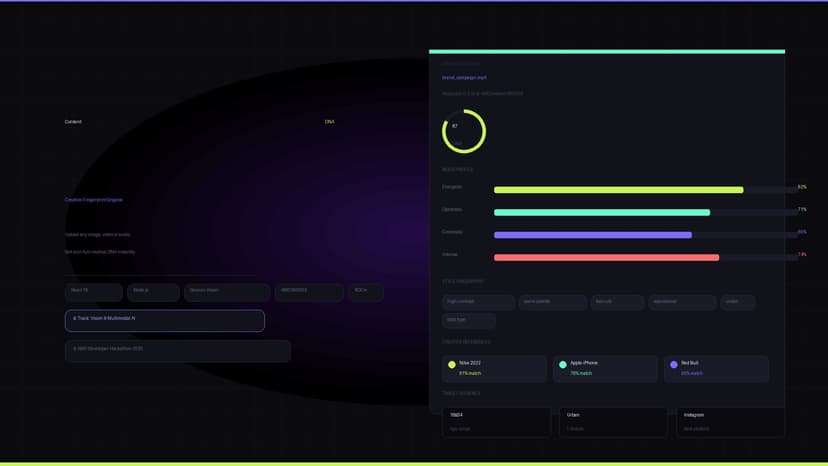
ContentDNA — Creative Fingerprint Engine
ContentDNA is a multimodal AI application that generates a unique creative fingerprint for any media content. Just like DNA reveals a person's identity, ContentDNA reveals the hidden creative identity of your work. Upload an image, video, or audio file and instantly receive a deep structured analysis: a DNA Score (0–100 distinctiveness rating), a 5-dimensional mood profile (energetic, optimistic, cinematic, melancholic, intense), pacing and rhythm analysis (cut rate, BPM, visual density), a style fingerprint with 8 descriptive tags, color palette breakdown, the top 3 real-world creative references it most closely resembles with match scores, target audience prediction (age range, lifestyle, best platform), and a plain-language AI creative brief. The application is built on a React 18 + Vite frontend with a Node.js + Express backend. Media preprocessing uses ffmpeg for video frame extraction and Sharp for image optimization. The AI vision layer uses Gemini 1.5 Flash for multimodal understanding across image, video, and audio inputs — architected to run on AMD Instinct MI300X via ROCm and Qwen-VL when AMD Developer Cloud credits are provisioned. ContentDNA targets filmmakers, content creators, brand teams, and audio producers who need to understand the emotional and stylistic DNA of their creative work in seconds. The project is fully open-source and deployed as a Hugging Face Space.
10 May 2026


