Top Builders
Explore the top contributors showcasing the highest number of app submissions within our community.

.png&w=96&q=75)
.png&w=96&q=75)
.png&w=96&q=75)
Qualcomm
Qualcomm was founded in July 1985 in San Diego by seven engineers, including Irwin Jacobs and Andrew Viterbi, as a wireless communications research firm. Over four decades it has become the defining company in mobile silicon, designing the Snapdragon family of system-on-chips that sit inside the majority of the world's Android smartphones, Copilot+ PCs, XR headsets, and connected automotive systems. Qualcomm operates as a fabless semiconductor company, focusing on chip design and its vast patent portfolio covering CDMA, 3G, 4G LTE, and 5G NR technologies.
| General | |
|---|---|
| Company | Qualcomm Incorporated |
| Founded | July 1, 1985 by Irwin Jacobs, Andrew Viterbi, and five colleagues |
| Headquarters | San Diego, California, USA |
| Website | qualcomm.com |
| Documentation | Developer Portal |
| GitHub | github.com/qualcomm |
| Type | Semiconductor and Wireless Technology |
Core Products
Snapdragon SoC Platform
Snapdragon is Qualcomm's flagship system-on-chip brand integrating CPU, GPU, NPU (Hexagon), modem, and connectivity in a single package. Snapdragon chips power mobile phones, Windows laptops (Copilot+ PC), AR/VR headsets, automotive cockpits, and IoT devices.
Dragonwing
Qualcomm's commercial and industrial product line, built on Snapdragon silicon, targeting industrial IoT, robotics, and smart edge deployments.
Qualcomm AI Hub
A developer platform at aihub.qualcomm.com offering 175+ pre-optimized AI models, a cloud-based profiling workbench for testing across 50+ device types, and sample applications. Developers can optimize, benchmark, and deploy models on Snapdragon hardware without owning devices.
Connectivity and RF
Qualcomm designs Wi-Fi, Bluetooth, and 5G modem products used across consumer electronics, automotive, and infrastructure.
Developer Resources
Qualcomm provides a full developer toolkit for building AI-accelerated applications on Snapdragon hardware, from low-level NPU SDKs to cloud-hosted device profiling.
Helpful Links
- Qualcomm AI Hub — pre-optimized models, cloud profiling, and deployment tools
- AI Hub Models GitHub — open-source model repository (BSD-3-Clause)
- Developer Portal — SDKs, documentation, and dev kits
- GitHub — open-source SDKs and tools
- Developer Discord — community support
- YouTube Channel — tutorials and product walkthroughs
Key Features
Heterogeneous AI Engine Qualcomm's AI Engine combines the Hexagon NPU, Adreno GPU, and Oryon/Kryo CPU into a coordinated compute pipeline. This lets applications shift workloads to the most efficient processor at runtime, achieving high performance at low power.
On-Device AI at Scale Qualcomm AI Engine ships in over 4.3 billion devices. The Hexagon NPU supports FP32, FP16, INT16, and INT8 precision, enabling deployment of large language models and image generation on mobile hardware without cloud dependency.
Broad SDK Ecosystem Developer tools include the AI Engine Direct SDK (QNN), the AI Model Efficiency Toolkit (AIMET) for quantization and pruning, the Snapdragon Neural Processing Engine (SNPE), and an ONNX Runtime execution provider plugin.
Use Cases
On-Device Generative AI
Run quantized LLMs (Llama, Mistral, Qwen) and image-generation models locally on Snapdragon phones and laptops. AI Hub provides ready-to-deploy .pte and optimized model artifacts for direct integration.
Mobile and Embedded Vision Object detection, depth estimation, scene segmentation, and OCR run at real-time framerates on the Hexagon NPU with Qualcomm's pre-optimized model zoo.
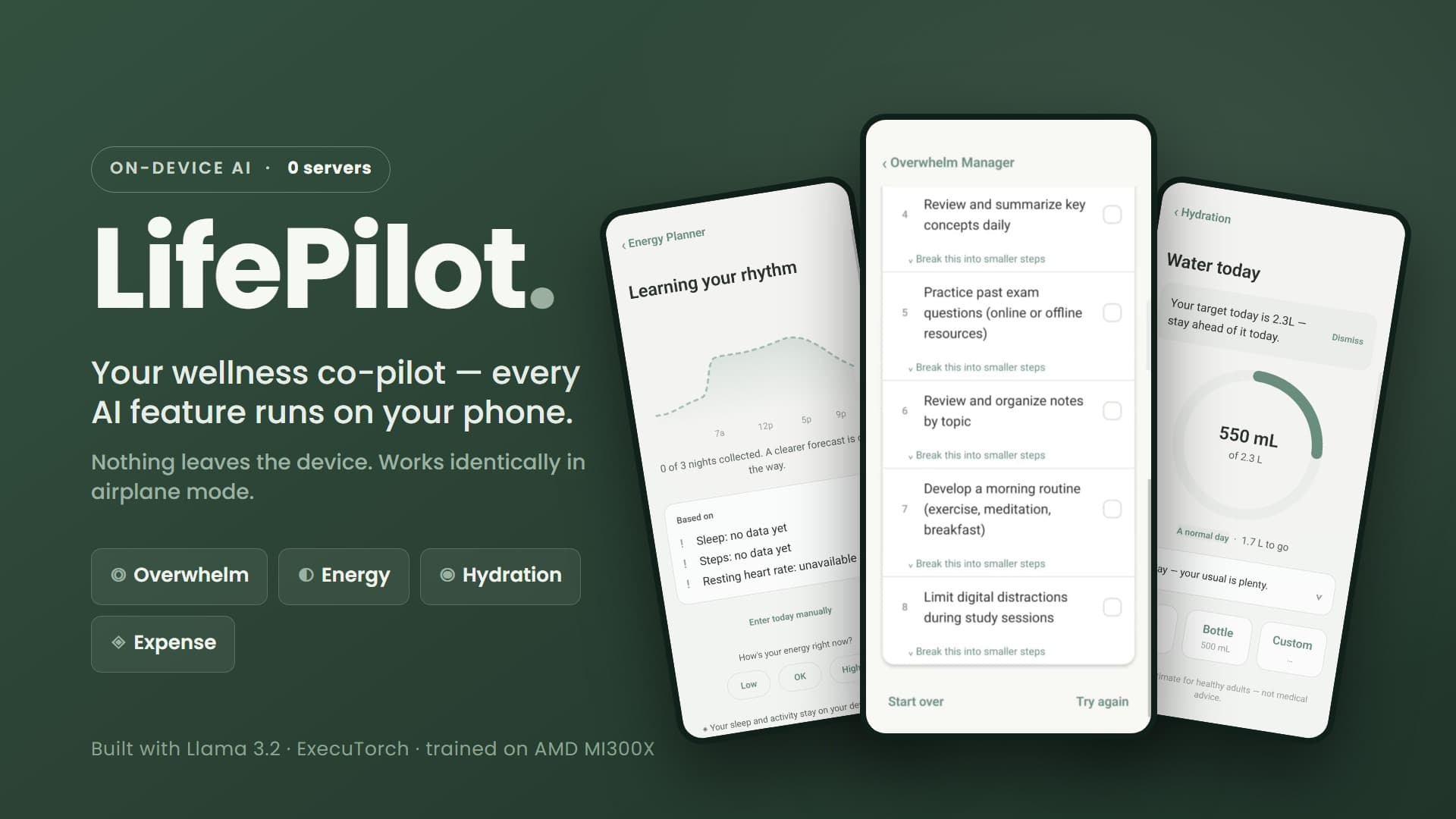
Qualcomm AI Technologies Hackathon projects
Discover innovative solutions crafted with Qualcomm AI Technologies, developed by our community members during our engaging hackathons.

.png&w=3840&q=75)
.png&w=3840&q=75)
.png&w=3840&q=75)