
🤓 Latest Submissions
.png&w=828&q=75)
Toddle AI
Toddle AI is an on-device Android prototype built to help parents capture and understand toddler walking patterns more clearly and privately. A parent can record a new clip or import an existing side-view walking video, and the app evaluates whether the recording is usable by checking framing, visibility, and whether enough continuous walking steps are present. Once a clip passes the quality gate, Toddle AI runs pose estimation locally on the device using a 33-landmark body model, then applies a deterministic gait-analysis pipeline to detect steps, measure temporal walking features, and generate structured observations. The app focuses on explainable metrics rather than black-box scoring, so each result comes from a measurable part of the walking sequence instead of an unsupported diagnosis. Toddle AI also includes a local AI assistant that helps explain the structured results in parent-friendly language and answer follow-up questions without sending raw video to a server. The current prototype is designed around privacy, transparency, and better home capture guidance. It is a research prototype for educational support and tracking, not a clinical diagnostic tool.
28 Jun 2026
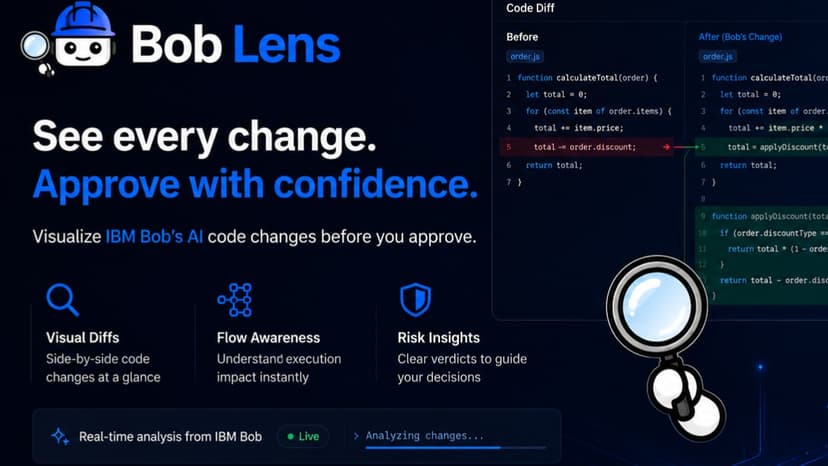
Bob Lens
Bob Lens is a Bob native npm package built for the IBM Bob during the IBM Hackathon 2026 theme, “Turn idea into impact faster.” It installs into any project and sits alongside IBM Bob IDE to help developers understand AI generated code changes before approving them. When Bob modifies files in your workspace, Bob Lens automatically captures the before and after state, renders a live review session, and shows not only what changed, but how that change may affect execution. Instead of relying on raw diffs alone, Bob Lens turns each Bob generated update into an explainable review flow. It shows side by side before and after diffs with character level highlighting, a visual execution flow powered by BobShell, and a risk analysis that summarizes what changed, what may break, and whether the change looks Safe, Review, or Risky. IBM Bob is central to the package. Bob Lens is not a separate review tool pasted on top of the workflow. It is designed to work natively with Bob through MCP change notifications, Bob checkpoints, and BobShell analysis. Bob edits the code, Bob Lens receives the change event, snapshots the relevant state, and BobShell helps explain the behavior of the change programmatically. This creates a live feedback loop inside the Bob development experience. There is no pull request setup, no manual wiring, and no extra review process. Developers install the package, connect it to Bob, and as Bob makes changes, Bob Lens visualizes them in real time. The goal is simple: AI agents can ship code faster than humans can reason about it. Bob Lens gives developers the missing layer between generation and approval. It helps them move fast with Bob while still understanding the behavior, risk, and execution path of every change. With Bob Lens, developers can approve with confidence or rollback immediately. It makes IBM Bob’s code generation more transparent, reviewable, and trustworthy by turning every AI generated edit into an interactive, explainable decision point.
17 May 2026

Pheromone
When the FDA recalls a food product in the U.S., no law guarantees direct notice to the people who bought it. Recall notices usually sit on agency websites, press releases, or store signs. Meanwhile, 109M units were recalled in the first nine months of 2025, and foodborne illness affects 48M Americans annually. Pheromone is a multi-agent AI recall operating system that closes this notification gap. When a recall is issued by FDA, USDA, or a supplier, Pheromone parses the messy notice, traces the supply chain backward, identifies affected products by store and time window, estimates per-transaction risk without checkout lot codes, and drafts the right message for each customer across six confidence tiers. Its key differentiator is Reassurance Notifications. Existing tools notify only affected customers. But when a recall hits the news, unaffected customers panic too: they throw away safe food, demand refunds, and lose trust. Pheromone also tells clean customers why they are safe: “Your Salsa-Verde purchase came from Plant 1, not affected Plant 2. As of this UTC timestamp, your purchase is clean. We’ll notify you if scope changes.” Architecture: five agents plus deterministic systems code. Intake and Comms use Qwen3-32B; Trace uses recursive Postgres CTEs; Match replays inventory composition to compute pallet-level probability; Ops creates store tasks and POS blocks; Compliance Logger records every state transition. LangGraph orchestrates agents with Postgres-backed checkpointing. Pheromone runs on one AMD Instinct MI300X with vLLM and ROCm. Its 192GB HBM3 memory lets agents share live context without paging. The system passed 67/67 tests, including real Qwen3-32B validation on OpenFDA fixtures and multi-tier scenarios. Target users include independent grocers, regional chains, and large retailers preparing for the FDA Food Traceability Rule. Pheromone enables surgical POS blocks and customer notifications instead of broad inventory pulls and vague press releases.
10 May 2026


