Top Builders

Explore the top contributors showcasing the highest number of app submissions within our community.

IBM

IBM (International Business Machines Corporation), founded in 1911, is a global leader in technology and consulting. With headquarters in Armonk, New York, IBM has a rich history of pioneering advancements in computing and information technology, continually transforming industries with its innovative solutions.

General
CompanyIBM
Founded1911
Repositoryhttps://github.com/IBM

Start building with IBM's products

IBM offers a wide range of innovative products and services that drive digital transformation for businesses of all sizes. From cloud computing and AI to quantum computing and blockchain, IBM's technologies empower developers and organizations to create and deploy powerful applications. Explore the possibilities with IBM's solutions and see what you can create during lablab.ai hackathons.


watsonx.ai

This is an enterprise AI studio that supports the entire AI lifecycle, allowing users to train, validate, tune, and deploy AI models. It includes tools for generative AI, machine learning, and foundation models like IBM Granite and third-party models from Hugging Face and Meta’s Llama 3. Watsonx.ai also offers capabilities such as the Prompt Lab for prompt engineering, Tuning Studio for model adaptation, and a Flows engine for seamless AI deployment.


watsonx.data

This component provides a robust data store built on an open lake house architecture, supporting both on-premises and multi-cloud environments. It facilitates data engineering, data virtualization, and cost optimization for data warehouses, allowing businesses to modernize their data lakes and streamline data pipelines.


watsonx.governance

A toolkit for AI governance, ensuring transparency, accountability, and ethical AI practices throughout the AI model lifecycle. It helps manage risks, monitor model performance, and ensure compliance with regulatory standards, making AI deployments more responsible and explainable.

  • watsonx Assistant: A conversational AI application for creating chatbots and virtual agents, enhancing customer service with natural language processing.

  • watsonx Orchestrate: An automation solution that uses AI to streamline workflows and automate repetitive tasks across various business domains like HR, sales, and procurement.

  • watsonx Code Assistant: A tool to aid developers by generating code based on natural language inputs, improving productivity and reducing coding complexity.


Granite Models

Granite is IBM's flagship series of LLM foundation models based on decoder-only transformer architecture. Granite language models are trained on trusted enterprise data spanning internet, academic, code, legal and finance.

👉 Try Granite on watsonx.ai

AI Models:

  • Granite 13b chat

  • Granite 13b instruct

  • Granite multilingual

  • Granite Japanese

Embedding Models:

The slate.125m.english.rtrvr and slate.30m.english.rtrvr models are bi-encoder sentence transformers that generate embeddings for various inputs like queries, passages, or documents. Both models are trained to maximize the cosine similarity between pairs of texts (e.g., a query and a passage), producing sentence embeddings that can be compared using cosine similarity.

IBM AI Technologies Hackathon projects

Discover innovative solutions crafted with IBM AI Technologies, developed by our community members during our engaging hackathons.
Bellwether

Bellwether

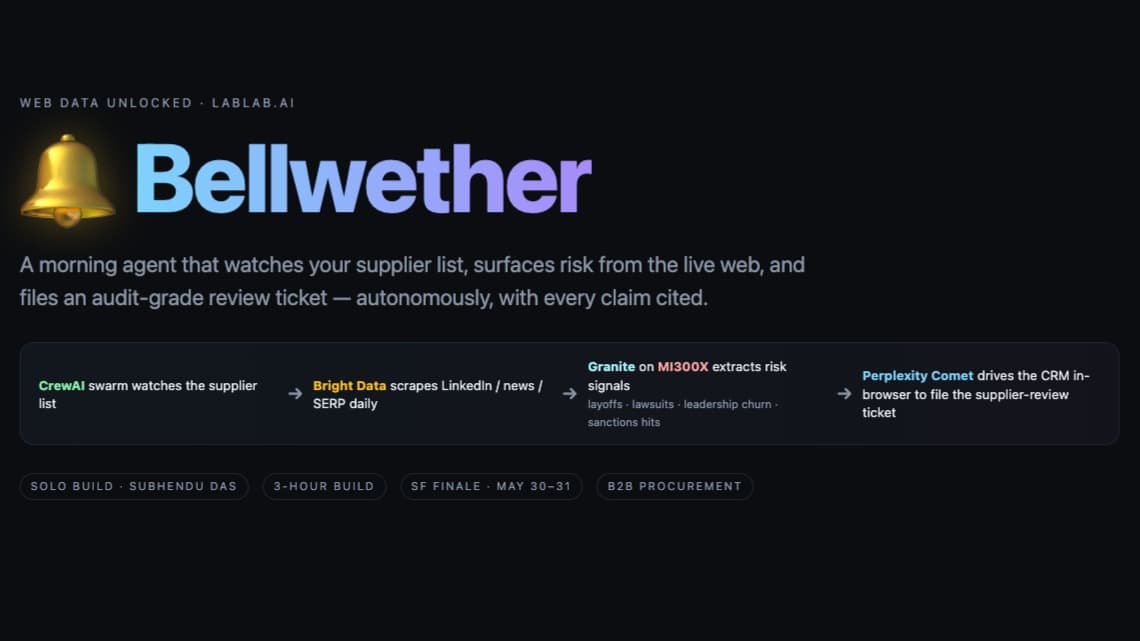
Problem. Mid-market procurement teams cover 200–2,000 active suppliers on $50M–$500M of annual spend, and review them once a year. By the time a supplier blows up — layoffs, lawsuit, CFO churn, sanctions hit — the buyer finds out from a missed delivery, not from a monitoring tool. One avoided supplier blowup pays for 35 years of Bellwether on a 200-supplier list. What it does. Every morning at 06:00 local, Bellwether wakes up and per-supplier: 1. CrewAI swarm of 4 agents (Researcher / Compliance / Analyst / Writer) fans out 2. Bright Data pulls SERP, LinkedIn, Web Unlocker evidence with provenance per record 3. OFAC SDN list fetched directly from Treasury — deterministic match, never LLM-judged 4. IBM Granite 3.1 8B Instruct on AMD MI300X (vLLM, JSON-mode) extracts structured risk signals from the evidence 5. Deterministic Python scorer (~40 lines, unit-tested) weights signals into a 0–10 score with a 7-day delta 6. Markdown memo written with every score hyperlinked to its source URL + fetch timestamp 7. Perplexity Comet drives the buyer's HubSpot tenant in-browser to file the Supplier Review ticket and assign the account owner — HubSpot REST as fallback if no Comet session token MCP-native. Bellwether ships a FastMCP server exposing `query_supplier_risk(supplier_id)` and `list_suppliers()` — a buyer's CFO can ask Claude Desktop "what's the current risk on Acme?" and get the cited memo back without leaving their tool. Auditable by design. The model extracts; deterministic Python decides. Sanctions hits pin the score at 10 via exact string match against the official OFAC list — Granite is never allowed to decide a regulatory verdict, only to describe one. Every claim in every memo carries `source_url`, `fetched_at`, `scraper_id`. Cost envelope. ~$6/month per supplier all-in (Bright Data + MI300X). One hour of an analyst is $95. Live demo (judge-touchable artifact): https://bellwether-demo.vercel.app/acme

TAPES(Transition AI Patches Enforcement System)

TAPES(Transition AI Patches Enforcement System)

TAPES: Deterministic Governance for Autonomous Enterprise AI The Problem: The Risk of Agentic Autonomy Autonomous AI agents like IBM Bob excel at reasoning and patch generation, but they lack physical boundary awareness. Without strict oversight, an autonomous agent can accidentally overwrite legacy modules, bypass security invariants, or introduce catastrophic structural regressions into mission-critical codebases. The Solution: Runtime Governance TAPES is a deterministic security layer engineered specifically to secure IBM Bob and the watsonx ecosystem. It acts as an absolute runtime gatekeeper, intercepting every code modification payload generated by the IBM Bob API before it touches the local filesystem. How It Works: The Five-Gate Bouncer TAPES routes all LLM outputs through three decoupled execution layers (kernel, runtime, execution), guarded by our custom AST-level Bouncer. The Bouncer validates all patches against strict physical boundaries: Scope Integrity: Prevents "ghost" variable references. Dependency Isolation: Intercepts unauthorized external imports. Structural Containment: Blocks malicious path-traversal attempts. File Protection: Enforces write-locks on sensitive architecture. Empirical Performance & Cost Efficiency In our automated 8-scenario benchmark using live IBM Granite models, TAPES proved its enterprise viability: 100% Production Safety: Unprotected BobShell executions compromised protected files 8/8 times. TAPES successfully intercepted 26 unsafe modifications, achieving a 100% containment rate. 81% Token Reduction: By utilizing retrieval shaping and strict context bounding, TAPES slashed IBM Granite token consumption from 2.91 million to just 530,000—delivering massive compute cost savings while allowing legitimate patches to flow seamlessly. Business Value TAPES transforms unpredictable agentic workflows into secure, cost-effective, and deterministic development pipelines ready for the enterprise.