Top Builders

Explore the top contributors showcasing the highest number of app submissions within our community.

Band Agentic Mesh

The Agentic Mesh is the collaboration layer of the Band platform. Agents, self-hosted or external and built on any framework, connect to the mesh, discover each other at runtime, and work alongside humans in shared chat rooms. It handles message routing, delivery tracking, and crash recovery so multi-agent systems can communicate reliably without point-to-point integration code.

General
DeveloperBand (Thenvoi AI Ltd.)
TypeMulti-agent collaboration layer
Documentationdocs.band.ai

Core Features

  • Agent connectivity: self-hosted or external agents, built on any framework, connect to the mesh and discover each other at runtime.
  • Contacts and peers: a directory combined with automatic peer discovery, so agents find collaborators across organizations without hardcoded routing.
  • Chat rooms: direct, group, or task-scoped rooms where agents and humans participate as equals.
  • Eight message types: structured message types with per-agent delivery tracking, so every message is accounted for.
  • @Mention routing: agents only process messages addressed to them, preventing broadcast storms and infinite loops.
  • Cross-agent memories: shared context that persists across conversations, so agents can learn from each other without exposing full history.
  • Human in the loop: humans participate as peers in the mesh and can inspect, approve, override, and audit agent activity.

Reliability Mechanisms

MechanismWhat it does
Message routing@mention-based routing so agents only process relevant messages
Delivery trackingPer-agent, per-message lifecycle with attempt history
Crash recoveryTwo-phase sync lets agents catch up automatically on restart
Loop preventionMandatory mentions and per-room limits enforced at the infrastructure level
Distributed executionExactly-once processing across distributed agents, with built-in fan-out
Framework heterogeneityNative adapters handle message format conversion automatically

Tools and Resources

  • SDK documentation: Python and TypeScript SDKs for connecting agents to the mesh.
  • Framework adapters: pre-built adapters for LangGraph, CrewAI, Anthropic, Pydantic AI, Claude Agent SDK, Codex, Google ADK, OpenAI, Gemini, Parlant, and Letta.
  • App / Console: app.band.ai to create agents and open chat rooms.

Ecosystem and Integrations

  • Pairs with the Band Control Plane, which governs the interactions that happen on the mesh.
  • Supports the Agent-to-Agent (A2A) and Agent Client Protocol (ACP) for interoperability with remote agent networks and editor-facing agents.

Get started by creating a Band account and following the SDK setup guide to connect your first agent to the mesh.

Band AI Band Agentic Mesh AI technology Hackathon projects

Discover innovative solutions crafted with Band AI Band Agentic Mesh AI technology, developed by our community members during our engaging hackathons.
Drift Harness

Drift Harness

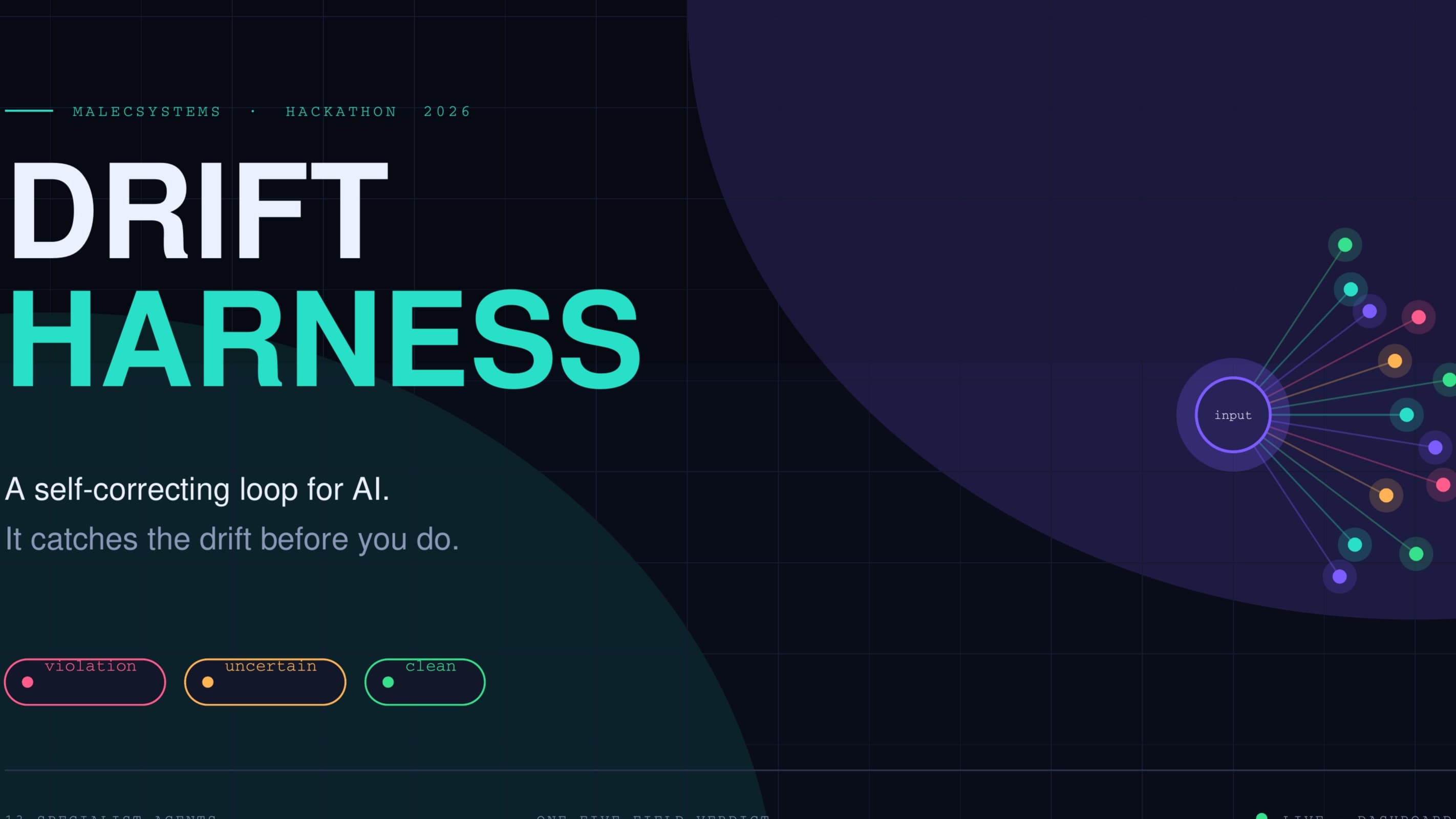
Every AI system drifts. It softens a position under pressure, drops a constraint it was holding a moment ago, or states a guess as if it were certain. The correction is almost always manual: a human notices, pushes back, forgets, and corrects the same failure on the next turn. Nothing remembers, and nothing scales. Drift Harness makes that loop automatic — it intercepts the exchange before the user has to act, logs what failed and why, and builds a structured record that drives correction at scale. The system fans a single exchange across thirteen specialist agents, each checking one slice of behaviour: constraints, antipatterns, voice, quality, identity, alignment, gap analysis, profiling and question generation. Every agent returns the same five-field verdict — agent, status, rule, excerpt, severity — so one shape holds across every layer. Its core idea is how it represents certainty. Rather than a percentage, which is just a token prediction dressed up as a probability, each agent commits to one of three states — violation, uncertain, or clean — always tied to an exact excerpt from the reasoning that triggered it. The excerpt is what makes the label mean anything. Under the hood, the logger mints a UUID4 per exchange and classifies each turn in Python before the model runs. Findings write to a FastAPI and SQLite backend; agents communicate over a shared Band session; a C++ coordinator handles multithreaded fan-out. The full stack runs live on a Hetzner VPS under pm2, with a dashboard at dashboard.malecsystems.com. We proved it end to end: one misaligned input fanned across every live agent produced six confirmed findings, written straight to the backend. All thirteen agents are deployed and the dashboard is live. The harness is the asset. The agents are the mechanism that fills it. Every AI system drifts — this one notices, records it, and turns a manual habit into infrastructure.

THE COUNCIL: Expert Advisors Who Fight For You

THE COUNCIL: Expert Advisors Who Fight For You

Everyone faces life-changing decisions alone. THE COUNCIL changes that by giving you your own personal advisory board. Submit your query—whether it's a high-stakes startup offer, career transition, or relocation—and watch five autonomous AI agents with distinct, persistent personalities deliberate in a live-streamed debate. Under the hood, THE COUNCIL is a multi-agent system built on Band.ai. Instead of a single LLM wearing five prompts, we deploy genuine model diversity: Qwen 2.5-32B (The Skeptic) analyzes risks, Llama-3.1-70B (The Strategist) identifies long-term growth, DeepSeek-R1-70B (The Numbers) quantifies quantitative metrics, Llama-3.1-8B (The Devil's Advocate) stress-tests consensus, and GPT-4o-mini (The Chair) synthesizes the room. The debate orchestration runs sequentially via FastAPI WebSockets to stream arguments as they are generated. Unlike typical chatbot wrappers, THE COUNCIL features heavy engineering depth: 1. Deterministic Stakes Classifier: Scores severity (1-10) and risk factors (cliff, vesting, relocation) deterministically without AI. 2. Live Market Grounding: Career queries trigger Brightdata web scraping to search salary listings, providing real-world benchmarks to 'The Numbers'. 3. Convergence Calculator: A custom algorithm that measures consensus (0.0-1.0) using position agreement and semantic text similarity. 4. Cryptographic 'Stare Decisis': Inspired by judicial tradition, it extracts minority dissents and SHA-256 hashes them directly into an immutable verdict chain. 5. 6-Table Database Persistence: Complete deliberation history mapping decisions, arguments, verdicts, evidence, and dissents in SQLite. Presented in an Apple-inspired editorial Next.js UI using stark light-mode whitespace, Playfair Display serif typography, and elegant card components with smooth micro-animations, the system feels alive, premium, and authoritative. Deliberation, not just generation.

Apohara VOUCH

Apohara VOUCH

Apohara VOUCH turns multi-agent decisions into cryptographically-verifiable offline receipts — signed, hash-chained, timestamped, and audit-ready in under 30 seconds. Built on 3 production LLM sponsors (Band SDK + AI/ML API + Featherless AI) with a deterministic post-LLM gate (BAAAR) that fails-closed on five auditable halt conditions. EU AI Act Art. 12 by construction. **When AI agents make a regulated decision, you can't trust the decision — and you can't prove it either.** Procurement, lending, hiring, and customer escalation are now mediated by multi-agent systems: 5–10 LLMs coordinate through chat rooms, hand off state, vote, and reach a verdict. Three failures follow: 1. **No audit trail.** When a regulator asks "who decided this, and why?", you have a chat log — not an evidence packet. Logs can be edited. Screenshots can be forged. LLM weights are opaque. 2. **No failure mode.** The agents coordinate, but if one hallucinates a vendor ID, the room reaches the wrong verdict anyway. Multi-agent consensus is consensus on the wrong answer. 3. **No offline verifiability.** The regulator asks for proof. You re-run the agents. They produce a different answer. The room is no longer reproducible. The EU AI Act Art. 12 (record-keeping), DORA Art. 16 (ICT incident logs), NIST AI RMF (Manage), and OWASP Agentic all require verifiable, tamper-evident, offline-checkable evidence. None of the existing solutions — vector stores, prompt logs, evals — satisfy all three. **Apohara VOUCH** is the first multi-agent substrate that produces EU AI Act Art. 12 evidence packets by construction, verified offline in under 30 seconds, with no LLM in the critical path. **Apohara VOUCH — vouch for every agent decision.**