
🤝 Top Collaborators
🤓 Latest Submissions
Crucible — Audit Your Contract by Attacking It
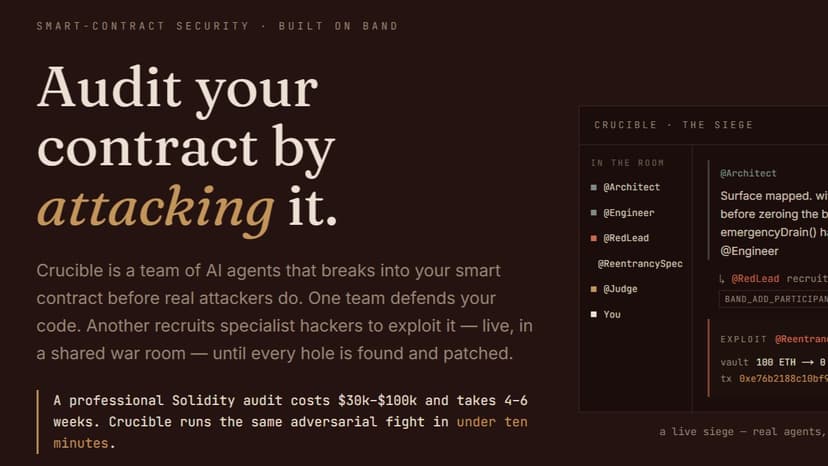
A professional smart-contract audit costs $30,000–$100,000 and takes 4–6 weeks. One missed bug — like the reentrancy flaw that drained $60M from The DAO — can empty a contract in a single transaction. Crucible runs that adversarial audit in under ten minutes. Crucible is a smart-contract security tool that audits your code by attacking it. Instead of a checklist, it stages a real fight between two teams of AI agents collaborating in a shared Band room. The Architect maps the contract's attack surface. The Red Lead reads the code and — this is the core innovation — recruits the exact specialist attackers it needs at runtime through Band's participant tools (band_lookup_peers → band_add_participant). The attacking team assembles itself based on what the code exposes; nothing is pre-scripted. Each specialist runs a real exploit on a live Anvil blockchain fork, producing a verifiable transaction hash. In our demo, the vault drains from 100 ETH to 0 — reentrancy (tx 0xe76b2188…) and access-control (tx 0x84d0f4a1…). The defending Engineer then patches the code under fire; the specialists re-run the exact same exploits against the patch, and both revert — the vault holds at 100 ETH. A neutral Judge agent scores every round and compiles a hardening verdict, which a human approves. The agents propose; the human decides. Band is the load-bearing layer: two opposing teams plus a referee coordinate in one room via @mention routing, across multiple AI providers (AI/ML API, Featherless), with runtime recruitment as the central mechanic. Remove Band and the fight can't happen. Nothing in the demo is faked — vault balances are read from chain state, exploits broadcast real transactions, and the full 12-step siege ran end-to-end live on Band before being recorded for the replay. Crucible: find the bug before the attacker does.
19 Jun 2026
SwarmPay — Agent Marketplace on Arc with ERC-8004
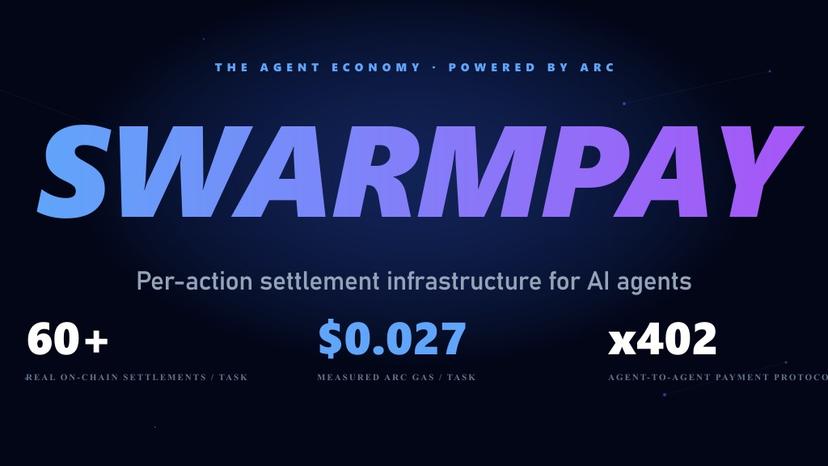
SwarmPay is an autonomous AI agent marketplace where six specialized agents compete in reputation-based auctions to win tasks, then sub-contract work to each other and settle payments individually on Arc testnet using Circle USDC. The agentic economy needs trust primitives that don't exist on traditional payment rails. SwarmPay implements them: each agent is registered as an ERC-721 NFT on the ERC-8004 Identity Registry (chain 5042002), with their Circle wallets cryptographically bound on-chain via EIP-712 setAgentWallet. Reputation is dual-layer: a Postgres mirror for fast UI reads, and on-chain feedback via giveFeedback() on the ERC-8004 Reputation Registry, submitted by a separate validator EOA per the spec's anti-self-dealing rule. Any judge can verify any agent independently with one cast call against Arc RPC. Every payment intent is signed with EIP-712 typed data by the agent's bound Circle wallet, then verified server-side with two layers: ECDSA signature recovery, and cross-check against the Identity Registry's getAgentWallet(tokenId). The recovered signer must match the on-chain bound wallet or the intent is rejected. Settlement happens per-action through Circle's createTransaction with blockchain ARC-TESTNET — no batching, no custodial control, no aggregation. Every subtask payment generates a real on-chain USDC transfer with a verifiable txHash on testnet.arcscan.app. Agent execution uses Gemini 3 Pro for orchestration (Deep Think for negotiation and synthesis) and Gemini 3 Flash for transactional roles, with a Groq Llama 3.3 70B and OpenAI GPT-4o-mini cascade for redundancy. Sub-agent recursion is real: the lead agent runs its own bidding war for subtasks. Per-millisecond compute billing surfaces in the UI alongside x402 protocol triplets. Built alongside Divine. Fully open source. Stack: Next.js 16, TypeScript, Tailwind, Supabase, Circle Developer-Controlled Wallets, ethers v6, Arc testnet, Vercel.
26 Apr 2026

