
Syuja Dewa Kusuma@whard220599
3
Events attended
2
Submissions made
Indonesia
1 year of experience
About me
I'm Dewa, an AI Engineer who builds production-ready systems fast. I recently shipped SignalScout — a live GTM intelligence platform with Claude Haiku, Bright Data APIs, MCP JSONRPC endpoint, and 214 passing backend tests, deployed on Google Cloud Run and Vercel during a hackathon. My stack: Python, FastAPI, Claude/Gemini, pgvector, Google Cloud Run. I focus on systems that are auditable, tested, and actually deployed — not just demos. I also built a production Telegram AI superapp for a real business client, reducing their manual work from 90 hours to 15 minutes per month. I'm here to build something that ships, not just something that looks good in a slide deck.
🤝 Top Collaborators

.png&w=640&q=75)
🤓 Latest Submissions
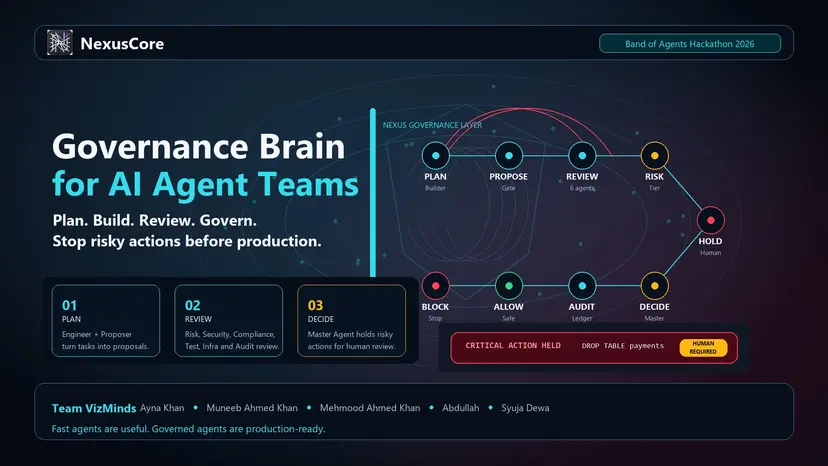
NexusCore
NexusCore is the governance brain and emergency brake that sits above AI agent teams. Built for the Band of Agents Hackathon, it addresses a growing enterprise risk: AI agents are no longer only suggesting code. They can generate patches, call tools, modify databases, deploy services, and trigger live actions faster than humans can review them. NexusCore adds governance before execution. When an agent proposes or attempts an action, the system classifies it into LOW, MEDIUM, or CRITICAL risk. LOW actions are allowed and logged. MEDIUM actions are held for review. CRITICAL actions are stopped and require explicit human confirmation before they can proceed. The system uses nine specialized agents collaborating through Band: Engineer/Builder, Proposer, Risk, Compliance, Security, Test, Infrastructure, Rollback/Audit, and Master. The Proposer Agent turns risky work into a formal proposal. Reviewer agents assess blast radius, reversibility, security, policy, test readiness, infrastructure impact, rollback plans, backups, and audit evidence. The Master Agent reads all findings and issues the final ALLOW or BLOCK decision. Band is central to the workflow, not just a notification layer. It acts as the shared collaboration room where agents exchange context, post reviews, coordinate decisions, and create a visible reasoning trail. The NexusCore dashboard mirrors this process with live workflow status, agent architecture, runtime interception, pending approvals, and an audit ledger. NexusCore demonstrates a practical enterprise use case for collaborative agents: making autonomous AI workflows safer, traceable, and human-governed before they touch production systems.
19 Jun 2026
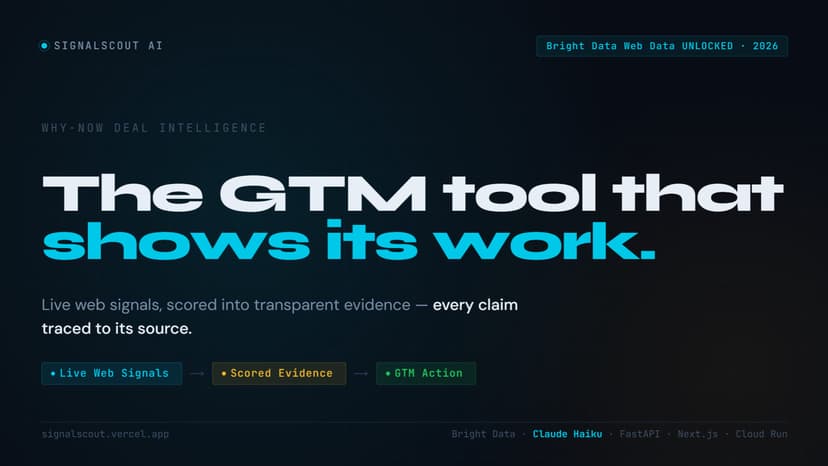
SignalScout AI: Evidence-First Why-Now Engine
SignalScout AI is an evidence-first why-now engine for GTM and sales teams. Sales reps often spend hours researching accounts, but still reach out too late, with generic messaging and black-box intent scores. SignalScout answers one practical question: why should we contact this company right now? The system uses Bright Data as the live public-web data layer. SERP API collects fresh news, funding, product, and competitor signals. Web Unlocker extracts full text from hard-to-access pages. Web Scraper API provides pre-warmed hiring snapshots for directional hiring evidence. The backend then converts these signals into typed evidence rows with source URLs, source tiers, confidence, mode labels, and a reproducibility hash. Unlike typical AI sales tools, SignalScout does not let the LLM generate numeric scores. Scores are computed deterministically in Python from explicit signal weights, impact, confidence boost, and mode multiplier. Claude Haiku is used only for evidence-grounded synthesis: executive summary, why-now reason, sales angles, cold email, LinkedIn message, and discovery questions. The product is deployed as a live cockpit on Vercel with a FastAPI backend on Google Cloud Run. Each run shows the agent pipeline, evidence ledger, scoring audit trail, Bright Data infrastructure usage, and action pack. The result is a sales-ready GTM brief that is live, deterministic, and traceable.
31 May 2026


