
Ivan Ivanka@theivanivanka
1
Events attended
1
Submissions made
Hungary
10+ years of experience
About me
Ivan Ivanka is the founder and CEO of Markster, and a builder who ships operated systems, not demos. Markster runs sales, marketing, CRM, follow-up, and pipeline as one operated system for businesses that still run on the owner. The owner approves what goes out. Markster runs the rest. The outreach goes out, the content ships, the follow-ups happen, and the CRM stays current every week, with AI doing the repeatable work and people on judgment, none of it by hand. The problem he kept seeing is simple. Most small business owners know they should be doing more sales and marketing, and almost none do. They have no team to run it, no system to run it on, and no time to build one. So the work that wins customers never gets done, and the company stays stuck on the one person at the top. Ivan spent 15 years running growth at every scale, from frontline operations at 18 to Chief Growth Officer of a 1,500-person enterprise. He built four agencies along the way. Everywhere, the failure mode was the same: when the owner stops pushing, pipeline stops moving. He became convinced this is an operating problem, not a motivation problem, and the only durable fix is a system that runs the work whether or not the owner is in the room. Markster's agents act on live data and write real actions into the tools teams already use, every claim traceable to its source. He builds on live web data on purpose: the signals that change a business decision live on the open web, and an agent is only worth trusting if you can see where its answer came from. Ivan also created ScaleOS, the methodology behind Markster. Markster was founded in 2024 and is backed by 500 Global. Ivan is building it with his co-founder, Attila Sukosd. His thesis is that the next generation of great companies will not be built by the people who work the hardest, but by the ones who install the right operating system early, let AI run the repeatable work, and keep humans on judgment.
🤓 Latest Submissions
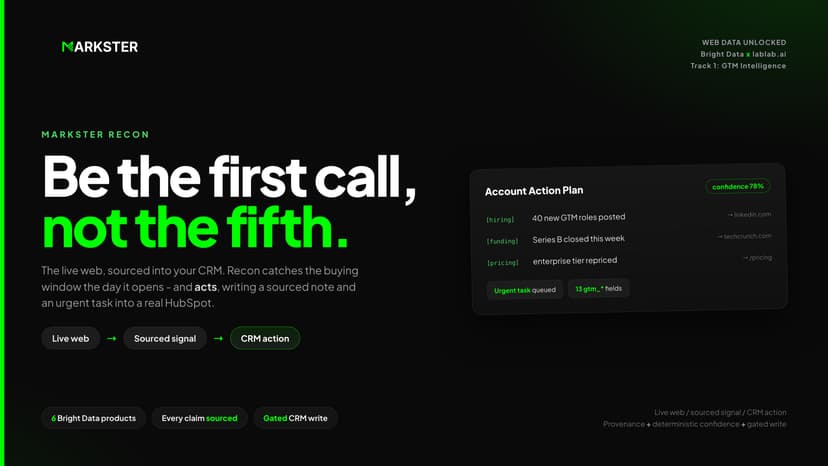
Markster Recon: Be the First Call, Not the Fifth
A rep opens the CRM Monday morning. A target account: "no recent activity." They move on. Meanwhile that same account just posted 40 sales roles, closed a round, and quietly repriced - on the open web, where the CRM never looks. That gap is where pipeline dies. (76% of companies say fewer than half their CRM records are accurate - Validity, 2025.) Markster Recon closes it. Point it at any company and it runs a real pipeline, not a prompt: COLLECT - six Bright Data products fire in parallel: LinkedIn hiring (Web Scraper API), news + funding (Web Unlocker), competitor landscape (Discover API), market results (SERP API), JS-rendered pricing (Browser API), and funding research (Deep Lookup). SOURCE - every datum carries provenance: source URL, timestamp, method. Click any claim and verify it live. Nothing is unattributed. SCORE - confidence is computed (coverage x signal strength), not guessed by a model. SYNTHESIZE - the LLM writes the Account Action Plan: the read, routes in, who shapes the decision, honest evidence gaps, next actions. It writes narrative only - it can never invent a signal. Then the part most projects skip: Recon acts. It writes the decision into a live HubSpot - gtm_* properties, a sourced note on the timeline, and an urgent task where an AI agent executes or prioritizes for the rep. And it polices itself: a thin or low-confidence run is gated to "review only," so a weak signal can never look like an approved action. It is a standing watch on your target list, not a one-time lookup: run the loop on a schedule and you catch the window the day it opens. Judge-testable, no login: any company returns a full plan plus a preview of exactly what hits the CRM. It runs on a real production CRM, and synthesis is provider-portable - Azure OpenAI, AI/ML API, or open-source via Featherless. Built by a team that runs GTM on this exact stack. Live web -> sourced signal -> CRM action. That's the loop.
31 May 2026

