

🤓 Latest Submissions
Andon AI
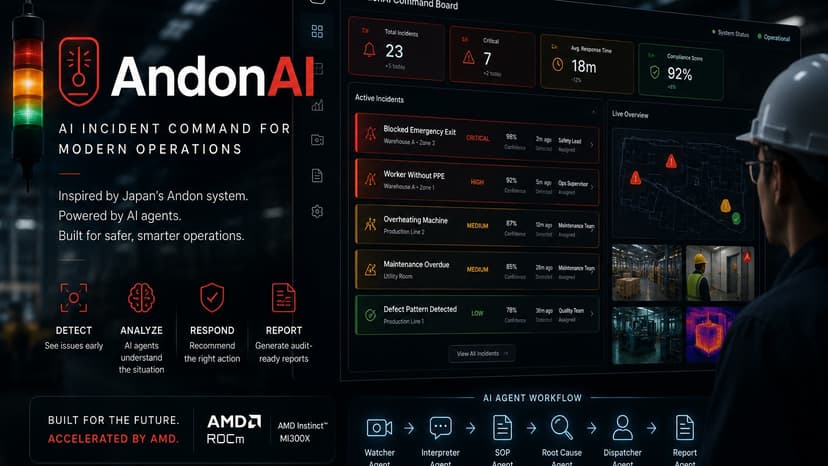
AndonAI is an AI incident command board for modern operations, inspired by the Japanese Andon pullcord system used in manufacturing to signal problems the moment they happen. The platform helps factories, warehouses, labs, hospitals, construction sites and event venues detect operational risks earlier and respond with more clarity. Users can upload images, video clips, sensor logs, shift notes or SOP documents. AndonAI then runs a coordinated workflow of AI agents. A Watcher Agent identifies the issue, an Interpreter Agent explains the situation, an SOP Agent matches it to the right procedure, a Root Cause Agent suggests possible causes, a Dispatcher Agent assigns severity and ownership and a Report Agent generates an audit ready incident report. For the demo, AndonAI analyzes scenarios such as a blocked emergency exit, missing PPE, overheating equipment, production defects and shift handover risks. The system is designed to be accelerated by AMD Developer Cloud, ROCm and AMD Instinct GPUs for multimodal inference, batch video frame analysis, embeddings and parallel agent workloads. Instead of being just another chatbot, AndonAI acts as an intelligent operations teammate that helps teams detect, coordinate, resolve and document incidents faster.
12 Jul 2026
Balai: Agentic Meeting Hall
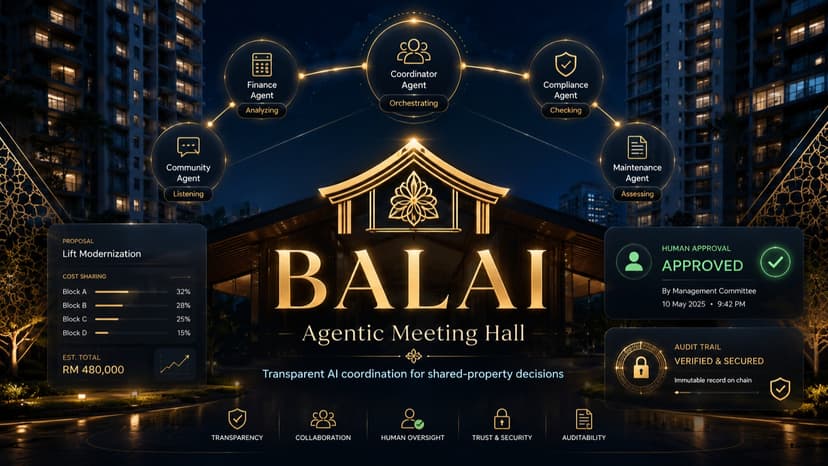
Balai is an agentic meeting hall for shared property and community governance decisions. It is designed for situations such as condominium repairs, resident cost sharing, vendor selection and committee approvals, where decisions are often slow, unclear and difficult to audit. In our demo scenario, an emergency lift repair is triggered. The OpsAgent reports the safety issue, ContractorAgents provide repair options, the CommitteeAgent reviews policy, ResidentAgents check consent and mandate limits and the Penghulu acts as the neutral orchestrator coordinating the discussion. When a resident's cost share exceeds their approved mandate cap, Balai automatically pauses the workflow and asks for human approval before proceeding. After the decision is approved, Balai finalizes the repair recommendation and creates a sealed audit trail showing every key action such as issue report, vendor quotes, policy review, cost split, approval and final decision. Balai is inspired by gotong royong, the Malaysian idea of communal cooperation, but reimagined as a transparent AI native decision workflow for modern property management.
19 Jun 2026
Keiretsu Radar: AI Supplier Risk Map
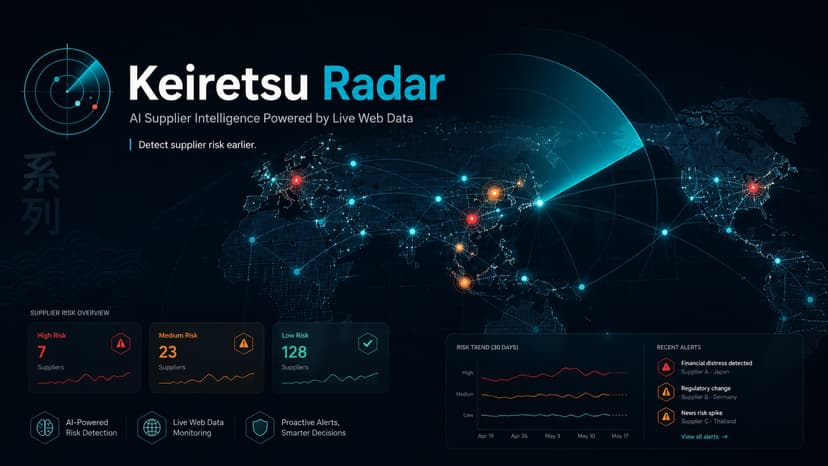
Keiretsu Radar is an AI-powered supplier intelligence platform that helps companies detect supplier and vendor risks earlier by turning live public web data into structured business intelligence. Inspired by the Japanese concept of keiretsu, where companies operate through deeply connected supplier and partner networks, the product treats supplier risk as a network problem rather than a single company problem. Users can enter a company, industry or supplier list and Keiretsu Radar scans public web signals such as news, company websites, hiring activity, leadership changes, regulatory updates, product availability, pricing movement and reputation signals. The system then generates a supplier network graph, risk scores, evidence cards and a boardroom ready executive brief. Bright Data acts as the primary live web intelligence layer, helping the agent collect and structure public web data reliably. The platform also includes fallback connectors for demo resilience, such as Firecrawl, Tavily, Exa, GDELT, NewsAPI and seeded demo data when live credentials are unavailable. The interface clearly labels whether it is running in Live Mode or Demo Mode. Keiretsu Radar is built for procurement, finance, strategy and risk teams that need faster supplier due diligence and earlier warning signs before disruptions appear in internal systems. Instead of manually checking scattered web pages, teams get one clear dashboard showing which suppliers are stable, which require monitoring and which present urgent risks.
31 May 2026
KintsugiOps AI: Green Software Repair
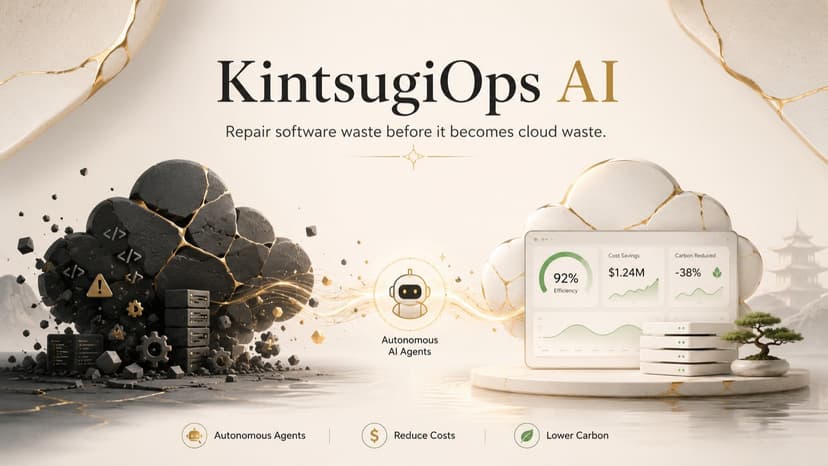
KintsugiOps AI is an agentic AI platform that helps software teams identify and repair software waste before it turns into unnecessary cloud cost, slower performance and higher digital carbon impact. Inspired by the Japanese art of kintsugi, where broken pottery is repaired with gold instead of being discarded, the product applies the same idea to software systems where inefficient systems should be improved, not simply replaced. The platform uses multiple AI agents to analyse software and cloud workflows. One agent finds issues such as bloated Docker images, unused dependencies, repeated AI API calls, idle cloud resources and slow CI/CD pipelines. Another agent estimates the financial and carbon impact, while other agents recommend repairs, check risk levels and generate a clear impact report. The goal is to give engineering, DevOps and sustainability teams a simple way to understand where waste exists, what should be fixed first and how much value can be recovered. KintsugiOps AI turns messy software systems into cleaner, more efficient and more sustainable digital infrastructure.
19 May 2026
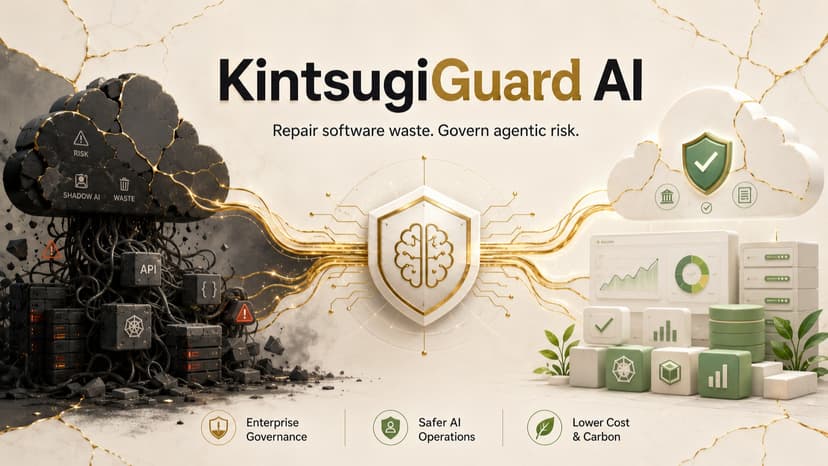
KintsugiGuard AI
KintsugiGuard AI is an enterprise AI governance and software repair platform that helps teams make autonomous AI workflows safer, cleaner and more accountable. As companies adopt AI agents for engineering, DevOps and cloud operations, they face two problems at once: software waste accumulates silently, while agentic actions can happen without enough oversight. KintsugiGuard AI solves this through a governed multi agent workflow. It detects issues such as bloated containers, idle cloud resources, repeated API calls, slow CI/CD pipelines and risky repair actions. The platform then estimates cost impact, carbon impact, risk level and business value before recommending what should happen next. Each repair is classified as auto approved, human review required, blocked by policy or safe to simulate only. The system also includes security inspection, governance policy checks, Gemini ready reasoning, X402 style governed payment simulation and an audit trail for every decision. The result is a practical enterprise tool that turns software waste and agentic risk into measurable, policy approved repair.
19 May 2026
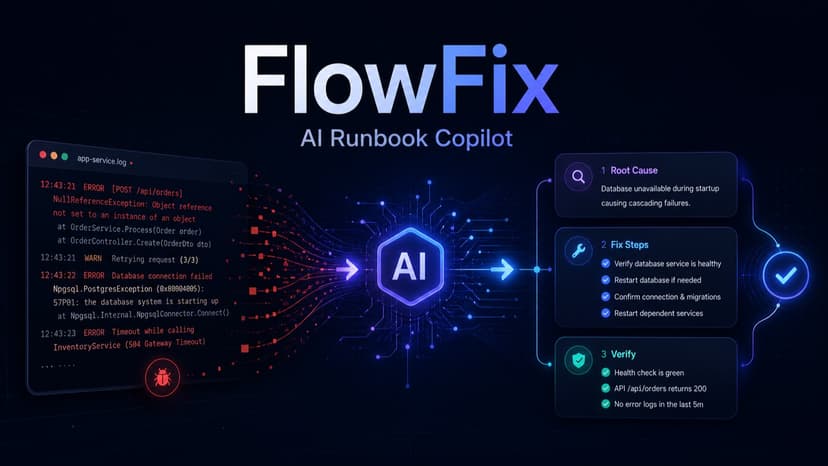
FlowFix - AI Runbook Copilot
FlowFix is an AI-powered debugging assistant that helps developers understand broken engineering workflows faster. Instead of manually reading messy logs, scripts, configuration files and documentation, users can paste a failed log and related repository context such as a Dockerfile, shell script, requirements file or project notes. FlowFix then analyzes the failure and generates a structured debugging report. The tool produces a plain English error summary, explains what the workflow is trying to do, ranks likely root causes with confidence levels and supporting evidence, and creates a step-by-step fix runbook with verification commands. It also generates prevention tips and a downloadable DEBUG_RUNBOOK.md file that can be reused as team documentation. FlowFix is useful because developers often lose time not from writing code, but from figuring out why a build, setup or deployment broke. By converting scattered debugging information into an actionable runbook, FlowFix helps junior developers onboard faster, reduces debugging friction and turns one time fixes into reusable knowledge.
17 May 2026

EchoLens
EchoLens is an AI powered immersive memory experience generator that transforms ordinary digital messages into interactive, shareable moments. Instead of sending a plain text message, static photo or generic greeting card, users can upload a photo, write a short message or provide a voice note. EchoLens then uses an agentic AI workflow to understand the user’s intent, emotional tone and context before generating a polished message, visual direction, scene concept and interactive web-based memory card. The project is designed around a simple idea: digital communication should feel more human. EchoLens allows users to create small immersive experiences for birthdays, appreciation notes, travel memories, event invitations, personal milestones or long distance messages. The final output can be explored as a lightweight 3D scene or animated digital card and shared through a link or QR code. For the AMD Developer Hackathon, EchoLens demonstrates how AMD Developer Cloud and ROCm can support practical AI inference for creative, multimodal and agentic applications. The system combines AI agents, multimodal input and immersive web technology to create a complete end-to-end experience from raw user input to a finished interactive memory.
10 May 2026


