
🤓 Latest Submissions
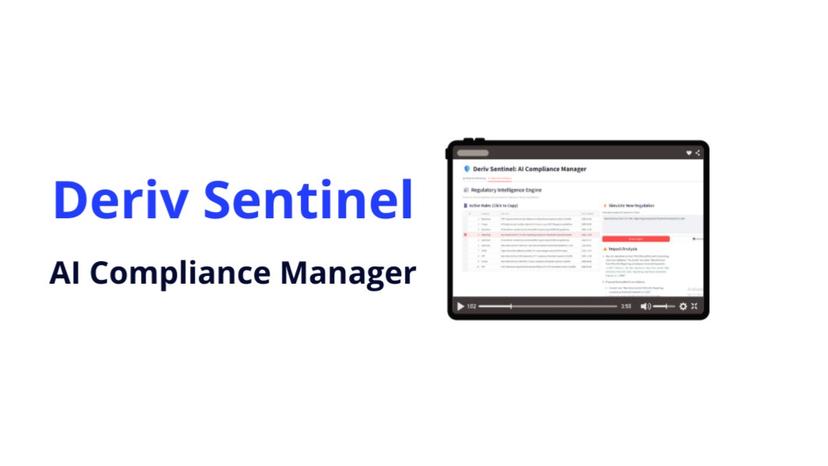
Sentinel Compliance Manager
The Problem Financial compliance teams are currently drowning in data. Traditional rule-based monitoring systems generate excessive false positives, wasting valuable analyst time. Meanwhile, sophisticated money launderers use techniques like "structuring" (splitting large transfers) to bypass static thresholds. Furthermore, when global regulations (e.g., FATF or FCA rules) change, it often takes weeks for companies to manually update their monitoring code, leaving them vulnerable to heavy fines. The Solution Deriv Sentinel transforms compliance from a reactive checklist into a proactive AI intelligence system. It does not just filter data; it understands context. Key Features: Context-Aware Behavioral Monitoring: Unlike legacy systems, Sentinel analyzes transactions against the specific user's profile (Declared Income, Occupation, Location). It instantly flags anomalies like "Source of Funds Risk" or "Sanctioned Geo-Hopping" and provides a human-readable AI explanation for every alert. Automated Regulatory Intelligence: The system creates a bridge between global news and internal databases. If a new regulation is announced (e.g., "Crypto Travel Rule threshold lowered to $1,000"), the AI assesses the impact and automatically updates the SQL rule engine. This ensures "Zero-Day Compliance" without requiring manual code deployment. How It's Built The application is built using Python and Streamlit for a responsive interface, powered by OpenAI's LLMs for reasoning and pattern recognition. It utilizes a Dual-Database Architecture (SQLite) to securely segregate transaction logs from regulatory rules. Impact Deriv Sentinel drastically reduces investigation time, minimizes the risk of regulatory penalties, and allows Deriv to scale its operations safely without linearly increasing compliance headcount. It is the future of automated fintech security
7 Feb 2026

Smart Panel Cleaner Simulation with Gemini AI
The Problem: Solar energy is vital for a sustainable future, but environmental factors like dust, sandstorms, and debris can reduce solar panel efficiency by up to 30%. Manual cleaning is labor-intensive, costly, and often dangerous. The Solution : This project, Smart Panel Cleaner, is an intelligent simulation of an autonomous cleaning robot designed to maintain a commercial solar farm (represented by a 10x10 grid of 100 panels). Unlike standard robots that follow a fixed path, this agent uses Google Gemini 2.0 Flash as its "brain" to make real-time strategic decisions based on battery levels and grid cleanliness. Key Features AI Copilot: The robot communicates with Google Gemini to analyze telemetry data and decide whether to clean, charge, or wait. Dynamic Weather System: The simulation reacts to environmental triggers. "Sandstorms" drastically lower efficiency and revenue, while "Rain" provides natural cleaning, allowing the robot to save energy. Smart Navigation: Uses Breadth-First Search (BFS) algorithms to navigate around static walls and dynamic obstacles to find the nearest dirty panel. Real-Time Economics: The dashboard tracks the direct business impact, calculating "Revenue (USD)" lost to dirt versus energy gained from cleaning. Technical Implementation Built using Python and Streamlit, the application features a custom Matplotlib rendering engine to ensure a flicker-free, non-blocking visual experience. The AI logic runs asynchronously, ensuring the robot moves smoothly every second while the LLM processes data in the background.
15 Feb 2026


