🤓 Latest Submissions
OutreachOS: compliance-gated agents on Band
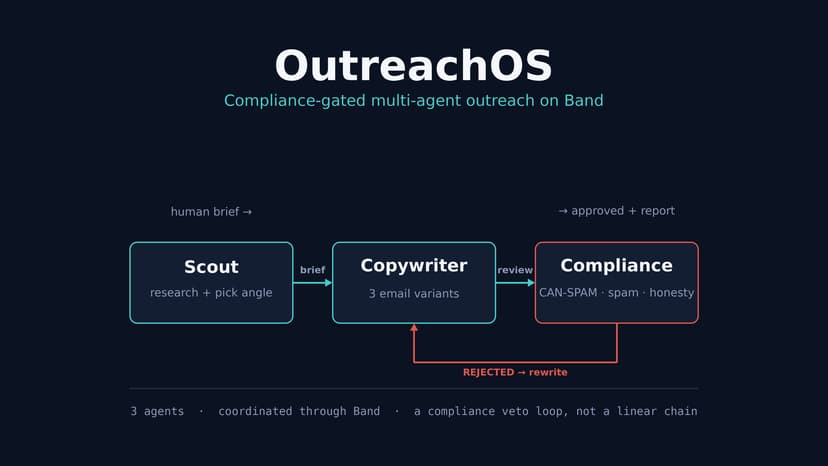
Cold outreach has a hidden failure mode: one non-compliant or misleading email can damage a sender's domain reputation for months. The expensive part isn't When writing the email, it's the review that stops a bad one from going out. That Review is exactly what gets skipped when outreach is automated. OutreachOS rebuilds that workflow as three specialized agents that collaborate through a shared band room, where every handoff is a visible message: Scout researches the target company and persona, selects an outreach angle (pain-, opportunity-, or social-proof-based), and hands a brief to the Copywriter. The copywriter writes three cold-email variants (short, medium, long) and submits them to compliance. Compliance holds veto power. It reviews every variant against CAN-SPAM rules, spam-trigger language, and honesty. If anything fails, it does not pass the work forward; it returns the batch to the Copywriter with specific required fixes, and the loop repeats until every variant clears. The non-linear review loop is the core of the system. In a live run targeting Notion's Head of Sales, Compliance approved two variants but rejected the third: it caught an unverifiable performance statistic ("20–30% more at-risk deals") presented as established fact an honesty violation, a single-pass generator would have shipped. The Copywriter rewrote the claim into an attributed, qualified statement, resubmitted, and Compliance approved with a per-variant compliance report and a reasoning log. Band is the coordination layer, not a wrapper. Each agent runs as its own process, connects over WebSocket, and only sees messages that @mention it. The agents discover each other and hand off work entirely through the room, so the whole multi-agent exchange including every rejection and rewrite is visible and auditable in one place. The coordination logic lives in the agents' system prompts; Band routes the messages. Built with the Band Python SDK and the Anthropic adapter. Open-source, MIT.
19 Jun 2026

