

🤝 Top Collaborators
.png&w=640&q=75)
🤓 Latest Submissions

Bazaar-AI: Zero-Cost WhatsApp AI Employee
Bazaar-AI is a zero-cost AI employee for small merchants in underserved-language markets, built for Track 3: LocalFirst. It talks to customers and shop owners in English, Hindi, Hinglish, Tagalog, or Taglish over a direct API or straight through WhatsApp, handling everything from quick product questions to fully negotiated bulk orders with auto-generated invoices. The core idea is a ComputeRouter: a semantic classifier that scores every incoming message on negotiation intent, invoice/tool-calling signals, code-switched vernacular density, and conversation history, then routes it to one of two tiers, a fast low-VRAM edge model for simple lookups, or a deep-reasoning heavy model for negotiations and structured invoice extraction. A direct API endpoint and a Twilio WhatsApp webhook both run through the exact same routing pipeline, so behavior never drifts between entry points. The architecture targets self-hosted Gemma-4 models on AMD Instinct MI300X GPUs via vLLM. During public evaluation, a transparently-disclosed Model ID Translation Layer substitutes free Fireworks serverless models with equivalent parameter counts, so the routing logic can be demonstrated at zero API cost without dedicated GPU hosting. Moving to the real Gemma-4 deployment needs only an endpoint config change. A live Streamlit dashboard gives judges a real-time view of routing decisions, compute saved, and cost ($0.00 throughout). A 17-check automated regression suite validates routing precision, webhook handling, and invoice JSON extraction. Phases 1 through 3 are complete and verified end-to-end, with a hardening roadmap (guided decoding, ML-based vernacular detection, persistent storage, webhook signature verification) scoped for post-hackathon work.
13 Jul 2026
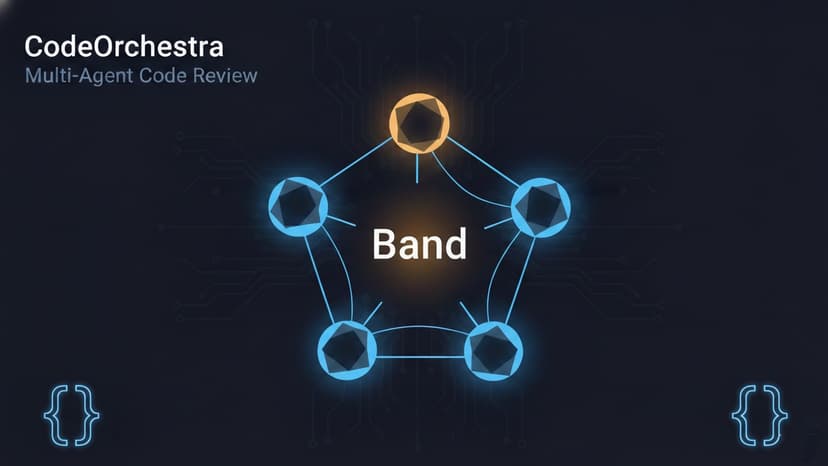
CodeOrchestra
CodeOrchestra transforms code review from a manual, slow process into a fully automated, multi-agent workflow powered by Band's coordination layer. Five specialized agents, including a Planner, Coder, Reviewer, Tester, and Docs Writer, operate in a shared Band coordination room, passing context, handoffs, and results in real time. Band serves as the central interaction layer: every agent posts to the room after completing its task, preserving a full, auditable trail of the review session. What makes CodeOrchestra unique is its Quantum Test Path Optimizer. Built with Qiskit's QAOA algorithm on a local AerSimulator and IBM Quantum, it solves the NP-hard minimum set cover problem to select the optimal subset of tests from all possible paths, maximizing coverage while minimizing redundant execution. This marks the first integration of quantum computing into a multi-agent code review pipeline. Models are intelligently routed: complex planning uses AI/ML API's o3-mini for deep reasoning, while code analysis and documentation leverage OpenRouter's open-source Qwen2.5-Coder and Mistral models for efficient, free inference. As a result, a PR is reviewed end-to-end in minutes, providing a structured report, a quantum-optimized test plan, and a full Band room audit log, all at near-zero compute cost.
19 Jun 2026
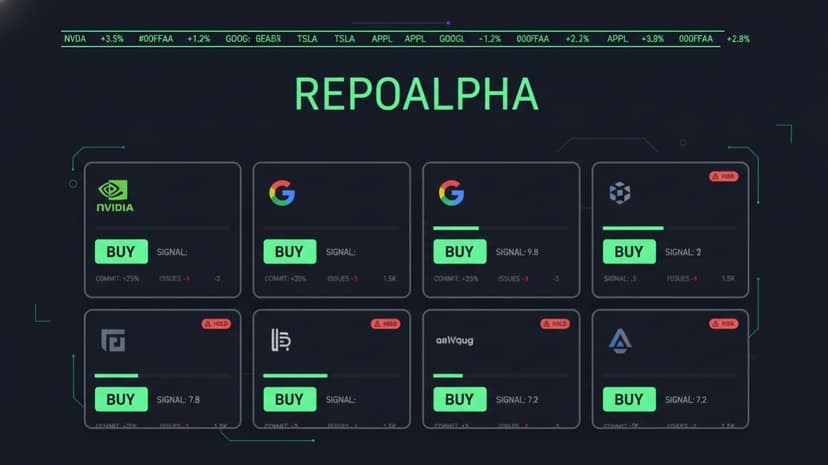
RepoAlpha - Open Source M&A Intelligence
RepoAlpha transforms how Venture Capital and M&A teams evaluate open source projects. Traditional tools count stars — RepoAlpha asks who is starring. Using Bright Data's Web Unlocker, RepoAlpha scrapes the public GitHub profiles of every stargazer on trending repositories and extracts their employer. A Software Engineer at Nvidia starring a repo scores 15 points. An anonymous account scores zero. This Corporate Signal Score is the core innovation — behavioral data beats vanity metrics. The pipeline runs automatically every hour via GitHub Actions across five phases. Phase 1 harvests trending repositories via GitHub Search API. Phase 2 enriches stargazer profiles through Bright Data Web Unlocker to detect company affiliations. Phase 3 uses AI/ML API with Llama 3.1 70B to analyze each README for commercial value, generating a hype score from 1 to 10 and a one-sentence VC summary. Phase 4 fires real-time alerts to Slack, Discord, and email when a repo crosses the BUY threshold. Phase 5 generates pgvector embeddings for semantic similarity clustering. The War Room dashboard built on Streamlit displays live BUY, HOLD, and SELL ratings, top corporate adopters, license risk badges flagging AGPL as a legal minefield, hiring dossiers for acqui-hire targeting, historical score charts, and a voice alert feature powered by Speechmatics TTS that narrates signals aloud. The entire stack costs zero dollars. Bright Data handles scraping, Groq and AI/ML API handle intelligence, Supabase with pgvector handles storage and semantic search, Speechmatics handles voice, and Streamlit Community Cloud hosts the dashboard publicly. RepoAlpha delivers the same market mosaic intelligence that hedge funds pay millions for in equity markets — now available for the teams betting on the next generation of open source infrastructure.
31 May 2026

Q-Optima - Autonomous Quantum Logistics Agent
Q-Optima is a production-ready multi-cloud autonomous AI agent that solves the Travelling Salesman Problem an NP-Hard logistics optimization challenge using real Quantum Computing. HOW IT WORKS: A logistics commander speaks a voice instruction and uploads a delivery route map. The 7-node LangGraph agent pipeline: 1. Speechmatics (sponsor) transcribes the audio instruction in real time 2. Gemini 2.5 Flash Lite analyzes the map image and extracts city locations 3. OSRM, Open-Meteo, TomTom, and Climatiq enrich the distance matrix with real road distances, weather penalties, traffic congestion, and carbon costs 4. The agent auto-generates a Qiskit QAOA circuit from the enriched QUBO matrix 5. IBM Quantum (or Aer simulator) executes the circuit with 512 shots 6. A self-reflection loop autonomously retries with higher QAOA depth if quality fails 7. The optimal route is decoded, a Telegram dispatch alert fires, and the job is saved to Supabase analytics WHAT MAKES IT ORIGINAL: - First agent combining multimodal vision AI + real quantum computing for logistics - QUBO matrix encodes weather + traffic + carbon simultaneously — one quantum pass - LangGraph self-reflection: the agent improves its own answer autonomously - Classical vs quantum comparison shows measurable advantage TECH STACK (14 APIs, 3 clouds, $0 cost): Frontend: Next.js 14, Framer Motion, Leaflet.js — Vercel Backend: FastAPI, LangGraph, Python 3.11 — Render STT: Speechmatics batch + RT API (sponsor) Vision: Google Gemini 2.5 Flash Lite Quantum: IBM Quantum / Qiskit QAOA GPU STT: OpenAI Whisper on AMD ROCm Road data: OSRM (free, no key) Weather: Open-Meteo (free, no key) Traffic: TomTom Flow API Carbon: Climatiq freight emissions Dispatch: Telegram Bot API Analytics: Supabase PostgreSQL Tunneling: Cloudflare Tunnel
19 May 2026


