.png&w=256&q=75)
🤓 Latest Submissions
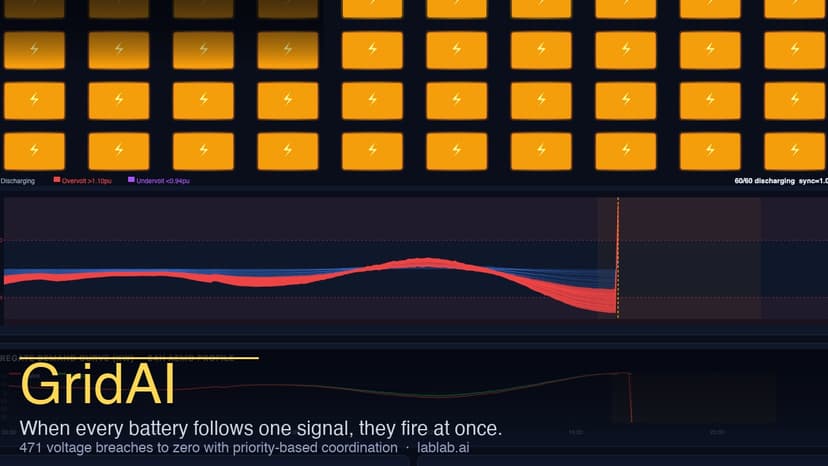
GridAI - DER Coordination Protocol
Problem Australia has roughly 15 GWh of home batteries and the number is climbing fast. They mostly see the same thing: the National Electricity Market price signal. When price drops in the evening they all discharge at once. Following one shared signal makes a fleet synchronise, and a synchronised fleet builds a new evening demand peak instead of smoothing the old one, while pushing voltage outside legal limits at the edge of the distribution network. This failure mode gets worse as virtual-power-plant deployment scales, because it appears precisely when fleets start coordinating against shared signals. It is a second-order problem that today's market design walks straight into. GridAI's novelty is the diagnosis: desynchronisation depends on fleet-level value heterogeneity, and each voltage breach can be attributed by cause, separating PV-export conditions from battery-herding events so only protocol-induced failures escalate. Solution GridAI is a multi-agent coordination protocol. Four agents, Forecaster, Coordinator, Compliance, and Operator, collaborate through Band as the actual collaboration layer, not a notification wrapper. The Coordinator runs a priority-based dispatch: each battery's slot is allocated from global fleet state using its state of charge and the owner's willingness-to-discharge. The fleet desynchronises through heterogeneity, the diversity in what each battery wants, not through symmetric negotiation. The Compliance agent reviews every plan against AS IEC 60038:2022 voltage limits, flags battery-herding breaches (kept distinct from midday PV-export breaches), and escalates to a human Operator with a full Band-native audit trail. Result: battery-herding overvoltage breaches cut from 471 to 0, fleet synchrony from 1.000 to 0.167. Convergence takes 1 to 2 rounds, runs on existing inverter hardware, and fits the CSIP-AUS standard already mandated in Australia.
19 Jun 2026

