
🤓 Latest Submissions
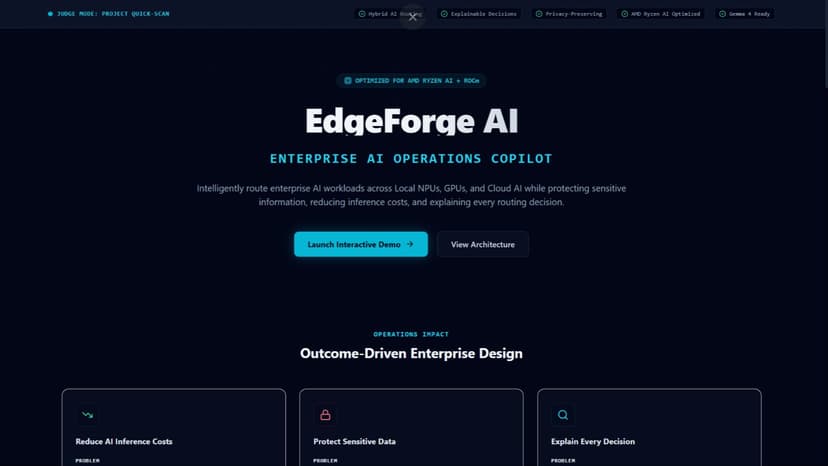
EdgeForge AI: Explainable Hybrid AI Router
EdgeForge AI addresses a major enterprise AI challenge: choosing between local AI for privacy and cloud AI for advanced reasoning. Instead of forcing a single approach, it uses an explainable hybrid routing engine that intelligently decides whether each request should run locally on AMD-powered hardware, in the cloud, or through a hybrid workflow. Every routing decision is transparent. The platform evaluates privacy sensitivity, request complexity, local hardware capability, confidence, latency, and estimated cost before selecting the optimal execution path. Sensitive information is automatically detected, masked, and protected before any cloud processing occurs. The Explainability Dashboard helps users understand every decision through an Executive AI Briefing, Routing Decision Graph, Route Comparison Matrix, Privacy Viewer, Trust Analytics Dashboard, and detailed execution traces. The backend is built with FastAPI using Clean Architecture, while the frontend uses React, TypeScript, and Tailwind CSS. The platform includes modular routing strategies, provider abstraction with automatic fallback handling, analytics collection, and real-time observability. EdgeForge AI is designed for privacy-sensitive industries including healthcare, financial services, manufacturing, cybersecurity, and smart cities. Instead of sending every request to the cloud, EdgeForge AI keeps suitable workloads local to reduce latency, API costs, and data exposure, while using cloud models only when additional reasoning capability is required. Key capabilities include explainable AI routing, hybrid local/cloud execution, privacy-aware prompt masking, executive decision summaries, interactive routing visualization, trust analytics, resilient provider fallback, and an enterprise-ready interface. EdgeForge AI demonstrates how AMD-powered edge computing and modern foundation models can work together to deliver secure, transparent, and cost-efficient enterprise AI.
13 Jul 2026
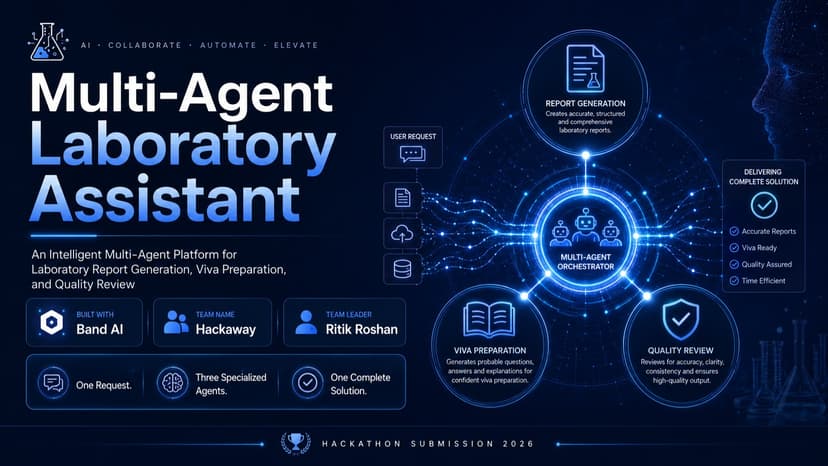
LabPilot AI: Multi-Agent Laboratory Assistant
My project is a multi-agent laboratory assistant platform built using Band as the coordination layer. The system addresses a common academic and enterprise workflow problem: transforming experiment requirements into complete, verified, and presentation-ready outputs while reducing manual effort and coordination overhead. The solution consists of three specialized AI agents working collaboratively. The Experiment Analyzer acts as the primary coordinator and domain expert. It receives user requests, understands experiment requirements, generates structured laboratory reports, performs calculations, and creates technical explanations. The Viva Coach specializes in oral examination preparation by generating viva questions, model answers, and conceptual explanations. The Lab Reviewer serves as a quality assurance agent that reviews reports for technical accuracy, formatting consistency, completeness, and compliance with laboratory standards. Band enables these agents to function as a coordinated team rather than isolated chatbots. Agents maintain role specialization, exchange context, perform task handoffs, and contribute their expertise to a shared workflow. The Experiment Analyzer delegates viva preparation tasks to the Viva Coach and validation tasks to the Lab Reviewer, then consolidates all outputs into a final deliverable. The project demonstrates how enterprise workflows can benefit from intelligent agent coordination. Specialized agents divide work, review outputs, and improve quality. The approach reduces errors, accelerates report generation, improves learning outcomes, and provides users with a complete end-to-end solution. By leveraging Band's orchestration capabilities, the platform showcases a practical implementation of collaborative AI systems for educational and technical documentation workflows.
19 Jun 2026


