Japhet Adjetey@remedy642
5
Events attended
2
Submissions made
5+ years of experience
About me
I am a full-stack software engineer who is adept at building web and mobile applications that span different disciplines in health and finance. I have built several applications used in day-to-day business operations. It particularly appeals to observing systems acting in a human-like manner. This approach allows me to integrate artificial intelligence into the applications I build. I like watching movies and playing 8-ball. I look forward to even building resilient systems that are completely resistant to attacks, leveraging agentic commerce where systems make intelligent decisions in executing financial transactions.
🤝 Top Collaborators

🤓 Latest Submissions
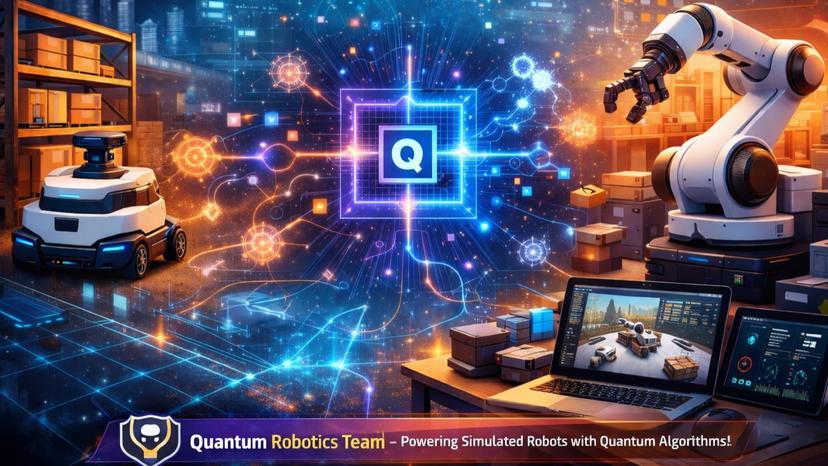
RoboDk based Quantum state simulator
The Quantum‑Enhanced Robotics Simulator (QERS) is a fully‑functional digital testbed for designing, testing and validating robotic systems without physical hardware. Our goal is to narrow the reality gap between simulation and the real world by combining deterministic macro‑physics from engines like PyBullet with a quantum‑stochastic plugin that injects realistic noise via Qiskit. The simulator supports deterministic, stochastic and quantum‑perturbed stepping modes and exposes a FastAPI REST API for running jobs, retrieving metrics and managing assets. A Celery/Redis job system queues and executes simulation runs asynchronously, while the Next.js/Three.js web application provides a real‑time dashboard with a 3D viewport, scene tree, metrics panel and controls to toggle between classical domain randomization and quantum noise. Reality profiles define configurable dynamics, sensor and actuation parameters, enabling multi‑profile evaluation of policies. QERS computes gap metrics such as G<sub>dyn</sub>, G<sub>perc</sub> and G<sub>perf</sub> and includes scripts for benchmarking across profiles and generating reports. Users can import URDFs, run batch simulations and compute performance drops and rank stability. Future phases will add mesh segmentation, an AI‑driven text‑to‑algorithm pipeline for generating planner and controller skeletons, and neural‑augmented simulation informed by real data. By combining quantum computing, domain randomization, residual learning and modern web technologies, QERS demonstrates a practical path to sim‑to‑real transfer and a production‑minded robotics startup.
15 Feb 2026
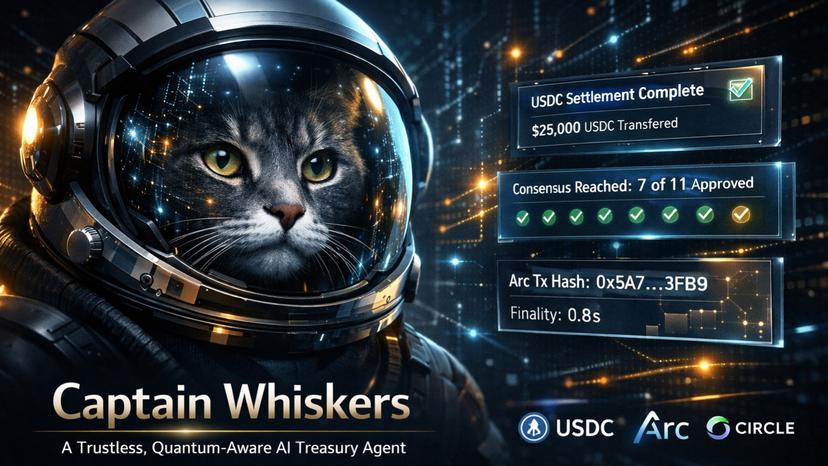
Captain Whiskers - A Trustless-Quantum-Aware Agent
Captain Whiskers demonstrates what it truly means to place real money under the control of an autonomous AI—without sacrificing trust, security, or accountability. As AI agents increasingly make financial decisions, the core challenge is no longer intelligence, but trust. Captain Whiskers solves this by combining Gemini-powered reasoning, quantum-inspired optimisation, and decentralised verification to create a treasury agent that is both autonomous and provably safe. Users interact with the system via a clean, high-performance trading interface inspired by modern platforms like Robinhood and Webull. High-level goals such as risk tolerance, allocation targets, or execution constraints are translated by Gemini into structured financial actions. Portfolio optimisation is performed using quantum algorithms (VQE via Qiskit), modelling multiple portfolio states simultaneously to identify optimal risk-return tradeoffs. Every decision is then passed through a trustless verification layer: an independent network of 11 verifiers evaluates the agent’s logic, risk checks, and cryptographic proofs. Only when a Byzantine Fault Tolerant quorum (7/11) is reached does execution proceed. This ensures decisions are not manipulated or hallucinated, or silently altered. Execution and settlement occur on the Arc testnet using USDC, powered by Circle Developer-Controlled Wallets and Circle Gateway. The system integrates post-quantum cryptography (CRYSTALS-Dilithium) and quantum-grade randomness to remain secure in a future where classical cryptography is failing. By combining Circle’s USDC infrastructure, Arc’s execution layer, and Gemini’s reasoning capabilities, Captain Whiskers showcases a credible future where AI agents can safely manage value at scale, earning trust not through promises, but through math, cryptography, and transparent on-chain proof.
24 Jan 2026


